
The profane and the sacred prove fairly close in Sompot Chidgasornpongse’s 9 Temples to Heaven. One need look no further than the premise of the Thai filmmaker’s first feature-length work of fiction to recognize the central tension anchored in superstition and sustained by the rhythms of the road movie. At the center of it is an elderly woman, “grandmother Saluay,” who’s about to die. Her eldest son, Sakol, appears to have found out, but not through the most recent medical checkup, and instead from his superior at work, who is said to be a clairvoyant. It is said clairvoyant who recommends Sakol to take his ailing mother on a day-long tour to and through nine Buddhist temples in closest proximity to “make merit” — a Buddhist concept which takes as its goal the “cultivation of inner qualities,” as the webpage of the Royal Thai Embassy Copenhagen puts it. Good deeds, in other words, or karma. There is a caveat, however: the deeds have to be done in pure and sincere intentions. And this might be precisely where the problems arise for Grandma Saluay, Sakol, and their extended family of nine.
There is much to appreciate and even relish in Chidgasornpongse’s direction, which appears infused with sociological curiosity and patience to marvel especially at the institutional minutiae of everyday life. The very first shot effectively showcases this simultaneity. Therein, we see a shrine veiled in golden candlelight, a seemingly far-off island among the impenetrable darkness that encases it. So long, at least, until an entire new level of illuminants is switched on and the shrine reveals itself to be merely the lower level of the actual, much closer altar, with the candles all electric lamps. A little later, yet another light source, now of a much cooler grade — the ceiling lamps — recontextualizes the scenery once more, now illuminating the light source itself, and with it the strangely worldly paraphernalia — most strikingly the ubiquitous and ever-rotating fans — that populate the holy spaces.
In the same mold are the following shots of the opening scene, which attest to Chidgasornpongse’s background in documentary filmmaking. After careful observation of the preparations going into a day at a Thai Buddhist temple — the collinear setting up of plastic chairs, the priest’s rehearsal of a eulogy to be performed later that day, now functioning as superimposed soundscape as the just-delivered buddha statues are erected and lavish flower bouquets receive final adjustments — there is almost a violence in how the story’s general conceit is quickly established after the title card is dropped.
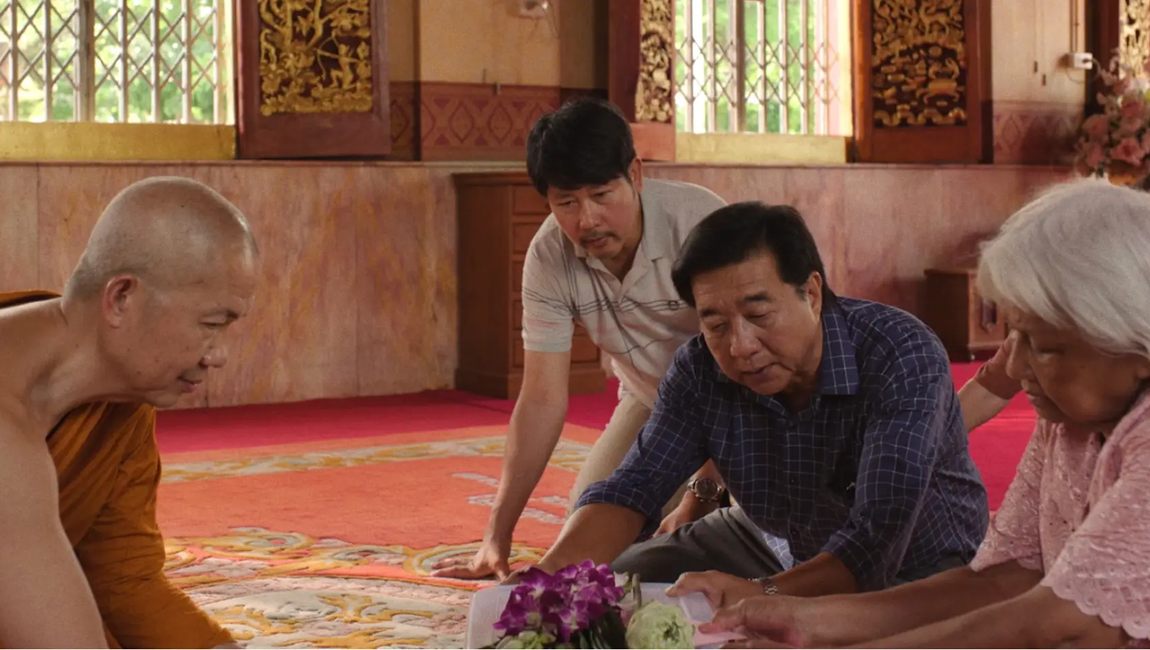
This is where the road-trip genre and its nine-stop itinerary claims its dues, which has us arrive on eye level with Sakol’s family, as if seated among them on the orange cushions of the first temple. “They always want me to go outside. They are afraid I’ll die in their house and make a mess,” the grandmother complaints to the young priest, and to everyone’s embarrassment. Long past such earthly notions, Grandma Saluay early signals to us (and to everyone else willing to listen, to see) that this journey happens not on her behalf, but especially on Sakol’s. This, in itself, is a common trope for films about the (presumed) last days in someone’s life, and Chidgasornpongse does well not to get hung up on the obvious tension between the characters and their postulated mission. However, as he develops his loose dramaturgical arc throughout car rides in different seating arrangements and character constellations, it becomes obvious that the characterological groundwork going into the ensemble — undertaken mostly through the interstitial moments between the temple visits — proves too threadbare to shoulder the emotional weight later imposed on them.
Trained and experienced in documentary filmmaking and video art, Chidgasornpongse — whose first long-feature film, the documentary Railway Sleepers on Thailand’s oldest railway line that he shot over eight years — is here unable to find a way to develop a compelling narrative through, and not despite, the many digressions that make the film worthwhile. This, then, even becomes a matter of rhythm, which is too often hampered by abrupt edits just as the scene seems to gain traction — a somewhat curious complaint, one might think, about the work of a regular collaborator of Apichatpong Weerasethakul (Chidgasornpongse worked as assistant director for Tropical Malady, Syndromes and a Century, Cemetery of Splendor, and Memoria). Especially when considering how enchanting his cinema can be when given the time to linger, to breathe, Chidgasornpongse’s commitment to the central conceit becomes increasingly puzzling.
The sociological interest, for one, never breaks off completely, allowing us insight into one of the temple’s backrooms, which has long turned into a storage for all the merit-making donations, preferably assorted in matching, stackable plastic boxes. Nor should the young, venerable monk be forgotten, who confides his precarious familial circumstances to Sakol and the others: that his days in office are numbered, hinging on the date that his brother will be conscripted into military service and the role of the family’s caregiver will be passed onto him. For another, and perhaps even more remarkable shift, Chidgasornpongse, about two-thirds of the way into the road trip, experiments with narrative perspective, expanding Grandma Saluay’s interiority into a shared perception of a world about to end. And while some will take issue with this sudden pivot into radical subjectivity, it is actually the subsequent epilogue, both a backtracking to realism and a conclusive attempt at tying narrative knots, that ultimately and conclusively fails to redeem the many promises that set this journey into motion.
Comments are closed.