
A monkey’s paw-inspired horror film that’s not-so-secretly about the loss of free will and specifically women being subjugated by their partners, Obsession — from 26-year-old YouTube creator-turned-feature filmmaker Curry Barker — is the latest in a line of films that ostensibly interrogates the idea of being a self-professed “nice guy” (see also: Companion, Ruby Sparks, The Beast). The saddest corners of the Internet are consumed with this kind of thing, particularly in the aftermath of Elliot Rodgers and the increased awareness of incels — you also see it in the concept of “white knighting” and the Virgin vs. Chad meme — but it’s a phenomenon meant to rationalize why lonely men who profess to truly value women are overlooked in favor of more conventionally handsome and self-confident guys, which this film acknowledges is a bit “doth protest too much.” Take, for instance, the film’s main character Baron (although everyone calls him “Bear”), played by Michael Johnston. So flop-sweat anxious that he always looks damp and afraid of his own shadow, Bear has spent years trying to work up the nerve to profess his true feelings to his longtime friend and coworker Nikki (Inde Navarrette, giving a pint-sized dynamo of a performance as a perversion of the “dream girl” trope). He rehearses gushy speeches that lay bare just how much he’s idealized her, “negs” her against his better judgment, and contemplates buying her gifts, which she neither needs nor wants. But what he’s incapable of doing is just being honest with her, even when she tosses him a lifeline and asks him directly “do you like me?” But Bear is a coward, so instead he wishes upon a cursed tchotchke he bought at a New Age store that Nikki would love him “more than anyone else in the world,” unwittingly binding her to him for the rest of his life. She, however, doesn’t have a say in the matter.
The “One Wish Willow,” a novelty item from, perhaps, the same people who created the Zoltar Fortune Telling Machine in Big, is the sort of plot device that really emphasizes how much the dark arts have been co-opted by late-stage capitalism. It’s sold on an endcap by bored sales clerks who blasé-ly tell Bear not to come back to them with his complaints about the product (it’s purposefully ambiguous whether his annoyance would stem from the product working or not). There are Reddit boards arguing its veracity — in a touch that rings true, replies are split 50/50 — and there’s a customer service number listed on the side of the janky-looking cardboard box it’s sold in where the person on the other end of the phone tells you that wishes can’t be cancelled and the only release comes with your death, in a tone that could be described as “you’re interrupting my lunch.” It’s a fascinating decision by the film to foreground the more quotidian qualities of damnation, and one is inclined to read into the fact that Barker is Gen-Z, a demographic that only knows of a world where once unthinkable, now regularly occurring, tragedies keep happening to the point that one simply becomes inured to them after a certain point. It’s not necessarily the extreme violence of Obsession that’s so unsettling so much as the internalized pessimism that undergirds it.
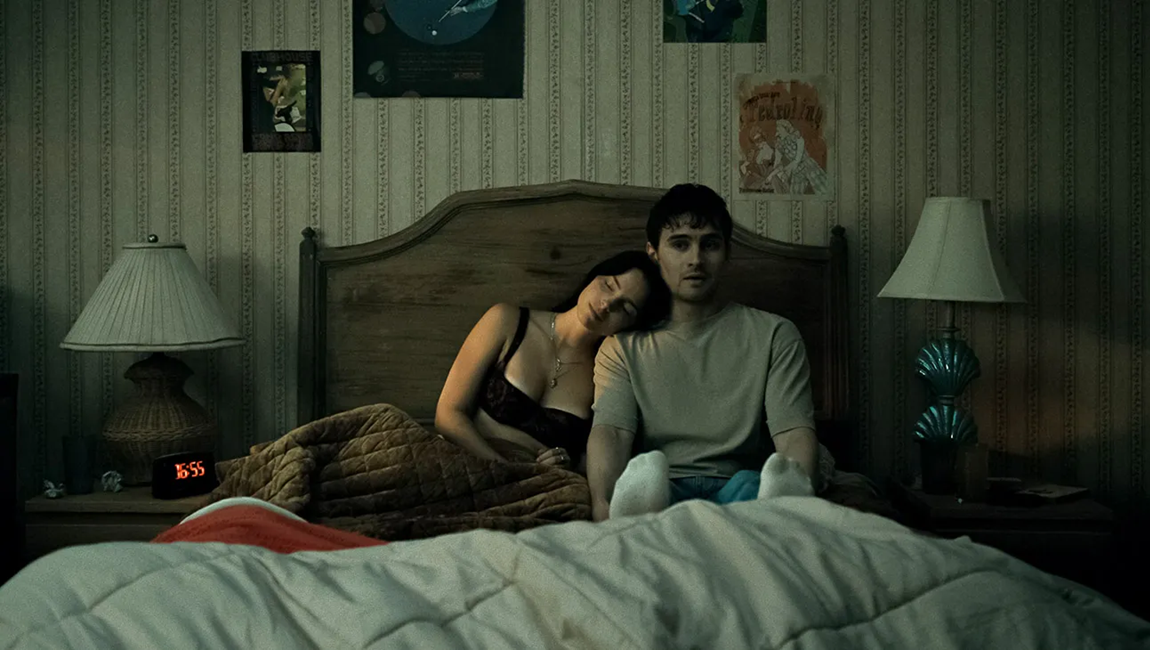
The events of the film are set in motion when Bear drives Nikki home from the bar after trivia night. In addition to being his unrequited love, Nikki is part of Bear’s core group of friends along with the bro-ish Ian (Cooper Tomlinson) and tattooed alt-girl Sarah (Megan Lawless). They even all work together in a music store owned by Sarah’s father (played by Andy Richter, functioning as both the only famous face and one of the few actual adults in what is a curiously underpopulated film), which allows Bear to drool over Nikki all day. After once again failing to tell her how he feels, Bear watches Nikki walk up the front steps of her house, removes the wooden dowel from the One Wish Willow packaging, says his wish aloud, and breaks the totem in half as instructed. And instantly something has changed in Nikki, although Bear is a bit slow to pick up on it. The already outgoing Nikki — the one moment of actual agency we get from the character before she’s reduced to a mindless sex slave is giving a homeless man $20 — now appears bubbly to the point of being manic. She all but drags Bear out of the car trying to get him to come inside her house, and when that fails she insists that he take her back to his place. Despite the fish jumping into the boat (as it were), Johnston plays Bear with panicked skepticism that borders on “girls are icky” infantilism. As Navarrette coos and cuddles and undresses as she climbs into his bed, Johnston spastically runs around his house, all but climbing the walls to put physical distance between himself and his longtime crush who is practically begging him to ravage her. In the end, he spends their first night together sleeping on the floor of his bedroom because, after all, he’s a “good guy.”
The conception of the Bear and Nikki characters speaks to the muddled nature of Obsession. On the one hand, the film recognizes how scummy (albeit unintentionally) Bear’s actions are and how much Nikki is at the mercy of forces outside of her comprehension. Nikki is reduced to, essentially, a non-playable character in a video game; acting out a remedial script that’s been written solely from the single-minded point of view of being Bear’s love interest. When she encounters everyday complications to being with him — like, for example, not being scheduled to work a shift at the same time as Bear or witnessing Sarah innocently bestowing attention on him — she “glitches,” often in ways that are deeply unnerving and dangerous to herself and others. But the limitations of the character says more about Barker than Bear. It’s understandable why a lonely guy might have tunnel vision about a pretty young woman, being unable to see her for all of her messiness and foibles, but the film is equally disinterested in the “real” Nikki. The character adopts a wild-eyed, perma-grin or exaggerated pouts to demonstrate something has changed inside of her, but it’s difficult to say exactly how much this is a funhouse mirror distortion as the film is barely invested in establishing Nikki’s personality to begin with.
At the same time, Obsession has limited interest in exploring Bear’s perspective, really declining to indict the character’s callousness and how much the character prioritizes his own happiness over the autonomy and well-being of the woman he claims to love. The film compresses the early stages of Nikki and Bear’s “relationship” into a lovey-dovey montage of making breakfast together, watching TV on the couch, and having sex. There’s no sense of how they might converse with one another — presumably she’s only interested in talking about him, whereas he no longer has to pretend to be interested in her day. There’s very little evolution to their romance; no barely perceptible cracks that grow into full-on fissures. Nor is there a sense of trouble in paradise until Nikki’s clinginess starts to manifest itself as self-harm, leaving behind macabre gifts for Bear, and completely abandoning self-hygiene. The film starts to feel less like a trenchant critique of the battle of the sexes or a twist on the Faustian bargain of finally getting what you wanted and more like a de facto Exorcist sequel. Help, my girlfriend has been possessed by a demon!
It’s awfully tempting to attribute the film’s flaws to the director’s youth. The world of Obsession, the psychology of the characters, and the workaday nature of the community they live in are all thinly sketched. The film’s gender politics are inchoate, with the viewer being asked to do most of the work in identifying their purpose because, at the end of the day, Obsession views them as merely a means to an end. The film will happily take the think pieces on modern dating, but it’s ultimately more interested in how far it can push the envelope when showing, say, a person’s face being bashed in with a brick. The film is entirely uninterested in class (e.g., all the characters are in their early twenties and have low-paying jobs, yet everyone lives alone in houses with no parents around)and all the little details feel off, as though nothing’s been thought through beyond the short-term shock effect. To wit, the film gets a lot of mileage out of the tragic fate of Bear’s pet cat, but no part of this thread stands up to the slightest bit of scrutiny (a pointed question to all the pet owners out there: on a scale of 1 to utterly impossible, how easy it to get an animal to voluntarily eat medication?)
And yet, for all of his missteps as a first time feature-filmmaker (you can find many of his shorts and featurettes online), there’s an undeniable confidence to Barker’s direction which is superficially thrilling. The individual parts of Obsession are better than its whole. Although set in the present day — the characters use cell phones and computers — the film emphasizes the more analog elements of this world in a way that lends it an eerie, “outside of time” quality. Televisions have rabbit ears, twenty-somethings still play Jenga at parties, and the One Wish Willow looks like something that’d be sold next to a Pet Rock, which really does add to the urban legend nature of the whole thing (there’s a version of this film where the plot’s set in motion by an app instead; way less interesting). Shot in an unconventional 1.50:1 aspect ratio, Obsession is bathed in shadows and gloom with almost dank, brown color timing. We spend much of the film gradually allowing our eyes to adjust to the darkness, which is all the better for hiding something scary in the background of scenes (most of the big jumps here involve something out of focus moving ever so slightly and in a manner that seems inhuman). Barker also steals well, with a lot of the film’s big swings drawing visual inspiration from sources as diverse as Japanese ghost stories and the new French Extremity movement; his film is designed to appeal equally to gore fiends and connoisseurs of the uncanny.
But the filmmaker’s greatest achievement is discovering Navarrette. Diminutive in size and frequently outfitted in barely existent skirts and micro shorts, the actress looks the part of an object of youthful affection. But the performance is more than a pretty face. Navarrette plays Nikki as a twisted pantomime of seduction, alternately rote and clumsily coquettish. Occasionally, we can see Nikki (the real Nikki that is) push through the wall built around her, hinting at both the confusion and horror of being forced to dance like a puppet on a string, before being “blipped” back into a prison of the mind. It’s a highly technical performance, emphasizing stillness and total control of her extremities and almost kabuki-like movements. Yet for all the volcanic explosions of rage we get from the character — you’ll be a little amazed at the precise nature of the noises that escape this tiny actress’ body — Navarrette’s performance never loses sight of the fact that Nikki is as much a victim as she is the film’s antagonist. Barker certainly has at least a tenuous grasp on the film’s central metaphor, but he stumbled into gold in casting Navarrette for this role. She lends Obsession a sense of urgency while humanizing some of the film’s more schematic choices, leaving the entire thing to feel like a more accomplished project than its individual parts would seem to suggest.
DIRECTOR: Curry Barker; CAST: Michael Johnston, Inde Navarrette, Cooper Tomlinson, Megan Lawless, Andy Richter; DISTRIBUTOR: Focus Features; IN THEATERS: May 15; RUNTIME: 1 hr. 48 min.
Comments are closed.