
More an indictment of pop referentiality than a true reflection of psyche, the opening minute of Katarina Zhu’s Bunnylovr edges toward a pat diagnosis of her main character’s aimless and slightly naïve state of mind. Dimly lit by a laptop’s glow while set to the effervescent synth tunes of Charli xcx’s “detonate,” the scene might appear self-contained and assured in its thesis that under modernity, all intimacy is digital and therefore alienating. But outside the virtual peep show of fishnets and feet foolery, twentysomething Rebecca (played by Zhu) is effectively invisible, to her peers (few), family (close to non-existent), and herself. Her existence, as a “big city girl living out her dreams” in boxed-in Brooklyn, neatly segments itself into a humdrum accounting gig by day and a cam-site spot by night, with no commingling between. Either the former grossly exploits her labor, or the latter is in part her tacit embrace of sex work as personal expression, because Rebecca is perennially broke. While she does not overtly struggle to secure her next meal, the stakes are in place for her to open up, sometimes in the wrong ways.
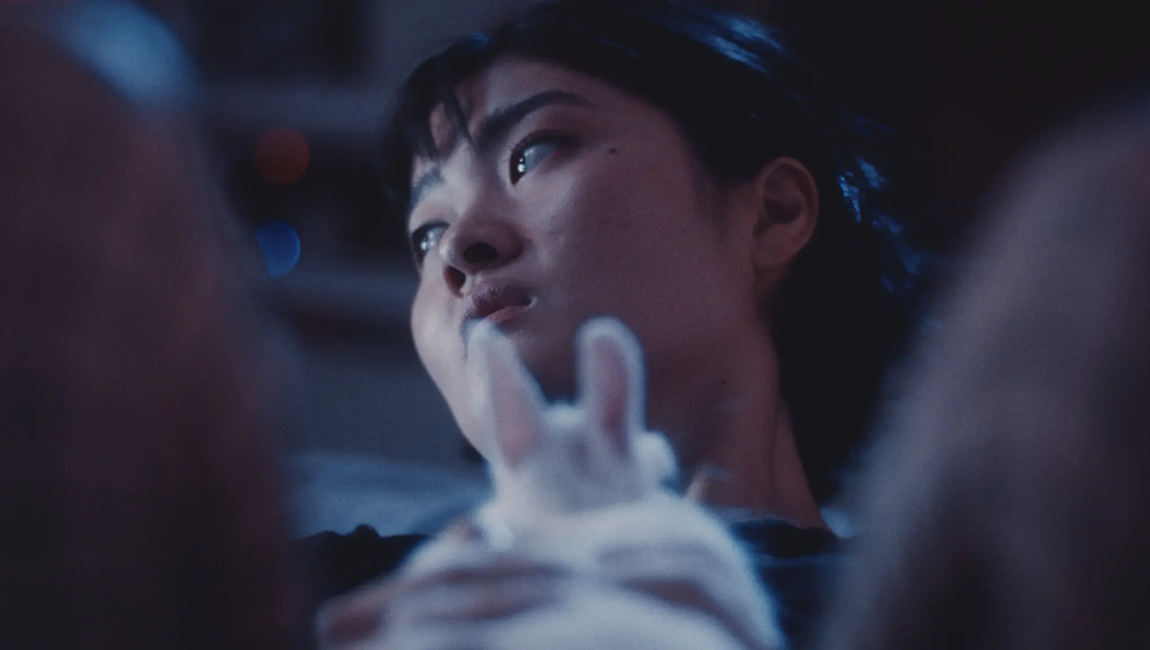
Shuttling between casual friend Bella (Rachel Sennott) and casual lay Carter (Jack Kilmer), Rebecca stumbles into an impulsive connection with one of her biggest tippers. The mysterious user Jas95 (Austin Amelio) initially refuses to show his face and gifts her a small white bunny, goading her to care for it and pose it with her on camera occasionally for sexual gratification. There is loneliness and perversion in the air, clearly, yet Bunnylovr is frequently loath to expound meaningfully on either. Zhu sells her character’s skin-deep, closed-off disaffection with the world through an unhealthy mix of detachment and submissive self-deprecation; she lets its noise steamroll her introverted sense of self. This alone, however, renders the film less in personal terms than it seeks to make an ethnographic statement about a certain kind of milieu and occupation. Although compassionate toward its protagonists, Bunnylovr is just as in denial of its interiority as they are.
With her chats with Jas95 — soon revealed to be a lanky white guy with nefariously ambiguous intentions — gradually taking on a cozier register, Rebecca also seeks to reconnect with her estranged father (Perry Yung), who, it is intimated, reveled in gambling and the general practice of child neglect. The emotional undercurrents of her floundering social life are therefore well-established, even as their sources find themselves reduced to easy cliché. As DOP Daisy Zhou’s light-sepia cinematography bathes Brooklyn’s Chinese-American enclave in swathes of nostalgic light, the film’s mumblecore ambitions soon exceed their capacity for engagement with both Rebecca and her inner turmoil. Transactions are presented as faits accomplis, with rarely a shot or sound that strives to something beyond the drifting abyss of modern cosmopolitan living. For all the title’s edgy truncation, Bunnylovr settles for something less than its potentially enthralling avatar.
DIRECTOR: Katarina Zhu; CAST: Katarina Zhu, Austin Amelio, Jack Kilmer, Rachel Sennott, Perry Yung; DISTRIBUTOR: Utopia; IN THEATERS: April 10; RUNTIME: 1 hr. 26 min.
Comments are closed.