
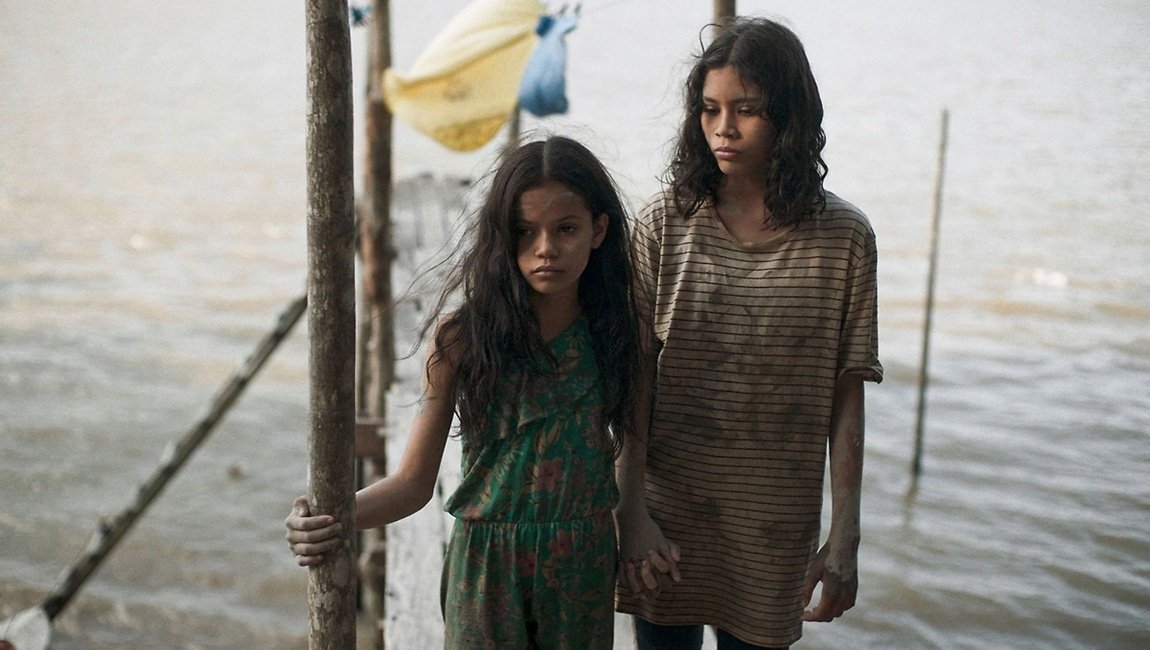
At the start of Manas, Tielle’s world seems boundless, idyllic. Tielle, short for Marcielle, is a 13-year-old girl played with astounding maturity by Jamilli Correa. She lives in a small, isolated community on Marajó, an island at the mouth of the Amazon River. Tielle might start her day by washing clothes with her mother on the riverbank. She’ll scale açaí palms with her sister late into the evening, shaking berries from their branches to sell to hands on passing barges. At night, Tielle joins her family in pulling hammocks down from the rafters of their stilt house to drift off in the cool night’s breeze. It’s the sort of life that sparks a honeyed wanderlust in Northern eyes, a cherry-picked bird’s-eye view of a simpler way to be. But Manas quickly reveals a rot that snatches at Tielle’s ankle like a tether, the endless horizon a cruel tease to a torturous, inescapable childhood.
Manas is the first narrative feature from documentarian Marianna Brennand, the fruit of 10 years of speaking with young girls and women on Marajó and around the Amazon rainforest. She found a community in which sexual violence — often inflicted by fathers toward their own daughters — is not just normalized, but twisted into a sort of rite of passage. Manas, like Brennand’s earlier work, was originally conceived as a documentary, but the prospect of forcing young women to relive traumatic, intrafamilial violence proved too severe. The resulting narrative is no lighter: Manas is a relentless and gut-wrenching construction, dead set on illuminating the untold horrors of a remote island community — even if flirting with polemics comes as collateral.
We first meet Tielle as she scrubs menstrual blood from her underwear in the river, making sure to hang it somewhere out of sight of her mother, Danielle (Fátima Macedo), to dry. Puberty’s onset is an ordeal for any kid, but it wields a particular brutality for Tielle: as she chats about rowing açaí berries out to the passing barges to sell, her father, Marcílio (Rômulo Braga), stiffens. “My daughter won’t be a filthy barge girl,” he says, abandoning the charisma he’d let shine in the movie’s first moments. It’s something of a tell; later, when the rope that secures Tielle’s hammock snaps, Marcílio insists that Tielle sleep with him in his bed. The incident becomes routine, Tielle retreats inside herself, and the world seems to abandon her.
Implication is Manas’ only reprieve. Little violence is depicted, but the build-ups and aftermath are so deliberately rendered that it makes little difference. It’s excruciating to watch Marcílio test boundaries and gain confidence — first with an arm around his teenage daughter in bed, and later taking her on a series of secluded hunting trips from which Tielle emerges ever more shaken. Manas’ brutality is as constant as a river, and Tielle’s failed reaches for solidarity and support from the women in her community rachet a sense of devastation well past the pain threshold.
Hopes of Tielle’s escape are dashed as quickly as they surface. Jaci (Ingrid Trigueiro), a shopkeeper who acts as something of an aunt to Tielle, reveals the limits of her warmth when Tielle confesses what she’s been enduring. “You’re not the only one,” says Jaci, resigned as if her hands were bound with rope. An office clerk’s care falls just as impotently as she turns Tielle away from receiving the fake ID that might help her leave Marajó. But the most piercing rebuttal comes from Tielle’s own mother. “There’s no use trying to change some things,” Danielle tells Tielle as she washes her hair, her arms bruised and battered from one of Marcílio’s more heinous outbursts. It is agonizing to see Tielle denied the support she needs; to understand that these women are under the thumb of the same system of abuse pushes Manas’ severity into a singular tier of difficult cinema.
Manas is a mission-based movie, one that’s steadfast in its commitment to raise awareness about Marajó’s culture of abuse. Brennand’s cause is admirable, but like so many movies of its ilk, Manas’ missive leaves its narrative vulnerable. Tielle is so thoroughly and consistently degraded that it eventually becomes numbing; the audience, like Tielle herself, is forced to recede within itself to endure the next blow. For most of its runtime, Manas manages to steer clear of the slog of an outright polemical work, but it occasionally teeters onto the wrong side of a morality play.
The two most egregious instances both involve Marcílio: painted flatly as a villain, the father’s come-to-Jesus shot at redemption trembles with the unsure footing of a daytime soap. When that moment fails to yield a rehabilitated man, Manas pivots to something of a revenge story. It’s a choice that offers a bit of catharsis at the cost of Brennand’s mission. To resolve Tielle’s story through convention, regardless of how satisfying it might be to see Marcílio get his due, pulls the rug from under any viable call to action. It’s tempting to wonder whether Manas should have indeed remained a documentary, whether the pain of relived trauma might have produced a more substantive article for the abused women of Marajó than the movie’s dizzying narrative.
Even in the shadow of a few wrong turns in the script, though, it’s hard not to leave Manas punch-drunk and gutted. Brennand’s craft rebukes her status as a freshman filmmaker; her work with cinematographer Pierre de Kerchove renders an Amazon as bucolic as Tielle’s life is dour, and editor Isabela Monteiro de Castro offers some of the more impressive cuts from the past few years of global cinema. It’s Correa’s turn as Tielle, though, that seals a movie otherwise prone to stumbling as an endearing work of empathy. Brennand has been vocal about her insistence to both cast an age-appropriate, non-professional actor and to protect that young girl amid the film’s sensitive subject matter. Correa approaches the role as if she’d written it herself, as if the horrors Tielle weathers were her own. Correa’s humanity supersedes the concessions of polemic narrative, of meandering dialogue, the conundrum of mission-based filmmaking. She is Tielle, a 13-year-old carving a life on the banks of the Amazon, learning what it costs to survive against the evil men do.
DIRECTOR: Marianna Brennand; CAST: Jamilli Correa, Fátima Macedo, Rômulo Braga, Emily Pantoja, Samira Eloá; DISTRIBUTOR: KimStim; IN THEATERS: May 22; RUNTIME: 1 hr. 41 min.
Comments are closed.