

In This Dispatch
The Riverbank
The northern city of Recife, Brazil, enjoyed something of a renaissance last year with the success of Kleber Mendonça Filho’s The Secret Agent. Garnering more attention than any of his previous films, this tale of political history at risk of disappearance shone a light on a vibrant if occasionally neglected city. At Locarno this year, filmmakers Matheus Farias and Enock Carvalho attempt to add to Recife’s recent cinematic cred with The Riverbank.
Told in the molasses-slow manner befitting its tropical climate, The Riverbank follows Izaquiel, a queer man who spends his late nights cruising the city’s dense mangrove forests for sex. Though he’s mostly just a lurker, happening upon and then staring blankly at other people’s intimacy, the night we meet him is the same night he meets Jeremias, a beefy fisherman who never seems to leave the riverbank that abuts the dense jungle. His dark, glistening muscles and cropped, bleach blonde hair are a siren call to Izaquiel. Though both are Black men living on the margins of their city, Jeremias is somehow exotic — to him, and to the viewer — possessed by some otherworldly, animalistic force that comes and goes in moments of sexual passion. But death follows Izaquiel and Jeremias. That first night, just before they have sex, a fellow cruiser is shot in the jungle. They hear a few shots ring through the trees, followed by the hurried footsteps of people escaping to safety. Something is killing their fellow queers under the cover of night.
In his daily life, Izaquiel is a janitor, contracted to various businesses that hire out the company he works for. Early in the film he’s fired for, once again, gawking at two men hooking up in a grocery store bathroom. He’s sent, like an inverted Maria in The Sound of Music, to work at an evangelical church, where hopefully his behavior will be kept in check. Izaquiel has his own issues with religion. While his large ear piercings and painted nails suggest he’s left his devout upbringing behind, a short visit to his parents’ house reveals, not subtly but not blatantly, that religion guides his family’s every choice. Izaquiel gets along well at his new job. He tries to keep his head down, to not ruffle any feathers, though Farias and Cravalho work hard to contrive scenarios in which he does anyways. It’s the great weakness of The Riverbank that so much of its plot is weighed down by a kind of dry inevitability. For a film as thrillingly immersed in the raw carnality of the natural world with its sweat, dew, and humidity, the narrative business surrounding it feels anything but organic.
The film also feels derivative of many queer films before it. Setting aside the hyper-specific details of its Recife setting, which are, admittedly, richly rewarding — it’s a delight to luxuriate with Izaqiel in the mangrove forest, to feel as close as he does to a concurrent sense of erotic danger and liberation — the skeleton of the film echoes dozens that have come before it. How many queer films have we seen up to this point in which a young man has left his religious upbringing yet still maintains a tenuous relationship to it? Izaquiel’s inescapable proximity to religion, particularly of the new-age, politically active, evangelical sort, wears thin, sapping the film of a sense of chance at unpredictability.
A near-mythical sense of predestination could have worked if the film’s political dimensions had more texture. The heads of the church, led by the pastor, Eurico, are on the precipice of launching a holy war against the queer people they believe are tainting the world with filth. When his roommate, Mica, a trans woman early in her transition, goes missing, and the pastor’s son is found dead, Izaquiel decides to dismantle the pastor’s house with the pastor’s tools — in this case, a fairly intimidating pistol he stole from his desk on (what we assume was) his first day on the job, and the trust he earned by getting baptized. But Mica turns up at the eleventh hour — a trail of excuses in her wake that are less her character’s fault than the fault of lazy screenwriting — and Izaquiel doesn’t follow through with his plan against Eurico, his hand stayed by the (also sudden) appearance of Jeremias, who leads him to the calm waters just beyond the grove. As they sink into the depths, knowing Izaquiel has no place else to go, one wonders what it was all for. — CHRIS CASSINGHAM
Hanabi
“Four years have passed since the accident. You feel that your relationship to radioactive contamination is changing,” intones the narrator near the beginning of Ana Vaz’s Hanabi in an intimate, yet almost affectless, voice. The accident in question is the 2011 Fukushima nuclear disaster, which displaced over 160,000 people. The “you” she is referring to is much more unclear, one of the many mysteries of the film that adds to a growing sense of alienation and remove, keeping the film’s subjective viewpoint a diffuse, implacable one. Filmed over 10 years, Hanabi is a soulful diary-essay on post-Fukushima Japan that doesn’t so much explain the disaster as categorize what it feels like to live in a world where human-made catastrophes can be easily accepted, ignored, and normalized.
Described in the credits as “a savage adaptation of Yoko Hayasuke’s Journal of a Radioactive Brain,” the film moves between second-person accounts of Hayasuke’s experience in the years after the incident and first-person interviews with people who were affected by it. Keeping all of the speakers and narrators offscreen, Vaz creates a mosaic effect that colors in the anxiety and melancholy of today without getting loaded down in details or specific technical descriptions of what happened and what the fallout was. It’s Peter Watkins’ The Journey by way of Chantal Akerman and Chris Marker, a very subjective vision of the nuclear issue, steeped in a sense of everydayness and individuality, yet rendered strange and nearly abstract through its structural parameters and a series of distancing effects. While never less than lucid on an emotional level — in the voices and words the sense of pain is palpable — the film frequently leaves us aloof on a narrative level, making us probe for a coherent grasp of the consequences of the event that never fully emerges. Like the regular stream of disasters that we encounter almost daily, we can understand it and feel it, but not truly comprehend it.
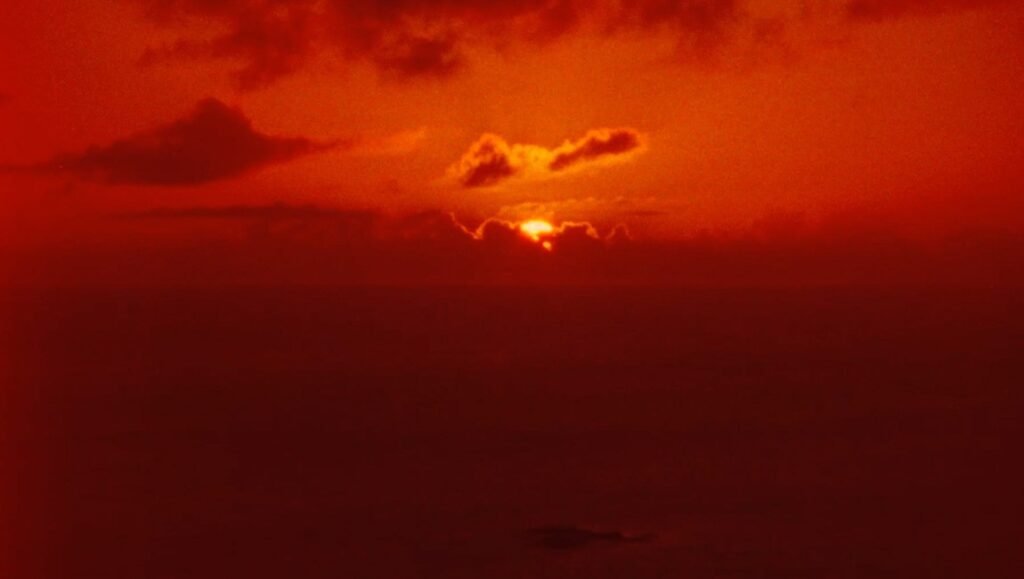
Adding to this sense of alienation is the complex relationship between sound and image Vaz crafts over the film. We never see any of the speakers that we hear, while diegetic ambient sound is sparse and hollow whenever it is present. The result is a certain emptiness, a building existential dread that’s heightened further by an atonal score that moves freely from electronic dings and buzzes to avant-garde jazz. There are tinges of cyberpunk to it, in a very Marker way, which is enhanced further by long sequences of eerie nocturnal cityscape imagery that is often shot from above or at a distance, city skylines appearing like abstract arrays of lights vaguely arranged in a series of rectangles. Largely shot on film with Vaz working as her own cinematographer, the visuals throughout are striking and well-varied, shuffling between those urban visions to highly detailed close-ups of flowers and bugs to POV footage of highways and railways taken from a passenger window. At times, the film even moves into bold structural gestures — a minutes-long shot of the sunset at one point; a jarring circular camera spin that feels relentlessly unending at another point — that are surprising enough to feel disorienting even if they’re nothing novel from a cinematic perspective.
As absorbing as much of the filmmaking and storytelling is, the film’s rhetorical depth unfortunately fails to grow as it goes on. Tedium starts to set in as one journal entry follows another at a very regular rhythm, never evolving in structure, tone, or argument. The constancy doesn’t build in force, and as one feels it spinning its wheels in its second half, the impact of the argument starts to wear down somewhat. This form of political filmmaking, however, a filmmaking that focuses more on communicating the emotional experiences of contemporary catastrophes rather than making direct statements, is both admirable and vital. It articulates a communal feeling that is often the seed of both action and understanding. The limitations of Hanabi are largely structural ones, which might lessen its achievements, but hopefully not its impact. It leaves one with both feelings and questions, which is what a good film should do. — JOSHUA BOGATIN
The Chilean
Andreas Fontana’s 2021 film Azor told the story of Argentina’s brutal military dictatorship through the lens of a ground-level functionary, observing how unremarkable bankers and bureaucrats acted as intermediaries and allowed the wheels of oppression to churn on. Set in 1976, Sergio Castro San Martin’s The Chilean attempts something similar, albeit from the point of view of actual left-wing militants. But the approaches have a few things in common, not least of which is draining the proceedings of spectacle and period-specific romanticism, instead drilling down into quotidian details and every-day banalities.
The Chilean charts the exploits of Aldo (Camilo Arancibia) as he attempts to navigate political and social upheavals in both Chile and Italy. As the film begins, Pinochet’s fascist government has begun seizing assets large and small around the country while the military roams the streets terrorizing citizens. A miner by trade, with a wife and baby at home, Aldo decides to flee Chile to find work in Turin. He will save some money and plans to return to his family in due time. Of course, things do not go as planned. Arriving with best friend Chapa (Andrew Bargsted), the duo finds themselves immediately immersed in Italy’s Years of Lead, as militant left-wing groups wage war on government forces. It’s an extremely volatile stew, and Aldo is soon drowning in world-historical forces beyond his control. Historians study major figures, the politicians and military commanders who made decisions on a grand scale, but The Chilean focuses on the micro, the story of one person affected by these decisions, and the lengths they will go to in an effort to protect what’s theirs.
Castro San Martin proves particularly adept at charting the day-to-day hardships that might lead an otherwise peaceful person to take violent action against their oppressors. Upon their arrival in Turin, Aldo and Chapa request political asylum. They are dumped in a small, shabby apartment, and find work at a factory. But as migrant workers, they are subjected to labor disputes and low pay, when they’re paid at all (any parallels to our here and now are surely intentional). Desperate for money, Chapa finds his way into the employ of local gangsters. For his part, Aldo wants nothing to do with illegal activities, but after finding and diffusing a bomb in the factory, a local militant group tracks him down and offers him enormous sums of money to become their in-house bomb-maker. As they put it, if he knows how to dismantle it he must also know how to build it. Aldo is very reluctant at first, but it doesn’t take much for him to decide to take their money. But he does not want direct involvement with their actions, declaring that he will make bombs but not deliver them or set them in specific locations (a meager semantic argument, but one that Aldo clings to in an effort to keep his conscience clean). He also gradually befriends Luciana (Sara Serraiocco), a young doctor who performs illegal abortions when she’s not working with the organization to bomb government buildings, and in many ways they are entirely unremarkable people. The fact that they have willingly become criminals has less to do with criminality or morality than it does the dire straits in which they have found themselves.
Castro San Martin has based his film on a true story, using Juan Cristóbal Guarello’s book Aldo Marín, Carne de Cañón as a loose guide, but The Chilean often feels like a paranoid 70s thriller. The overcast, muted color grade and empty streets suggest a psychological landscape as much as a physical one, and the filmmakers find offbeat architecture to situate bodies within. Aldo and Luciana are often dwarfed by looming buildings or isolated via alleyways and tunnels. They have gone underground, quietly severing other human connections for fear of being caught. Aldo’s attempts to contact his wife back home become increasingly harried, while Luciana’s dedication to helping young women leads to violent repercussions of her own. It’s a vicious universe that they are trapped in, cycles of violence continuing on and on, ending only in betrayal and self-destruction. But perhaps what cuts deepest is how The Chilean glimpses into the past as a means of suggesting our own bleak future, should the world continue on its current path. — DANIEL GORMAN
Also Playing
Down the Arm of God
It’s a common refrain that it takes an outsider filmmaker to capture the truth of a place. An influx of Germans like Billy Wilder and Fritz Lang in the 1930s transformed Hollywood with outsider depictions of American culture at a time when the movies still were American culture. Non-American filmmakers have been offering their take on the idea of America ever since. Peter Brunner’s latest film, Down the Arm of God, represents a low point in this legacy, an example of the uncomfortable truth that not even the best of intentions can shield a filmmaker from indulging in lowest common denominators.
Down the Arm of God is a tale of curdled niceties, brittle hypocrisy, and the bloody failure of the American project, all inspired by true events. The perennially creepy Caleb Landry Jones takes on an unexpectedly unambiguous role in Nick, a good-hearted young man who moves to a small town just outside the northern Texas city of Amarillo to be its new pastor. His reception is as friendly as you could expect, but it’s clear from the distant stares and ominously polite offers of hospitality from the local well-to-dos that, despite his holy mission, Nick can’t escape his foreignness. “This town needs some fuckin’ God,” says Deb, the local bartender who, along with the assistant pastor, Felicia, is one of Nick’s few allies in town.
The problem with Brunner’s depiction of small-town Texas isn’t that he’s identified a number of pertinent social and political dimensions that underscore the film’s main drama over the rights and treatment of a group of unhoused people displaced by a recent arctic storm. The fact that the de facto town leaders are a devout, financially prosperous family (played by Nick Stahl and Mena Suvari); that the town’s aloof, anti-religious handyman, John, is an alcoholic, amputee war vet; and that the group of unhoused people who take refuge in the church with Nick’s help are burdened by mental and physical illness are not inherently problematic. You’ll find complexity in Brunner and Jones’ (they worked together on this project for five years) organization of allegiances, beliefs, and life conditions — you just won’t find ambiguity.
Even Jones, whose deft touch at portraying villains obscured beneath layers of artifice has practically made him a type, has no room to infuse his angelic Nick with shades of complication. What little dimension he has is cornered into a nagging backstory about his own estranged, unhoused, war veteran father who, while the film unfolds, he struggles to locate. This context does at least give Nick an advantage in trying to connect with the unhoused population outside of town. They’re a tight-knit bunch who have clearly lived together in makeshift camps for a long time, so while Nick’s instinct to help initially feels like an intrusion, his goodness is enough for them to eventually defer to his paternal leadership.
Brunner and Jones have managed to make something whose drawbacks go beyond the mere misplacement of liberal good intentions. Their perspective, despite being made in collaboration with the unhoused cast members themselves, leans on caricature that eventually sours into degradation. In this harsh, winter-swept story, Father Nick tries and fails to deliver them the gift of dignity. It’s hard to even refer to the group of unhoused people as anything besides, such is the lack of depth to their characterizations. Their de facto leader is Raven (played by professional actor India Marie Cross), a Black woman with a septum piercing and a well of politicized anger from which she lashes out — every other unhoused character draws from their real-life experience. Their specificity is dampened into the angry wails of pitiable children (at one point during the mounting climax, Nick tells this group of adults to use their “indoor voices”). Brunner leaves little room for nuance to emerge from the shallow stereotypes they represent — that is, unless Nick hauls them out. Late in the film, as tensions between the unhoused group and the hypocritical Christian locals mount toward violence, Nick encourages a lesbian couple to hide their relationship while they try to get on the town’s good side — nothing like a bit of capitulation to hatred to really make a political statement!
The whole film is a lugubrious trudge towards the inevitable violent clash between the unhoused group and the town’s reactionary base. Brunner wields politicized buzzwords and naturalistic images devoid of personality like a drooling brute who, through sheer volume and a blunt club of a script, somehow bullies you into his ideological locker. Down the Arm of God is a cowardly film, its conclusion in defeat a cover for the cynical belief that the dignity and safety of a group of people into whose lives he inserts himself is ultimately not worth the trouble. — CHRIS CASSINGHAM
Tear Gas
Georgian filmmaker Uta Beria’s Tear Gas opens on a series of still images depicting people in migration, which eventually bleeds into the moving image as forest mist double-exposes itself over the final still. This notion of slow, of quiet, of creeping motion, is evocative of what follows, as roughly the first half of Beria’s film chronicles the unassuming quotidian details of a family. First, there’s a procession of elders through a forest, with a 16-year-old girl — our protagonist Elene — watching curiously as they carry a coffin past a border sign that reads “Do not cross! Territory under control of Russian Federation.” The only audible sounds are diegetic, from flittering birds and wind-swept trees to sudden bursts of artillery and munitions. Then, there’s the first indication that something is wrong, consummated by one of their own, as a man named Goga disappears in their flight from the gunfire.
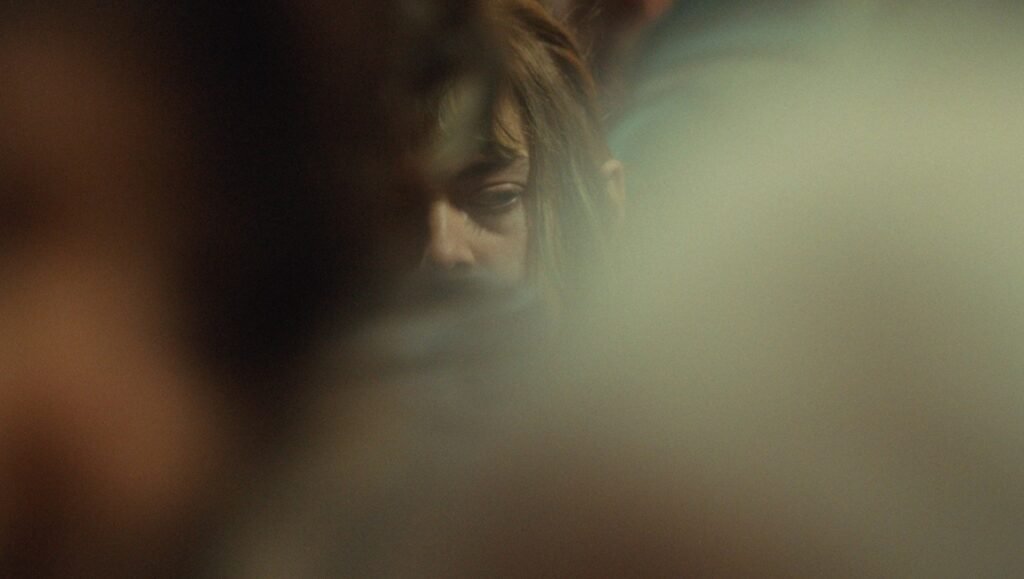
Back to the rural life, with Elene’s father doing farmwork, the teenager transfixed on a snail that’s slithering over her fingers, and then cut to her dying her grandmother’s hair the same color as her own (a lightning shade of purplish blue), making small talk in the bathroom — until it’s no longer small talk. Gradually, the conversations grow socially charged. The grandmother mentions wanting to bring Elene with her to a demonstration; she even cautions her to not mention it to her father. Elene views coverage of protests on her phone, and we catch an ephemeral mention of the political context: “students are protesting the government’s deviation from democratic politics.” The teenaged girl exudes a mix of forlorn and anger, especially in a stressful moment where she engages in a brutal back-and-forth judo session with her training partner that ends with her getting choked unconscious by a pressure point maneuver. This sequence is filmed in painstaking close-up, voyeuristically shoving our faces into the mat along with the two girls, our bloodflow seeming to constrict along with Elene’s.
“Constriction” is a good term to emphasize here. The close-up photography remains consistent in Tear Gas, even as the film follows Elene and her grandmother into the thick crowds of Tbilisi. The second half of Beria’s film, then, takes place entirely among these crowds and was reportedly shot within actual demonstrations. From the public transit ride into the city itself and through to the end, there is a foreboding, but always hopeful, sense of civic engagement through the close-ups, the over-the-shoulders, the obstructed vantage points within droves of activists. Beria also mines the most out of his docufiction approach here, interspersing the intimate shots of Elene and other actors with found footage of the real-life demonstrations calling for an independent Georgia that “chooses the EU,” as somebody can be heard declaring over a megaphone at one point.
It’s what we might call a civil aesthetic, opting to focus on the many faces of the movement, some as young as Elene, others politically-assured college students, and others still of middle age and much older. A tapestry of multigenerational resistance, a shifting of scale between the wider solidarity of the masses and the insular narrative of Elene voluntarily losing herself among them, is what keeps Tear Gas fresh and exhilarating. Where it falters, however, is in that insular narrative. Not Elene’s, but the adult figures surrounding her: her estranged mother being a journalist in the crowd; her father seen suiting up in riot gear among the suppression squad; the two of them eventually joining forces despite their ideological differences and dire romantic history to search for their daughter as things escalate.
This is all far less interesting than the film’s primary focus on a teenager, on her grappling with ennui as a burgeoning sense of political consciousness forces its way into her world — like when she puts on her headphones in the middle of the rally, something one could see a teenager absolutely doing. A film less entangled with narrative, one matching the aimlessness of its 16-year-old protagonist within the dense throng of protestors, one allowing itself to balance the docu with the fiction, as opposed to succumbing to much more of the latter, would have sharpened its affinity with its own title. We should acknowledge, however, one particularly enduring image (from the fictional end of this film’s spectrum) that does live up to the film’s title: Elene’s father in riot gear and gas mask, enveloped by a cloud of tear gas, heaving and beating his way through fleeing demonstrators, intercut with his own daughter asphyxiating on it. — TYLER THIER
Comments are closed.