
In Annihilation, Florida writer Jeff VanderMeer writes, “When you see beauty in desolation it changes something inside you. Desolation tries to colonize you.” That novel’s narrator, the as-yet-named Biologist, copes with the inching despair of being a human being in the human world by entering into something non-human twice over: a natural world (that feels eerily like Florida’s Forgotten Coast) supernaturally infected with cosmic horror. Annihilation is the story of something indescribable taking root, a colonization of unknowable but not unfeelable proportions.
Yes well, what of the humble Burmese python? Is his stake in Florida’s Everglades a colonial one, like Ponce de León before him? Is she the fearsome death queen birth machine of Hollywood’s Aliens, loosing an infinity of hatchlings on an unsuspecting, unspoiled ecosystem? Or, as in VanderMeer’s fiction, is the real horror of this alien invader that it forces humans to confront the sublimely unsolvable mysteries of our modern age? Our dying planet, our anti-human economic apparati, that creeping suspicion that we have all been deserted by previously-trusted (governmental, religious, familial) agencies — all of these anxieties periscope up in Xander Robin’s admirably swamped documentary feature, The Python Hunt.
The twin premises that set Robin’s film in motion are elemental. They are easy to convey quickly, and they make good subjects for the documentary form, which, as Les Blank argued again and again in his images, questions by observing rather than observes by questioning. Documentary is not the neat opposite of narrative fiction but in the affectionately-human, ensemble-heavy, and ecstatically objective gazes of a Robin or a John Wilson, of an Albert or David Maysles, the images celebrate themselves, rather than self-immolate for polemical or memoiristic reasons. This isn’t to say that they are not concerned with humanity; anything you learn about the world is always a little wobbly, because you’re learning it bounced off another human being.
The first premise of Robin’s documentary is that the Burmese python is an invasive species in Florida’s Everglades. As an observable reality, this premise is largely inarguable. Conservative estimates place the wild snake population somewhere around 50,000, with less bullish forecasts citing as many as 500,000. Most likely as a result of the exotic animal market (with some help from Hurricane Andrew to literally blow them around), the Burmese python population exploded in the Everglades sometime between 1990 and 2000. They have no natural predators and prey freely on the ecosystem’s abundance of birds, mammals, and crocodilians. The second premise — that a nominally successful strategy for dealing with this pestilence is the eradication of Burmese pythons, farmed out in state government-sanctioned, largely gamified “Python Hunts” — is trickier. The Everglades is home to 36 endangered or threatened species, with the recent decimation of mammalian life (especially raccoons, Virginia opossums, bobcats, marsh rabbits, gray foxes, and white-tailed deer) largely credited to the pronounced increase in Burmese pythons. As The Python Hunt’s rogue’s gallery of poets and bounty hunters suggest, it’s easy to scapegoat the python as a spectacular means of pulling attention from South Florida’s continuously rabid urban sprawl and its ensuing chomping up of the region’s biodiversity, to say nothing of the repeated historical incidences of Florida’s attempted draining and re-diversion of the Everglades’ waterways. Suffice it to say, those seeking to point a finger at Florida’s mismanaging Fish and Wildlife Conservation Commission and its cadre of governor-appointed trustees, CEOs, and former corporate presidents will find themselves represented in Robin’s cast.
Those are the conditions under which The Python Hunt takes place. It tracks its trackers over a 10-day stretch spent fumbling and stabbing around South Florida swamps. Robin’s ensemble includes a San Franciscan forty-something with an appetite for microdosing and hosting “Snaker Gatherings” at the hotel, an 82-year-old-widow recently transplanted to the area whose love of nature expresses itself via a frankly bloodlusty desire to pith a python and “scramble its brains,” and a former professional python bounty hunter outlawed from participating in the official state kill-off who nevertheless hypes up a bar’s localized version before maybe moving to Guam. If these sound not-unlike the cast of characters Flannery O’Connor might dream up, there is great solace to be found in how Robin and his collaborators simply present these peoples’ humanities on the levels on which they themselves present it. The Python Hunt is largely uninterested in entering into preconceived notions of cultural Floridadom. If there is some sublime weirdness to Florida, it occurs in much the same way that any sublime weirdness occurs in any such terroir or territory: in accordance with the individual whims of particular flora and fauna.
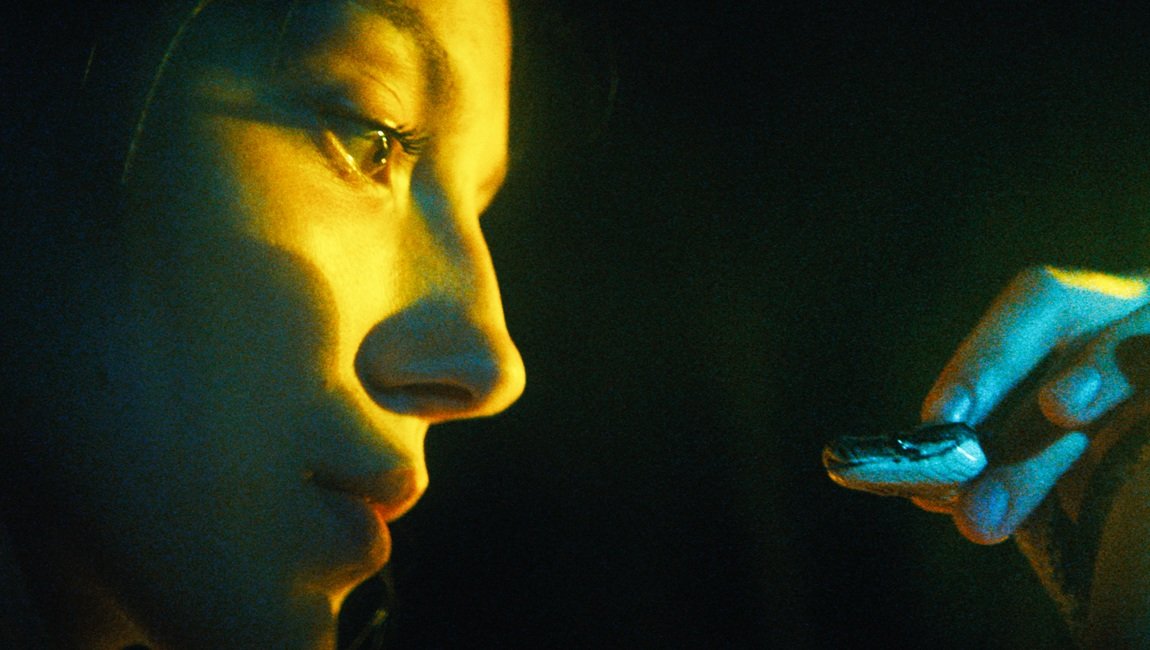
Even in its modern state, wracked by years of overdevelopment, the truth of Florida’s Everglades is that it is singular. One gets the feeling that it exists between things, water running where foliage is, grass growing from rivers in great gobs. There is nothing there and then there is an alligator. The same surface of water holds a clutter of whirligig beetles, pinging between the spatterdock. There is celebration in these images, in the zen-like manner in which some of the Florida natives enter into this great overgrown thing. During the first night of the hunt, Brandon (“an eighth-generation Floridian,” Robin revealed in an interview, the great-grandson of the storied Ted Smallwood) runs after a python and grabs hold, only to realize it’s a Cottonmouth. Rather than recoil, his companions nervously saying his name after him, he follows getting low and close to the snake. In a lesser film, something dramatic would happen. Even if it didn’t, the film would suggest that something dramatic might, or could. Here, the truth is that something dramatic has happened: the nonhuman world and the human world have collided, as they do constantly. It is wonderful and terrifying. It is always moving.
In that same interview, Robin expresses affection for Cane Toads: An Unnatural History (1988). That film’s maker, Mark Lewis, knew better than any that animals — like humans — live in the society we have constructed. Unlike humans, though, they had no stake in its construction, a fact made most apparent in how their livelihood is, at best, an afterthought in the fact of ours. The Python Hunt has as much to say about the weird morays of American governance and its historical prioritization of making a few folks a buck at the expense of others as it does the Everglades’ existence as a baffling photobook of supernatural imagery as it does the idiot glee encased in humanity’s eternal quest to see something new. But it expresses itself best when it gets on the snakes’ level, training them through nightscapes neoned with flash and headlights, proof of the human world and proof that it’s in the distance, a threat and a willing, affectionate audience.
DIRECTOR: Xander Robin; DISTRIBUTOR: Oscilloscope Laboratories; IN THEATERS: May 8; RUNTIME: 1 hr. 31 min.
Comments are closed.