
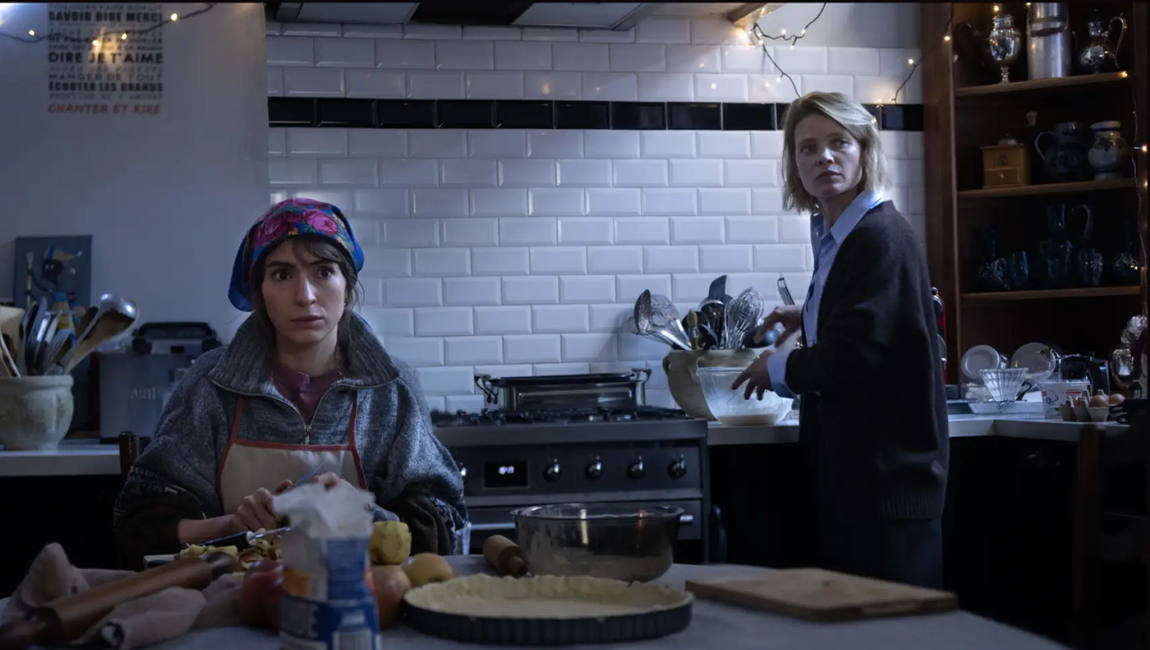
In The Diary of a Chambermaid, Radu Jude returns to one of his favorite subjects: Europe, as a bad joke. This time, the joke comes dressed in French social and artistic traditions. It’s no coincidence that the film takes its title from Octave Mirbeau’s 1900 novel, a book already adapted by Jean Renoir, Luis Buñuel, and Benoît Jacquot in the past. Jude’s version, however, is neither a remake nor an adaptation in any conventional sense. His take might best be described as a work of meta-fiction, wherein a young Romanian migrant working for a family in Bordeaux also takes part in an amateur theatre production of Mirbeau’s novel, playing a chambermaid on stage as well as working as one in real life.
Gianina, the chambermaid in Radu Jude’s world, is caught between two poles of the same role. In the house, she is reduced to an obedient, semi-invisible servant. In the theatre, she’s a servant to her own freedom, stripped of all her domestic restraints, unapologetically in the limelight. In one setting, she’s used to being reserved, grateful, and self-effacing while in the other, she’s a carnal beast that’s open to all forms of pleasure and experimentation. The duality here might seem a touch convenient, yet both spaces demand something morally compromising from her. The French family sees her as mere labor, though never as far to see her as a part of the family even though she is acting in as a substitute parent for their son most of the time. The theatre troupe sees her as an abject material for art, subjecting her to challenging, and at times humiliating, requests that vary from nudity to emotional exposure. What makes the film uncomfortable is how little distance there is between these two forms of being. There is no way to be sure which of the two is real and which is the act.
This split is also in parallel with the way the two child characters are portrayed throughout the film, both of whom deepen the social arrangement at the center of everything. Gianina takes care of the family’s son Louen and performs all the daily intimacies of parenthood for him. Although she is close to the child’s needs, requests, habits, and moods all day every day, she remains systemically outside the emotional center of the home. By contrast, she’s physically away from her daughter in Romania, but very much involved with the little girl’s life. Their relationship is maintained through calls, phone-recorded videos, and the mediated presence of others, such as the girl’s grandparents. There’s a dilemma at work here: she has to be near the other woman’s child in order to support her own. Jude seems to be less interested in the simple hypocrisy of the situation than in how ordinary and acceptable such disparity has become in Europe’s everyday politics, more so those that are shaped around migrancy and inequality.
But at what cost do Gianina’s multiple lives as a worker, a mother, and a migrant come into play? The small humiliations are everywhere, from the questions she has to face by the French family to the casual corrections of her speech, habits, and place by her friends. None of these moments are large enough to become an incident, which is precisely why they sting when accumulated. Even the children are drawn into this ritual of condescension, like when Madame Anne on Louen’s tablet screen asks Gianina about the poverty in Romania from a time the latter wasn’t even born, a classic recycling of stereotypes that run rampant in Europe’s inherited imagination of the East. Moreover, Gianina is told off by Louen’s mother to stop telling him tales from her homeland, including that of Făt-Frumos, the hero of a well-known Romanian fairytale, in which a young man leaves his home and doesn’t notice the passage of time. The irony lies in what Louen’s father calls “champagne socialism,” a term he uses to describe a comfortable, risk-free understanding of European leftism. However futile, everyone in the house seems to have a language for these injustices, so long as they happen elsewhere. Gianina, meanwhile, has to constantly make up for the new distances that the injustices in her own life seems to create, to an extent she has to lie to her daughter about Louen to mitigate her jealousy. What is at stake here, against her better judgment, is the risk that those distances become just another fodder to the same exploitative machinery that has been governing her life.
By the same token, it can be argued that Jude’s arrangement seems to invite that risk. A Romanian worker in France; an old French novel about domestic service; the friction between East and West; poverty and performance; the servant as actress and object. Each setup is almost too schematic, if not didactic, lacking Jude’s otherwise nuanced, mildly absurdist register. But perhaps his bluntness is part of the conceit here. The opening scene might give us a clue as to Jude’s intentions, in which Gianina is interrupted on the street by an unhoused man, only to have obscenities yelled at her when his pleas go unattended. It is evident that Europe is still the same beast that’s afraid of its own shadow, overwrought with centuries’ worth of systemic and social imbalances. Here is a film tailored around invisible labor, class divides, and the soft violence of being alive as a disadvantaged migrant, premiering at a festival that arguably depends, historically and materially, on some version of these same conditions. It is hard to imagine Jude not enjoying the irony here. His target is not only the family that employs Gianina, but the whole cultural chain that surrounds her: the theater scene, the novel, the history of adaptations, the festival circuit. Jude’s joke is that perhaps the audience, too, belongs somewhere in this traffic.
It might be wise to circle back to the earlier metafiction reference at this point. At the level of form, the film seems to purposely encourage the blurring of these distinctions. What emerges is a work that is thoroughly self-conscious in its grammar, layering its images and roles in a way that they begin to operate as one nested doll of references: the film’s own surfaces are often juxtaposed with those of other kinds, including the phone interfaces, television screens, and video recordings (made by Gianina in France; by her daughter in Romania; by the unknown hand filming the abandoned, derelict locations in both countries), which seem indistinguishable at times from the visual language of the film in composition and texture. This is only further reinforced in the journalistic structure of the film, where each setting is assigned a date from Gianina’s life and keeps record of moments that vary from a mere two-second view of roadside thistles to a whole scene in her stageplay. The understanding of reality is divided into multifarious performances played before each interface, prompting a multitude of selves around Gianina’s character.
The earlier adaptations of The Diary cast a long shadow over Jude’s polyphonic interpretation of the source material. Unlike Buñuel’s 1964 adaptation, which utilizes the conventions of suspense to expose the perversity and decay of a bourgeois household, Jude changes the scale of his diagnosis. The scope of rot is broader in his world, more institutional than domestic, yet waiting to be uncovered by someone who’s positioned at the lowest rung of both circles. The only common ground is the character’s proximity to the source of decay, and it’s no surprise that she conveniently sees more about it than everyone else. She watches how people speak around her, about her, through her. Still, she resists becoming a symbol of migrant suffering. Nor does she grant herself the privilege of a detached moral observer. In this sense, Jude’s The Diary can also be considered as a film about a woman being watched, a gendered practice that the history of cinema is not innocent of. What gives his take its bite, however, is its political undertones. Who gets to inherit power? Who gets to inherit a burden? Who gets to be transformed by which, and in what ways? Not even Gianina’s own family, nor the one she looks after, are exempt from the consequences of these questions. This is the cruel joke. The names have changed, the cultures have shifted, the borders have opened, and still the same old arrangement continues in some other part of the world, in other households, with another woman carrying the weight. The Diary of a Chambermaid may not be Jude’s most surprising provocation, but it seems like his freshest.
Comments are closed.