
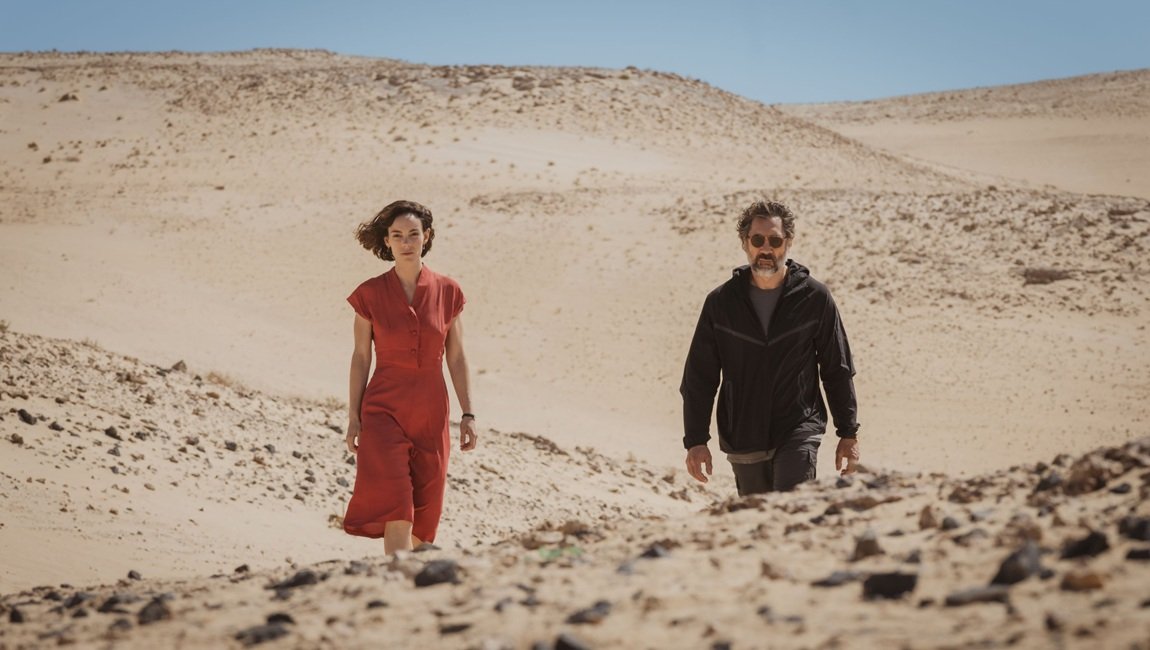
Surely critics will be quick to note that The Beloved (El ser querido) strongly recalls last year’s Sentimental Value, as Rodrigo Sorogoyen’s seventh feature film also explores a fraught father-daughter relationship against the backdrop of the film industry. Sorogoyen, however, mostly depicts what Joachim Trier’s Oscar-winner left to the imagination: the moments where a renowned director actually employs his daughter as lead actress on the set of his latest film project. It all starts with a nervous Esteban Martínez (Javier Bardem) reconvening with his estranged daughter Emilia (Victoria Luengo) to offer her a role in Desierto, an ambitious historical picture set in the Western Sahara in the times of its Spanish colonization. While acclaimed for his uncompromising films and infamous for his tendency toward violent on-set behavior, Esteban feels that at the dinner table with Emilia, he clearly is not in a position of power anymore. It’s understood that putting her in his film is the only way he can somehow reconnect with his lost family, a calculated risk for both that fuels much of the drama to follow.
The remainder of The Beloved dissects how their fragile relationship has to endure the mounting pressure of a grand-scale film set. Sorogoyen leaves little to the imagination in the way this father-daughter/director-actress dynamic evolves, although he employs an impressive array of stylistic devices to parse through what is shot for Desierto and what transpires behind the scenes. Flipping through various types of cameras, aspect ratios, and even seamlessly shifting between color and black-and-white, Sorogoyen’s recurring cinematographer Alejandro de Pablo constructs an elaborate cinematic mind palace of sorts, through which collaborators Esteban and Emilia are now doomed to dwell. While this filmic apparatus always carries the promise of bringing them closer, the demanding reality of on-set work can’t help but drive a wedge between the disconnected family members.
Once again penned by Sorogoyen and key collaborator Isabel Peña, The Beloved compensates for its lack of dramatic mystery with a devout dedication to craftsmanship. Luengo offers a strong emotional backbone to the film by carefully portraying how Emilia is willing to surrender to the logistics of a demanding shoot, all the while standing her ground against her father, who almost can’t help but slip into the role of the somewhat dictatorial director again. It’s especially Bardem, however, who carries this film as the troubled artist full of unease. The heaviness of his responsibility as director, the simmering anger at other people’s failures, and the sustained sense of disappointment toward his relationship with Emilia — it all pours from the screen thanks to the exact framing of his pitch-perfect acting. The last time a director made such good use of this tremendous thespian was probably Darren Aronofsky with the troubled apocalyptic melodrama Mother! (2017), or Terrence Malick before that with Bardem’s existential crisis of faith in To the Wonder (2012).
Compared to these more outré directors, Sorogoyen shows himself as a more moderate auteur. Earlier films like The Beasts (2022) and Mother (2019) carry a similar, highly pleasing exactness, while also coming across as somewhat compromised art films. Although The Beloved alludes to much deeper undercurrents by seemingly equating the Spanish colonization of the Western Sahara within Desierto with the overbearing approach of Esteban toward cast, crew, and daughter, it all kind of fizzles out at the end when there’s nothing much left to unpack anymore. Perhaps that’s the entire point of the film, as it’s implied that the greatest success for Esteban and Emilia is simply that they managed to jointly make this film before parting ways again. However, a forced close-up on Bardem’s crying face as he observes the closing shot of his film in the editing suite feels overwrought. It’s as if Sorogoyen suddenly realized he needed to amp the drama in a film that ends up feeling pretty sauceless once the closing credits draw near. That said, it’s not a decision that casts The Beloved a failure, but the highly elaborate narrative construct and agile acting offered here deserve a kind of cinematic catharsis Sorogoyen evidently hasn’t mastered yet.
Comments are closed.