
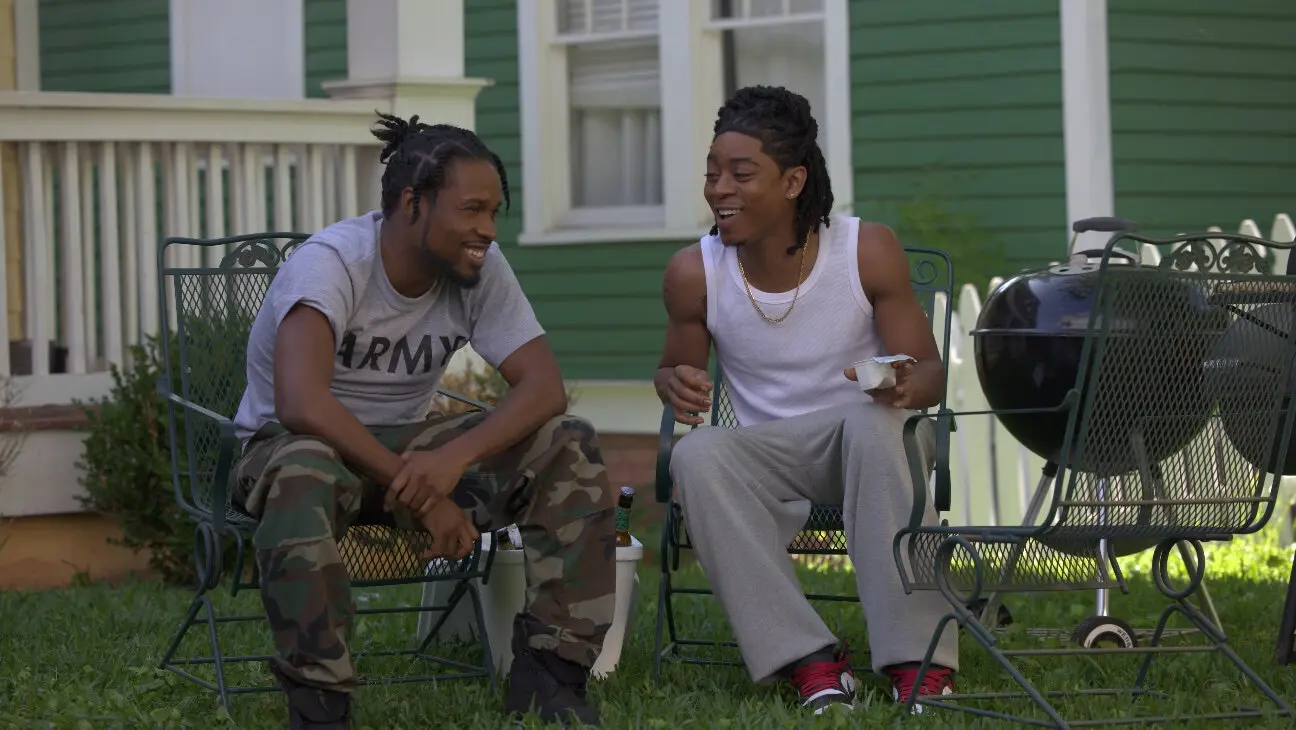
“From the mind of The RZA” and “presented” by Quentin Tarantino comes One Spoon of Chocolate. In the film, Shameik Moore plays a veteran, washed ashore after a stint in prison, stuck in the only place he has family, “Karensville,” Ohio. There, “he finds love and more trouble than he can handle,” but these bits of tagline hardly do the narrative justice. Randy “Unique” Joneson (Moore) has landed in a midwestern small town run by the racist sheriff’s racist son’s gang of skinhead hooligans, a “sundown” town in full effect. If the time period is a bit hazy — pre-production materials suggested the film would be a “period piece set between the 1960s and 1970s,” but the soundtrack and phone booths suggest the ’90s, while Joneson’s stint in Iraq suggests the aughts — we are fully welcome to read between the lines and see this as an exaggerated, but sadly palpable, survey of race dynamics in America today.
The film opens with the vicious murder of Lonnie Jones, Unique’s cousin. A star athlete, his killing is given shades of Emmett Till, and a shadowy, malignant doctor’s office where he awakes shakes with the memories of slavery, race science, and organ harvesting. The RZA is here to make a statement, and pulls no punches in doing so. Advertisements for the film tout “from the visionary mind of The RZA,” and that label is something no one having listened to 36 Chambers can refute. But this writer vividly recalls a trailer emblazoned with “the visionary director The RZA,” which is a harder claim to reckon with. His previous directorial efforts, The Man with the Iron Fists and Love Beats Rhymes, were poorly received both critically and commercially, so such marketing claims these absent any tether to the real world. But those films are beside the point. Before us is One Spoon of Chocolate, presented by Quentin Tarantino and claiming to be “a different kind of protest.” This film has big ideas, visually and thematically, and desires to be dealt with.
Lonnie’s death is a hint toward a grand racist design embedded within the system, one which ties together mass incarceration, police brutality, bodily autonomy, property ownership, and more. “The system is a giant,” Unique is told. How can he fight it? Who’s he going to fight? Where to even start? This sort of critique, protest we could call it, is clear-eyed and well received. It makes sense. In America, we have a two-faced system of “law and order,” one which criminalizes a broad swath of trivial activity yet turns its cheek to other, hateful rhetoric and violence.
The nondescript world that One Spoon of Chocolate details is poorly defined, but it is recognizable. Its injustices are real and familiar, yet already, still at the start of Unique’s journey, our momentum wavers. Jason Isbell appears, as a sort of travelling bard-turned-book salesman who gives Unique a “complete survival almanac,” a text that has a strange inner glow (not unlike Pulp Fiction’s briefcase) when later opened. When Unique arrives in Ohio to stay with his cousin Ramsee (Lonnie’s brother), the two are quickly hounded by a gang of racist thugs. The fulcrum of the story seems to be revenge sought for Lonnie’s killing, still an ungainly mystery hanging over the town, and the narrative does hinge on this, but only obliquely. Very quickly we seem to lose the plot, threads knitting together in unseemly patterns, while the action builds and builds. In no time at all, we are locked in an unending cycle of violence both sharp and meaningless. And perhaps this is a form of protest in itself. The film offers a certain catharsis through Unique’s fighting acumen (aptly inspired by Kung Fu) and righteous attitude, and Moore brings to the role a brutal deadpan not unlike John David Washington’s stellar turn in Tenet. Yet catharsis can only be had in half, because One Spoon of Chocolate cuts itself down, wheedling away the meat of the story until all that’s left is the idea of it.
The film’s emotional stakes likewise never fully take hold — perhaps aren’t allowed to. It becomes almost unbelievable how much the film jumps around, at one point cutting between a wild, drug-fueled bacchanal at the white power lodge (legion hall), and then a rare moment of serenity between Unique and Darla (Paris Jackson). Tonal shifts aside, one senses that this movie has been cut to pieces for some reason or other. Entire plot lines and character arcs seem dismembered, and the structural integrity of the whole seems to have been disregarded or ill-planned. While contradictions and juxtapositions might be apt for the material, they feel wholly unintentional in execution, and certainly uninspired.
Eventually, this awkward formal construction becomes distracting, with poorly layered sound effects (usually so integral to good action filmmaking) and sloppy editing plaguing the proceedings. At several points it even seems that shots have been repeated as filler, and it’s in these moments that it should dawn on viewers that this is at its core a B-movie. That’s not observed in a wholly derogatory way, but also as some amount of relief. One Spoon of Chocolate will surely suffer more because of its hype, because of the “visionary mind” of its writer/director (whose genuine genius lays elsewhere). It probably doesn’t deserve its fate, and it shouldn’t have been subjected to the, surely, copious meetings that led to its final cut. It should have been allowed to be itself, a middling action romp with big ideas. One of its biggest successes is that its rollicking pace, full-tilt violence, and R-rated approach don’t diminish its cultural protest, but that only goes so far to redeem a film so allergic to coherence.
Led to a no-holds-barred final battle, a melee of madness through the depraved, racist rooms of the legion hall, viewers await glorious catharsis. Again, it doesn’t come. The battle royale is entertaining, violent. The challengers mount, as they typically do, and Unique’s newly acquired survival skills become paramount in intriguing ways. But as the action becomes more intense, the film spinning wildly around Unique, the spectacle falls apart. Geography and space, so crucial for tight action, become nonsensical, and the punches begin to induce more groans from the audience that the victims. And the film’s ending, so nearly a bold statement, is left laughably abrupt.
So much of the film’s essential failure, and so many films of this ilk, likes in its fundamental cribbing. Nearly every alternate interpretation of Quentin Tarantino’s aesthetic of violence has unfortunately achieved no more than vapidity and cosplaying tedium. Perhaps this judgment comes down harsher after the recent They Will Kill You, which pulls from the same bag of tricks to, admittedly, even less effect. With One Spoon of Chocolate, The RZA at least has some clue where the train is headed, some grand notion of authorship, some… idea. Sadly, the vision hasn’t coalesced. We are left, in the end, with less than a spoon’s worth.
DIRECTOR: RZA; CAST: Shameik Moore, Paris Jackson, Blair Underwood, RJ Cyler; DISTRIBUTOR: Variance Films; IN THEATERS: May 1; RUNTIME: 1 hr. 52 min.
Comments are closed.