
Toward the beginning of Too Many Beasts, aging farmer Raoul Brun (Jean-Louis Coulloc’h) intentionally runs over several large boars, packs their bodies in the trunk of his car, and deposits them in the driveway of a nearby manor. In response, Antoine Lepage (Xavier de Guillebon) confronts Brun on his land. The two men stand off as in a Western, and the camera sells the comparison, capturing Brun’s crazed eyes in Sergio Leone-style close-up before he shoots and kills Lepage.
A year later, Brun has disappeared and disgraced Corsican cop Fuldo Orsini (Alexi Manenti), transferred to the area after an incident with a colleague, is pulled into a related case: someone is leaving dead boars on the property of hunters and the wealthy. The initial murder and the continuing community unrest are rooted in a conflict over the increasing population of abnormally large wild boars that are overrunning farmers’ land, but are kept well fed by the elites to support the woods as a hunting destination. Lepage, Orsini learns, was responsible for gentrifying the hunt in the area, bringing in cityfolk from Paris at the expense of the locals. To say more would spoil some of the grander, stranger directions the case takes, but suffice to say a satisfying conspiratorial yarn gradually takes shape as Orsini keeps digging, his unmatched observational prowess and uncommonly good policework leading him beyond presumed dead ends.
A simple synopsis of Sarah Arnold’s debut feature might suggest a gritty detective drama starring an alcoholic yet brilliantly perceptive policeman from the city who helps his new provincial department solve a crime they can’t handle, and Arnold displays enough talent that, were the film simply that, it could be a solid take on familiar material. As the movie unfolds, however, its tonal palette unexpectedly expands, finding space for humor, surprising tenderness, and a few surreal touches.
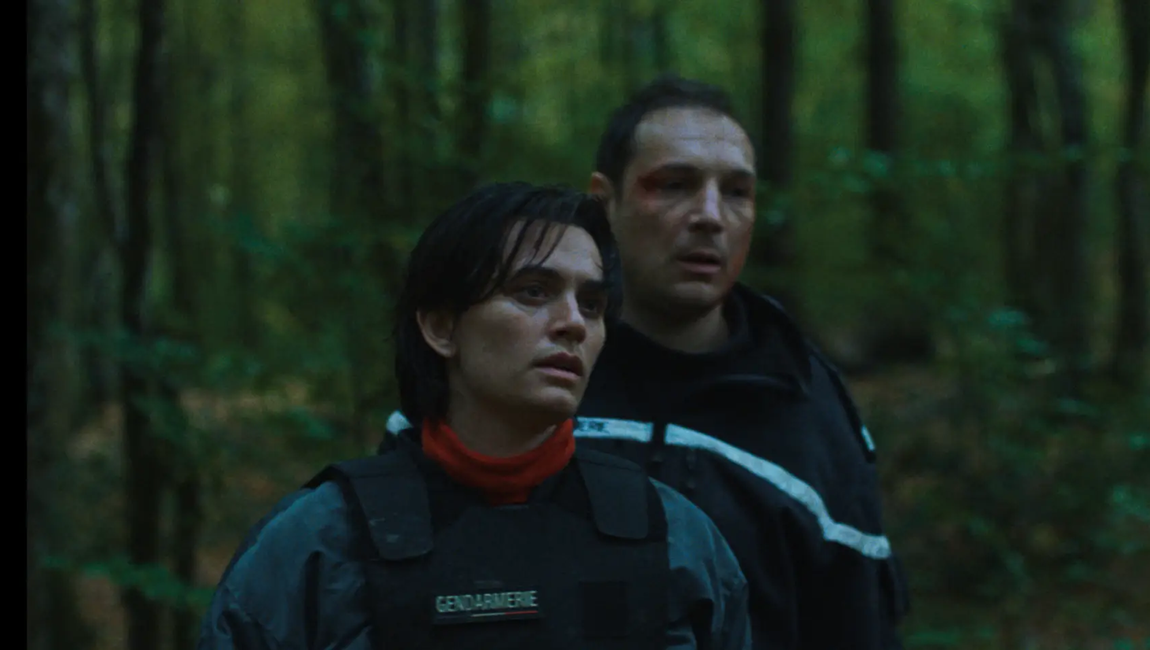
Also new to the department is psychologist Stéphane Danjir (Ella Rumpf) — her name is repeatedly mistaken for “Danger” — who Orsini is mandated to see on a daily basis in her ersatz office in the janitorial closet. In their sessions, Orsini comes off as hard-edged and misogynistic, a lost cause, violent cop whose tendency toward brutality and a ruined relationship with his ex appear destined to boil over, immediately placing him at odds with Danjir. But throughout the film, he also displays more sympathetic dimensions, including an underdog streak that aligns him with the farmers. Danjir, meanwhile, slowly emerges as the film’s second lead, as her understandably adversarial relationship to Orsini is challenged both by the department’s mistreatment of her and the discoveries she makes regarding the cop’s character.
Their eventual team-up is Too Many Beasts’ most exciting thread, and an extended drug-addled sequence gives Manenti and Rumpf space to explore more playful sides of their normally reserved, depressed characters. It nearly doesn’t work, as the sequence threatens to cross the line into outrageousness. Arnold proves adept at navigating tone, however, and each comedic shift comes across as a natural part of the film’s flow. Nothing feels out of place or out of the realm of possibility, and taken together these off-beat flourishes and genuine investment in character improve upon an already sturdy genre framework to mark Too Many Beasts as a notably exciting debut.
Comments are closed.