
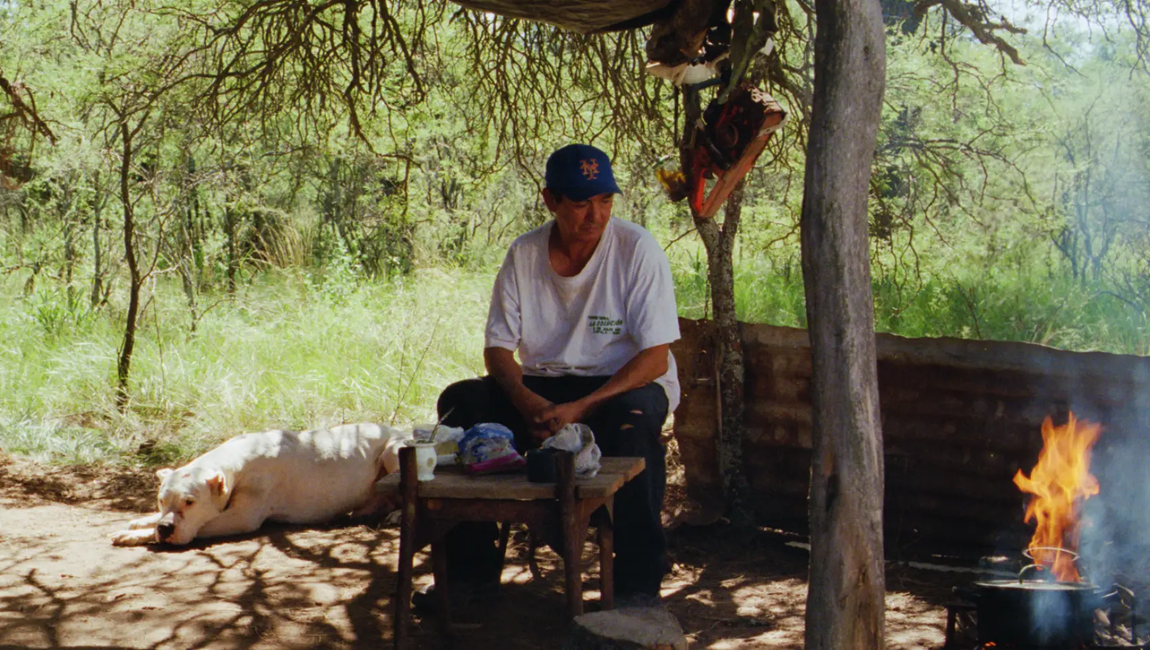
As landmark movies go, Lisandro Alonso’s 2001 debut Freedom could hardly have been less fitting. A documentary/fiction hybrid chronicling one day in the life of a woodcutter in the Pampas mountains, it’s the kind of patient, almost casual, incident-free fare that’s since become a bedrock of arthouse and experimental cinema — to the point that there’s little experimental about it anymore. But at the time, as the “slow cinema” movement — really more of a loose grouping — was only starting to take proper form, Freedom represented a genuinely radical, startling statement: cinema that featured characters, depicted events (however insignificant), chronicled the passage of time, but wasn’t really about any of those things, and which seemed to reject any and all inferences drawn by its inquisitive audience.
There may be few radical statements left to make in cinema, or in art in general for that matter, but, for a filmmaker who’s been expanding his scope and adapting his style in recent years, Alonso’s decision to return to his debut 25 years later is at least intriguing. His characters typically undertake journeys through space, time, or personal development; as his woodcutter returned, at the end of Freedom, to the same evening meal of roasted armadillo that had opened the movie, so too does Alonso return with Double Freedom. The woodcutter, Misael (Misael Saavedra), is the same. His rural shack is the same. His daily routine is the same. At first, it appears simply that his age and the presence of a dog are the only differences — entire shots and sequences from Freedom are repeated here, hewing so close to the first movie as to even employ the same camera tilt down to follow the same water bottle as Misael chucks it to the same ground.
Whether or not this dogged dedication to recreation is of value as an exercise in and of itself soon becomes moot, however. Alonso elides much of Freedom‘s action to condense it into just the first third of Double Freedom as he takes Misael on a new journey, one that he’s apparently avoided in the last 25 years: a journey toward obligation. His sister, Micaela (Catalina Saavedra), mentioned only briefly in Freedom, has again escaped from the psychiatric hospital where she’s stayed for 15 years, and Misael must travel into town to check on her. Sat in its brightly painted but nonetheless dingy corridor, opposite a nearly naked and seemingly non-responsive young man, he’s informed by the doctor that funding cuts mean the hospital must close, and Misael will have to take his sister home with him the next morning. As in everything he does, he dispassionately agrees, and this strange, mostly silent pair first drives and then walks through the plains and woods to his rustic abode, and to what could be a whole new way of living for both.
Obligation is incompatible with freedom, but if this unexpected development in Misael’s life, otherwise largely unchanged in 25 years, may threaten to impinge on his liberty, he’s stolidly unprepared to let it. Though he never exhibits any outright ill will toward his sister, he’s more than a tad cavalier toward the details of the treatment program the hospital has placed her on while under his care. The freedom he seeks, and has potentially achieved, is a self-defined one, not absolute — a visit to a gas station (again the same as in 2001) informs us that he’s still reliant on cash and fuel like the rest of us — but almost absolutely unyielding in its parameters, and even his own flesh and blood won’t disrupt them.
Yet Micaela’s appearance in Misael’s life isn’t just some sudden disruption. It’s a representation of the incongruity of an isolated life in a connected world and the incompatibility of these conflicting lifestyles, and a consequence of forces he’s long tried to avoid. His milieu is ostensibly humble, pastoral, idyllic, but his way of life involves the destruction of nature in pursuit of financial subsistence, and the chainsaw he uses to carve the twisted tree branches into straight logs suitable for dividing local farmland into clearly delineated pieces of property is a distinctly inorganic tool. When his sister arrives, her presence is similarly inorganic within Misael’s carefully curated lifestyle, though she quickly establishes a more harmonious relationship with the natural world around her. That she’s been forced to do so invites a political reading of Double Freedom that its predecessor fundamentally discouraged — under President Milei, Argentina’s health and social care services are seriously suffering, and Micaela’s situation is one manifestation of this suffering. Like Misael, Alonso is no longer able to ignore the political realities within his country.
If Freedom‘s title always carried a tinge of irony to it, contemporary politics only amplify this. Misael clings to the past, repeating the same day over and over — the same lightning bolts illuminating the same night sky as he eats the same dinner on the same stool as he did 25 years ago. And where has his journey taken him? Ever back to the same — a somewhat depressing vision of freedom. Alonso uses his own repetition here for alternative purposes, both to critique itself and to examine what occurs when change is foisted upon someone intrinsically resistant to it. The strictures of expectation among certain slow cinema devotees still cleaving to the old landmarks seem to mean less and less to Alonso with each new project — that he’s made his own journey back to them with Double Freedom may be only to make a point. It’s time to move on and — if the post-credits shot (cut from Freedom, supposedly to Alonso’s disapproval) is anything to go by — to look back and laugh. As landmark, statement-making movies go, Double Freedom could also hardly be less fitting, yet it’s thus that its statement is so profound. In an appropriately minor way, this is a major movie.
Comments are closed.