
The trouble with effective satire is that sometimes the original mark already exists in such a heightened state that any attempts to ridicule, undermine, or otherwise deconstruct it ultimately fall flat. Unless you happen to be riddled with gross ignorance, anyone reading this review must surely have some notion that the current state of the world is largely Not Great, with the tumult that is the United States of America reaching unseen levels of collapse that will only be surpassed by… tomorrow. But the existential dread of life marches on, and with it art follows, as filmmakers find a myriad of ways to hold up a mirror to a cracked society through the power of cinema. The Hunger Games transformed dystopian world-building into a billion-dollar franchise, and just last year the Stephen King adaptation The Long Walk landed as a modest hit with its bleak tale of young men pushed to the limit for the sake of entertainment. (Curiously, both projects were directed by Francis Lawrence. You feeling all right, man?). Making his own feature-length debut roughly within this sphere of bleak sociological survey is writer/director Todd Wiseman Jr., who puts an Orwellian spin on America’s gun epidemic with The School Duel. Armed with an achromatic color scheme and a heavily portentous mood, Wiseman clearly has a lot of thoughts about the state of the nation, though his efforts are ultimately rendered redundant by representing the real-life horrors that continue to permeate the country today presentationally, without much interrogation.
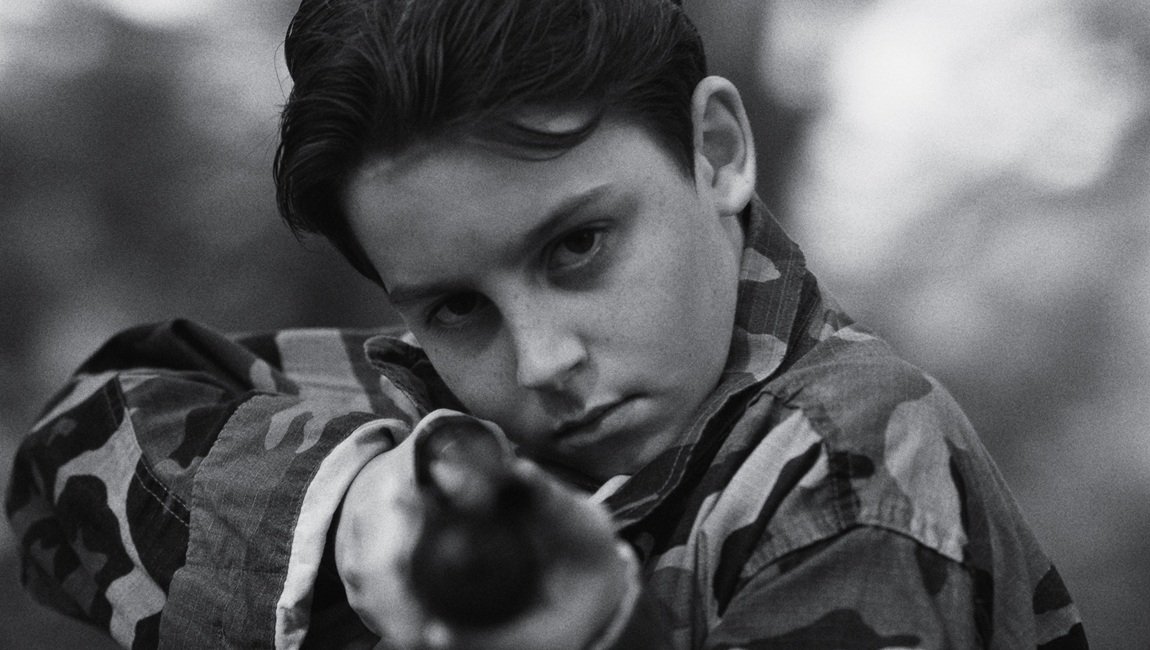
Set in the near future of Florida, USA, gun control has been outlawed and school shootings are at an all-time high. Knowing no better, the powers that be have opted to fight fire with fire, with Governor Ramiro (Oscar Nuñez) implementing The School Duel, an annual event pitting various tributes — well, “delegates” here — from educational institutions in a youth-oriented battle royale loaded with firearms. Last man standing is crowned the king, everyone who dies is hailed a martyr, and society somehow heals from this process. One of the prime candidates for the upcoming Duel is Sammy (Kue Lawrence), a 13-year old boy who lives with single mom Beth (Christina Brucato). A student who is frequently tormented and bullied, from both peers and faculty alike, Sammy fantasizes about getting revenge, going so far as to keep a hit list tucked inside a notebook. When the opportunity arises, Sammy finds himself a participant in The School Duel with 18 other adolescent boys, but once the bullets start flying, Sammy finds that taking a human life is not as simple as he imagined, soon fighting for survival rather than retribution as fellow duelists are picked off one by one.
But before we get there, following a preamble explaining the rules of the Duel, Wiseman first explores the world of Sammy, who spends his free time indulging in videos of manosphere-adjacent influencers on social media or playing with his late father’s rifle. Living in a robust religious community, the absence of Sammy’s father is sorely felt in his household, leaving worried mom Beth afraid to see the loss of her son in real time. The schoolyard offers no better respite, finding Sammy the butt of many other students’ cruelty, while the gym teacher encourages open-palm slap fights on the playground. When one instance of bullying pushes Sammy to the edge, he lashes out with an edged weapon, necessitating a trip to the principal’s office where the price must be paid with paddling. This leads to one of the film’s more humorous but casually terrifying visual touches, as the principal reprimands Sammy in her office, admonishing him for hurting another student, all while she’s framed in front of a large glass display case full of assault rifles. Which is to say, The School Duel is heavy-handed and blunt, but that’s precisely how Wiseman likes it, pulling no punches as real-world absurdities and hypocrisies are exploited to maximum effect.
The titular School Duel finally commences at the film’s halfway mark, fashioning a large football field into an arena of death, while the boys are outfitted with armor and weaponry selected from a spinning prize wheel (the firearms are all equipped with safety features to prevent trigger-happy opportunists from shooting their way out of the competition). But even with the promise of the premise established, violence is really only peppered in during the latter half of The School Duel, finding much of the conflict very start-and-stop, not lingering on any particular deaths. Wiseman is instead more infatuated with the design of the feature, keeping the world in black-and-white while cinematography explores 1984-esque camera setups, placing static fixtures in homes, schools, and even in the Duel’s arena. Much can be made about Wiseman’s commentary on how the nation has obviously devolved into a fascist failed state, but he undermines himself with a ludicrous twist ending, complete with a final shot that is too cute by half. Wiseman may have invoked real-world horrors in order to build an intriguing setup and tether dystopian texture to horrific present-day policy, but his failure to be bolder with the material results in something less timely than largely superfluous.
DIRECTOR: Todd Wiseman Jr.; CAST: Kue Lawrence, Christina Brucato, Oscar Nuñez, Jamad Mays; DISTRIBUTOR: Altered Innocence; IN THEATERS: April 24; RUNTIME: 1 hr. 32 min.
Comments are closed.