
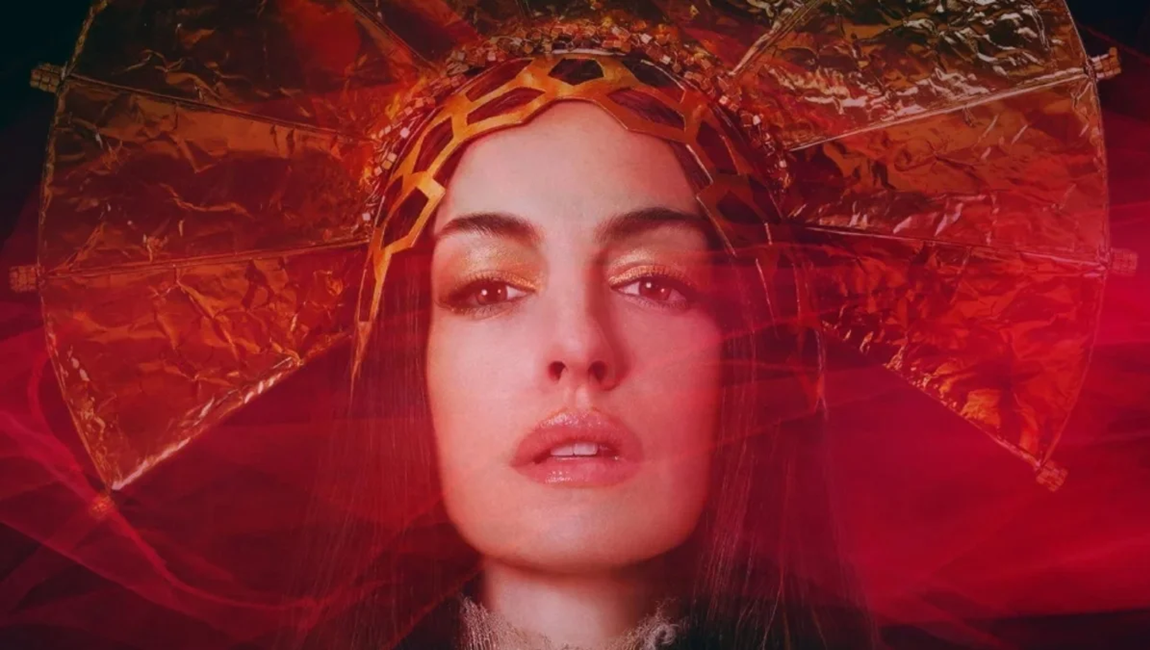
Existing at the nexus of fashion, popular music, and horror, David Lowery’s Mother Mary, a multi-genre whatsit, proudly wears its pretentiousness on its (couture) sleeve. A phantasmagoric extended dialogue about resentment, longing, and the nature of authorship when an artist’s primary canvas is their very body, the film starts small and talky only to expand outward, compressing time and space before fully embracing the supernatural. Equally parts moribund and campy, the film invites derision with its barbed tête-à-têtes, vampy musical performances featuring a leggy movie star, metaphors made corporeal, and a tendency to go full “galaxy brain.” But there’s a real boldness to Lowery’s vision and the rapturous way the film gives itself over to the metaphysical in dramatizing the way people drift apart and allow their emotions to overpower them. The film is transfixed by dance music, outré costumes, and the withering gaze of fearlessly self-possessed women, but amidst all the “fierce” signifiers one can sense Lowery feeling his way through heady material on the nature of longing and passions that burn so hot they threaten to immolate. If one is able to stifle the urge to laugh dismissively, they might recognize how admirable the swing is.
Ostensibly a two-hander between two successful women with a shared past, the film’s setup is simple enough. International recording artist Mother Mary (Anne Hathaway, in a flowing Morticia Addams wig and a series of slinky, lycra stage outfits) shows up on the doorstep of fashion maven and former lover Sam Anselm (Michaela Coel) while in the throes of a spiritual and career crisis. Although the two women haven’t spoken in a decade, Mother Mary — one assumes this is a stage name, but if she’s called something more familiar by her close friends the film never reveals it — has run away from her team of professional handlers in the days leading up to a high-profile televised performance (intended to be her glorious return to the spotlight after suffering a near fatal accident) and flown herself to Sam’s country estate in England. Showing up unannounced at her door, Mother Mary begs Sam to dress her in one of her designs (“something that feels like me”), as she did all the years they were together, for the upcoming concert. Under no obligation to oblige her ex and still smarting over the circumstances of their breakup, the sphinx-like Sam toys with Mother Mary; interrogating the circumstances of their abrupt dissolution, speaking in what sounds like riddles, and denying the pop diva the satisfaction of having listened to her omnipresent music post-breakup. With an ever-arched eyebrow and a keen appreciation of how the power dynamic in the relationship has shifted, Sam circles Mother Mary like a house cat would a wounded mouse. Sam eventually agrees to craft a bespoke garment, but her motives are guarded and likely serving her own agenda.
Situated primarily in a cavernous, sparsely decorated barn-cum-workshop and preoccupied with flourishy wordplay, all but tripping over its own metaphors — there’s so much discussion of opening and closing doors that even the characters occasionally seem confused whether they’re talking about literal ones — one could be forgiven for mistaking the first hour of Mother Mary for a variation on black box theater. Or certainly that would be the case if one overlooked the semi-regular flashbacks to Hathaway performing dance-pop song (written by FKA twigs, Jack Antonoff, and the ubiquitous Charli xcx), which allows Lowery to stage elaborate concert sequences with synchronized choreography, towering stage design, outlandish costumes — Mother Mary’s visual hallmark is ornate headpieces that resemble halos — and throngs of adoring fans. It makes for a stark contrast between Mother Mary as fabulous sexual goddess feeding off the energy of the crowd and the frightened wretch throwing herself at Sam’s mercy. Despite the fame disparity (both for the characters as well as the two actresses), Coel’s Sam is the film’s dominant perspective during its first hour, needling Hathaway’s character as she flings yards of fabric at her while brandishing a giant pair of shears. The film even initially appears to be a spiritual relative to Steven Soderbergh’s The Christophers, which likewise costars Coel and also finds its characters debating at length the authorial voice and authenticity. Here the film asks the pointed question of who the actual artist is in this dynamic: the person who conceived of Mother Mary’s entire aesthetic or the woman who has the level of otherworldly self-confidence required to convincingly inhabit it?
Through it all, Mother Mary remains contrite and humbled, her nerve perhaps shaken by a traumatic fall she suffered, but there’s a visibly haunted quality as well. As the psychosexual pas de deux progresses — the nature of designing a garment is inherently intimate, with its stripping off of outer layers, running your hands over someone’s body, and noting their contours while taking their measurements — the exact nature of Mother Mary’s “haunting” becomes clearer yet more opaque. We learn the two women share a spectral presence, personified by a crimson red fabric that announces itself at the foot of the bed one night, floating on the air as if it were dancing. It’s “alive” yet voiceless, persistently hovering and silently menacing Mother Mary. Even more incredibly, this spirit seems to have been birthed into the world by Sam: a physical manifestation of her seething hatred for her former paramour, allegedly wandering the earth for years before finding Mother Mary and burrowing inside of her (somewhat literally, as the film starts to dabble in body horror). None of this is especially lucid, but coherence isn’t Lowery’s concern. As the film’s perspective shifts from Sam’s to Mother Mary’s, the dramatic shape of the film is upended. The tangible gives way to the surreal, and the film’s desire to explicate its intentions is replaced by nightmarish interludes that evoke the lightless voids and sentient antimatter of Jonathan Glazer’s Under the Skin. As the Mother Mary character spirals into a self-destructive mania, it’s fair to wonder whether Sam has (unwittingly?) cursed her and might her impromptu visit have less to do with a dress and rather the need for an exorcism of some sorts.
Those seeking easy answers or the comfort of the explainable are likely to find Mother Mary a maddening experience. Lowery’s film has more in common with the barely constrained mania, dreaminess, and wild shocks of saturated colors of a giallo film than the trauma-based, “elevated horror” that the film’s distributor, A24, typically releases. The film feels governed by an almost alien energy that spurns any obvious structure. Instead, Lowery’s approach here is to present a series of stylistic and formal dichotomies and allow them to play off one another. Stillness and silence into club-beat propulsiveness; locked-down cameras and naturalism into complex effects shots with a hundred moving pieces; loquaciousness into speechless inscrutability. The film is “a ghost story” but it feels a million miles away from A Ghost Story, Lowery’s low-budget 2017 meditation on the vastness of eternity. By comparison, Mother Mary’s focus is more narrow (almost myopic, really), but the filmmaking is messier. The overall effect is less satisfying, but the film digs its claws into you nonetheless, treating its brazenness as its own reward.
What is the film actually saying? And does it all add up to anything beyond the filmmaker taking the viewer on a hallucinatory extrapolation of the interpersonal dramas of a music superstar and a fashionista? Taken on its face, one can interpret the film as an allegory for rancour and forgiveness; cutting out the cancer of bitterness before allowing it to consume you from the inside or transferring it onto someone else. But that’s almost boringly prosaic for a film so indifferent to internal logic. Perhaps the film isn’t meant to be solved so much as it’s designed to ensnare you with its ostentatiousness. It’s possible (likely even) that Mother Mary has rocks in its skull, but Lowery still understands how to conjure wonder and hold an audience in a death grip. What’s comprehension next to the sensation that you haven’t taken a breath in minutes?
DIRECTOR: David Lowery; CAST: Anne Hathaway, Michaela Coel, Hunter Schafer, Sian Clifford, FKA Twigs; DISTRIBUTOR: A24; IN THEATERS: April 17; RUNTIME: 1 hr. 52 min.
Comments are closed.