
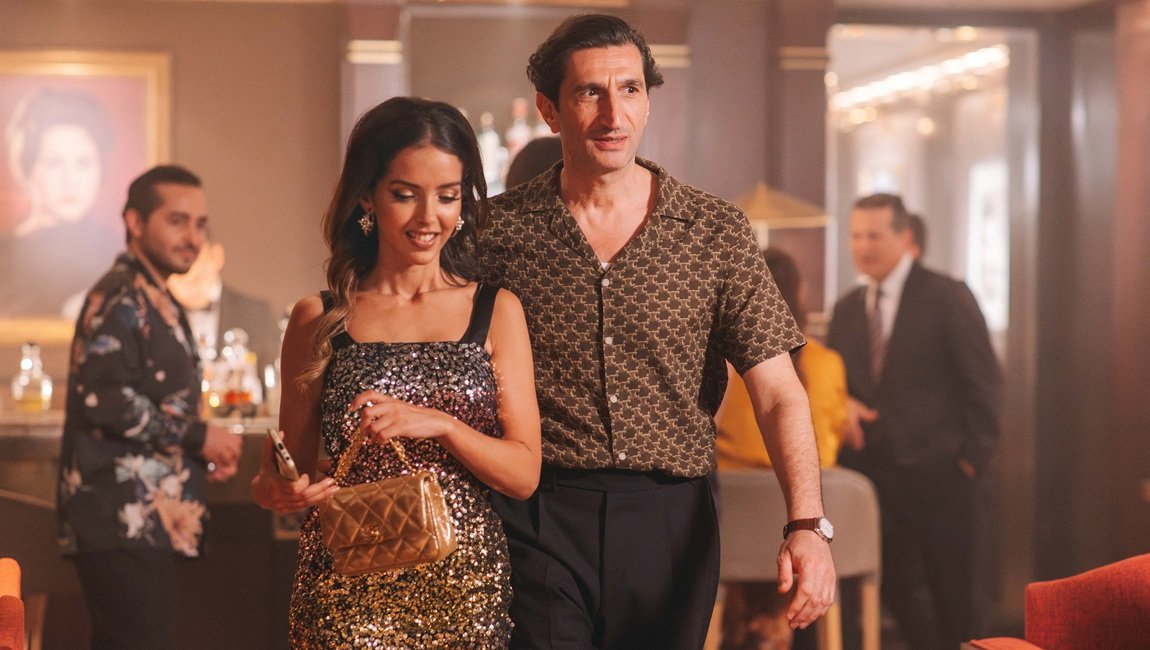
Tarik Saleh’s Eagles of the Republic, the final installment in the Swedish-Egyptian filmmaker’s Cairo trilogy following 2017’s The Nile Hilton Incident and 2022’s Cairo Conspiracy, all of which starred Fares Fares, is a stirring political satire filtered through thriller elements that takes its cue from political upheavals in present-day Egypt, now under the authoritarian regime of president Abdel Fattah el-Sisi, who rose to and remained in power since staging a coup in 2013. As with its predecessors, Eagles of the Republic had to be shot outside of Egypt (this time in Turkey) as Saleh has been effectively exiled from the country since 2015.
In the film, Fares plays George Fahmy, an Egyptian movie star so widely adored that he is monikered “Pharaoh of the Screen.” An A-list celebrity who has starred in such pictures as “The First Egyptian in Space,” George lives a fancy life. He drives a vintage Jaguar, dines in posh restaurants, and dates a gorgeous starlet close to his son’s age (Lyna Khoudri). It’s apparent why he would never trade such a coddled lifestyle for anything. That is, until high-ranking military men, self-proclaimed “Eagles of the Republic,” pressure him to play the modern-day pharaoh ruling the country in a forthcoming propagandistic film titled “The Will of the People.” Aware that the project will totally destroy his blockbuster status, he balks at the offer and resists. But not for long, especially after armed goons ambush him and threaten the life of his teenage son, Ramy (Suhaib Nashwan), should he decline the role. Not to mention that they already blacklisted his fellow actor, the openly defiant Rula Haddad (a moving Cherien Dabis), and that lately state-sponsored arrests and torture of dissenters have been rampant. What’s stopping them from keeping him untouched? And so, George is forced to accept the part, proving that supreme and corrupt power can dim even the country’s brightest star. The film’s anti-regime message accrues more dramatic power when the political begins to encroach on the personal.
Depiction is hardly a harmless act, this the regime knows as much as the power of stardom in building faux legacies, and so they co-opt George Fahmy’s image to rebrand that of el-Sisi. For one, George’s tall stature lifts the appeal of the short strongman. Then he is asked to drop the bald cap and the prosthetic belly and double chin in much the same way as he is warned by the controlling Dr. Mansour (Amr Waked), the president’s aide doubling as the film producer, to keep his imagination to himself. “I advise you to be very careful when you talk about the president,” the bureaucrat tells him. Saleh readily prizes these ridiculous demands and scenarios, putting the protagonist through the emotional wringer — one that later involves an affair with the defense minister’s enigmatic wife, Suzanne (Zineb Triki) — while lending the movie its humor. In one hilarious bit, accusations of advocating for democracy and human rights are hurled at the movie star, which he repels by suggesting that he’d rather tolerate being a Trotskyite, or perhaps being a capitalist, as his gay agent, Fawzy (Ahmed Khairy), would opine.
Soon enough, George learns to play the game, though without fully knowing the cards he’s been dealt, just as Saleh keeps us in the dark about where the tense proceedings are headed. Convoluted as it seems at times, suffused with double-crossings and conspiratorial swerves, the absurdities the film arrives at are instructive, evoking the tumult of living under totalitarian rule. At the same time, it sheds light on how state agents and celebrities, to some extent, are alike in how they fashion themselves in the cultural and public imagination, which feels particularly emblematic of the solipsistic spirit of our times.
Fares is compelling as a self-absorbed, scandalous star, especially in his scenes with Waked’s Mansour, whose silent and sinister demeanor, finding fault in his performance at one point, unsettles him. And as the troubled artist inches closer to the level of his own vanity and how naïve he really is about the real nature of autocracy, the fine line between fact and fiction, collaboration and complicity, starts to fracture, at which point the film settles into a rather jaded resolution, doubling down on how powerless its protagonist is. Yet, somehow, Eagles of the Republic is striking in its cynicism, precisely because this cynicism doesn’t arrive out of the blue.
DIRECTOR: Tarik Saleh; CAST: Fares Fares, Lyna Khoudri, Zineb Triki, Amr Waked, Cherien Dabis; DISTRIBUTOR: Cohen Media Group; IN THEATERS: April 17; RUNTIME: 2 hr. 9 min.
Comments are closed.