
Maybe Our Land, Lucrecia Martel’s new film, reminds me of Edits, Chuquimamani-Condori’s 2025 laptop dump of DJ edits, simply because I listened to the latter after watching the former. The edit — a unit of time that cheats — creates false borders over which real transformation occurs. Two different ideas get smushed up against each other, and the smushing yields another new idea. In cinema, our eyes make a history of these after-images, the imprint of what was ghosting across what is in ways that feel complicated to write out and instinctual when we see and feel them. Think, as in The Headless Woman (2008), how a woman drives a car and, distracted by her cellphone, hits some unseen thing. The camera cuts to a dead dog. A false reality is created, truthfully.
Certainly, a suspicion over the sovereignty of truth pervades. Chuquimamani-Condori’s fractured assaults of — and on — Andean folk, Nashville bro country, tecnocumbia, et al. winnow away at Western (culture’s) hegemony while simultaneously rebodying our notion of wholeness. Like Our Land, Edits is an experiment in certainty. As soon as a sound feels settled, it pitches, wiggles. It flanges into something else. In the DJ set, history gets re-moved, as samples collide in stacks across time all in order to create a new present fixated on moving the body in and out of time. Think, as in Zama (2017), how a contemporary actor wears 18th century outfits and moves to a soundtrack of Brazilian folk guitar, sounding more emblematic of Ed Sullivan-ready World Music™ than the group’s Tabajara origins. The certainty (and so, fiction) of the “realistic” gives way to a vast and wobbling contingency of realness. A certain vibration becomes necessary, otherwise we’d be stuck in that cruelest hegemony of them all: reality.
Our Land moves in similar fragments, undertaking as it does an understanding of the 2009 murder of Indigenous activist Javier Chocobar and continued violence against and land theft from the Chuschagasta people he counted himself a member of. The case fractures the logic of justice in familiar rhythms: Chocobar was killed in 2009, but it wasn’t until 2018 that a trial was finally held. Awaiting final sentencing in 2020, Chocobar’s murderers were freed when an appeals court still hadn’t made a ruling. In 2021, Chocobar’s murderer died. His two accomplices (both former police officers) remain free.
Nominally a chronicle of his 2018 murder trial, Our Land is a hacked time capsule, leaking into the past, begging of the future. The film mixes and remixes the blurred and damning cell phone video with new footage shot by Martel of the Chuschagasta community. It dives deep into Chocobar’s family history, his loves, and his life, as well as Argentina’s ongoing history of suffocating the truth and its Indigenous people in equal measure. It dives deep, submerging the camera in slow aerial whorls across the Tucumán province that Chocobar died trying to protect. Like in Edits, there is something mesmeric at work.
In the week before Our Land’s opening at Film Forum in New York City, I spoke with Lucrecia Martel over video chat. Our conversation is indebted to Cordelia Montes, who helped interpret.
Frank Falisi: When the film played at NYFF and in its initial festival run, the English \translation was Landmarks. It’s now being presented as Our Land. Could you speak a little about those titles, and maybe why a shift felt necessary?
Lucrecia Martel: Well, we first presented the film in Venice with the translation “Landmarks.” And then after going through the festival circuits and speaking to a lot of Anglophones, we were told that it was not a good translation. I don’t think “Our land” quite captures the title in Spanish because you lose the double sense: “Nuestra tierra” means both “our land” and “our Earth,” the planet Earth. So it’s one of those times where there is a lack in the translation.
FF: That double meaning really comes across in the opening shot, which is of Earth itself, first viewed from beyond, in space, and then steadily getting closer to Argentina, to the Chuschagasta people. When did you decide that the film had to start in space?
LM: I remember exactly when it was. It was the beginning of January, 2025. We had actually finished our editing process, and I knew I was interested in the image of the planet. I had spent a lot of time on Google Earth, looking at the Tucumán region through Google Earth. In those days, I was travelling a lot in my truck, and in those travels, I was listening to a classic Argentinian piece called “Misa Criolla.” And I don’t know if I was trying to make concessions between my own Agnosticism and the fact that the Chuschagasta community is a Christian one, but I found that this was the perfect music to anchor it.
But I was always very conscious that I wanted to start from very, very, very far away. And I didn’t want it to seem like it was the eye of God or anything like that. I wanted to show that these images were taken by satellites. Just like the drone footage, where I decided to leave in the sound of the machine to make sure that we maintain this kind of register of these machines and the footage that they’re taking of us.
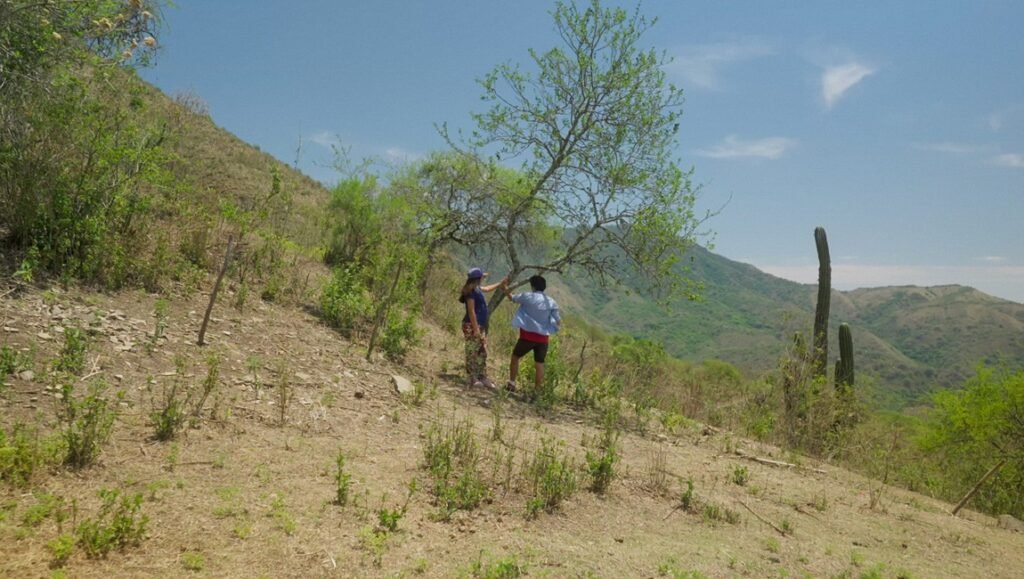
FF: It’s very beautiful. But it’s also very sinister, to be reminded of this constant, buzzing surveillance. How did you go about integrating the pre-existing cell phone footage alongside your own images?
LM: It was inevitable. It was inevitable with all of the different types of materials that we were working with, that we needed to work with in order to build. And what I wanted to make sure I did was not exaggerate or dramatize this aspect of the film. I didn’t want to highlight this. It’s simply a fact that in order to tell a story like this, we needed to collect a diversity of materials. So that decision was simple. In the editing process, I wanted to be simple because I wanted this film to be accessible to anyone that wasn’t necessarily interested in these topics.
FF: It’s interesting to watch in a theater with people, because people really sit up during the trial sequences. These are the, I guess, classically compelling pieces of the film, and certainly the most lurid parts. It made me think about true crime as a genre, and how careful you have to be, as you’ve said, to not render these cases as pure spectacle.
LM: I think what’s interesting with true crime is that the problem is always around truth — who’s telling the truth, what the truth is. But with a film like this, it’s not so much the search for truth but how truth is constructed in a place like Argentina.
And because the problem with history with a capital “H” is that it determines or it pretends to have a specific origin story of our civilization or of a nation that is inherently a myth. It wants to pretend that it’s all fact, but there is no such thing as fact without an opinion, or without a perspective. I don’t want to say it’s always this way, but I think with this film in particular, it’s very much about the construction of truth, and less about the truth itself.
FF: That feels like it accounts for the film’s triangulated structure — you have to deconstruct the truth from multiple perspectives in order to get at what it means, materially and in the world.
LM: Without entirely closing off that process — because that process is never complete — as you deconstruct, you also start constructing something else. So you create certain concepts and tools and forms of questions to get at what happened, and what has caused a lot of suffering in populations in Argentina.
FF: I really admired something you wrote in regard to the film:“fiction is protected from the idea of truth.” Did you find yourself thinking more about “the truth,” given that this is your first “nonfiction” feature, slippery as that term is?
LM: Actually, what interested me and where I started to become more interested about creating a film about this subject was that in this process I began to really understand the way that a country operates in a fiction that is convened, and that we protect. And getting to know the community more pushed me to create this film. In general, I feel like that is what comes from cinema. I think that’s why I think that, today, cinema is even more necessary. We can kind of save the planet with the cinema. People that are in cinema are trained to know that the truth is relative and that many times it’s imposed. And this is what happens when you’re dealing with fiction. So it’s a great time for cinema because we need to deactivate the Western truths that have gotten us here in the first place.
And this may be a terrible, what I’m going to say, but I do think that the governments of Trump and Milei have contributed to making transparent the lunacy of power. There is no longer this discourse of freedom and democracy that is hiding all of the military operations and all of the violence that’s done in its place. There’s no longer a mask. There’s no longer a value system that is invoked in the name of. And for this and many reasons, I think it’s a good time for cinema. Because we start to see power reveal itself for what it is. I think Milei still sort of tries to hide using some of these arguments, but it’s a great shock to me that a president, for example here [in the U.S.], a president can stop using this language and simply show or reveal the nakedness of being able to do all of these operations with no longer needing to hide behind anything.
FF: Maybe by way of getting that bad feeling back to the first question: “Our land” really implicates the audience. Without removing the specific historical context, the film feels like a call to involvement, rather than something distanced, either in spectacle or horror.
LM: I think for it to be this species on a planet, and then to say our land, it really forces us to ask “who?” I think the title in itself, the sense behind it, is really meant as a question, because it’s inevitable to ask, Well, who? Who is this “our?” And who does the land belong to?
Comments are closed.