
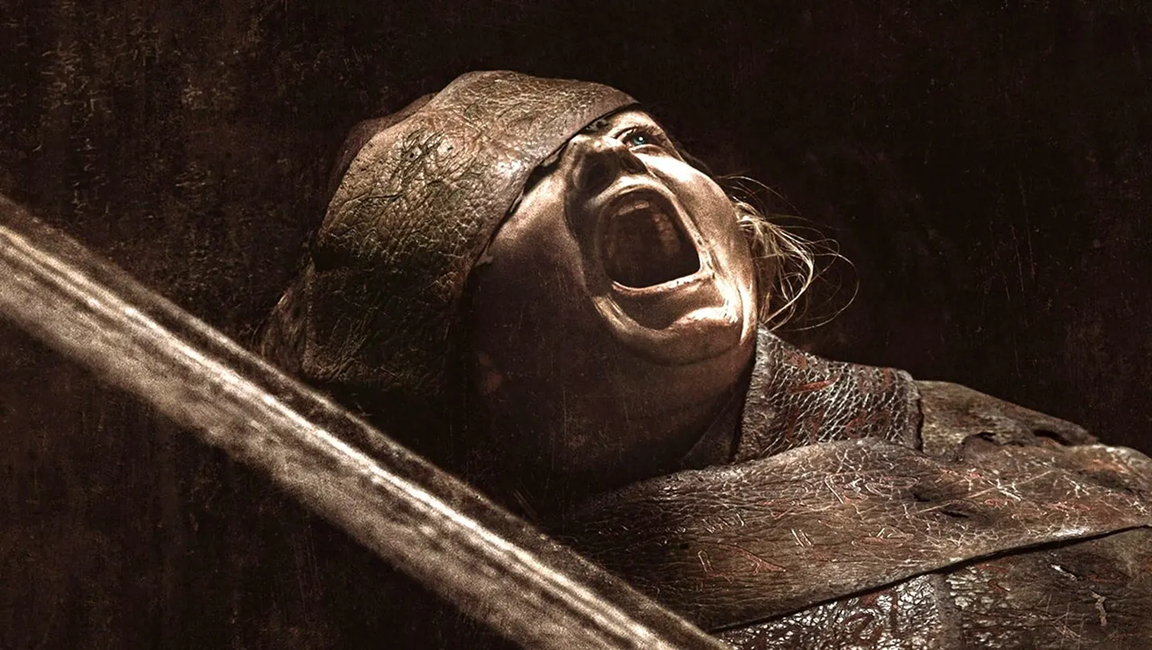
No, it’s not the Brendan Fraser vehicle, nor is Boris Karloff back from the dead; Tom Cruise, mercifully, is nowhere to be found. An original story set primarily in its protagonist’s house, Lee Cronin’s The Mummy is connected to the Universal IP only nominally. Instead, drawing inspiration from a potpourri of seemingly incompatible influences — chief among them M. Night Shyamalan and David Fincher, taking aim at the nexus between the former’s shake-the-rafters populism and the latter’s clinical detachment — Cronin attempts to break free from the spell of The Mummy’s history and strike out on his own.
Like many contemporary horror films, Lee Cronin’s The Mummy is not a fleet machine, and you can often see Cronin’s shadow behind the curtain yanking on massive levers and pulleys, straining to get the gears turning. But turn they do, and after shaking the rust off with a less-than-menacing cold open, he introduces us to Charlie, a TV journalist stationed with his family in Egypt when his daughter Katie is whisked away by an enigmatic and threatening woman. Eight years later, Charlie gets the call that Katie has resurfaced inside of a sarcophagus, severely traumatized. He returns her, wheelchair-bound and abscess-pocked, home to New Mexico to begin the rehabilitation process.
In truth, The Mummy more closely resembles Dr. Jekyll than any other monster, transmogrifying into something shocking, mellowing out into a more modest Mr. Hyde, and then back again. It roves from gross-out horror to Zodiac-style procedural to family melodrama, and the alternating modes tease out a very Shyamalanian emotional thread: what it’s like to carry latent guilt over being the parent to a traumatized kid. The willful ignorance, the compartmentalizing, and the anger that denies the foundational wound — you may have to squint, but seen with your head cocked at the correct angle, Cronin’s approach is a more provocative and heartfelt take on the lingering effects of the school shooter phenomenon than Kristoffer Brogli’s myopic handwringing in The Drama, and it laces the movie with a melancholy many horror filmmakers have forgotten is an essential ingredient to the recipe’s full-bodied flavor.
Meanwhile, back in Egypt, a Detective Zaki has been tasked with helping Charlie uncover the mystery of Katie’s disappearance and subsequent possession. Criss-crossing between Albuquerque and Cairo as Zaki gumshoes her way to some answers, Cronin evinces scale the likes of which is rare for a 2020s horror movie — or American cinema writ large, for that matter. Indeed, we’re more connected as a globe than ever, yet it’s reflected in our art less and less, so it’s welcome to find that The Mummy is refreshingly international. At times, however, the mystery is so doggedly pursued that the horror trappings become something of an afterthought. Demons in the spirit of Raimi and Jackson pop up to shock or frighten us, just to retreat for the Fincherisms to take hold again.
And there are so many points of contact for The Mummy’s style when it does get scary that it’s hard to parse out what Cronin is going for stylistically. He holds a robust toolkit of in-camera tricks, no doubt, utilizing symmetry in his frames, cutting into wide-angle close-ups of feet and mouths, and abusing — truly, honestly abusing — the split diopter shot. But one moment he might cut to something that suggests Cronenberg, Katie looking on at the camera trapped within this body she despises, and in the next she’ll be rising up off her bed à la The Exorcist. It’s good to be well-versed in your cinema history and to deploy your arsenal of references to the fullest extent of their power, but there’s no synthesis to Cronin’s application. The lazy decadence of late-stage horror rears its ugly head by the time the film shambles to its climax, too: an explosive, anonymous action set piece recalling last year’s uninspired The Conjuring: Last Rites exposes the film’s budgetary limitations and enervates rather than galvanizes.
Stumbling, mumbling, and groaning to reach its audience, The Mummy’s assembled parts don’t cohere into anything satisfying. But one can’t deny that they are charming in isolation, and the effort reflects a winsome stab at primetime: while the name above the title may suggest auteurism, The Mummy has blockbuster DNA in its guts and isn’t afraid to peel its skin off to show you.
DIRECTOR: Lee Cronin; CAST: Jack Reynor, Laia Costa, ; DISTRIBUTOR: Warner Bros. Pictures; IN THEATERS: April 17; RUNTIME: 2 hr. 14 min.
Comments are closed.