
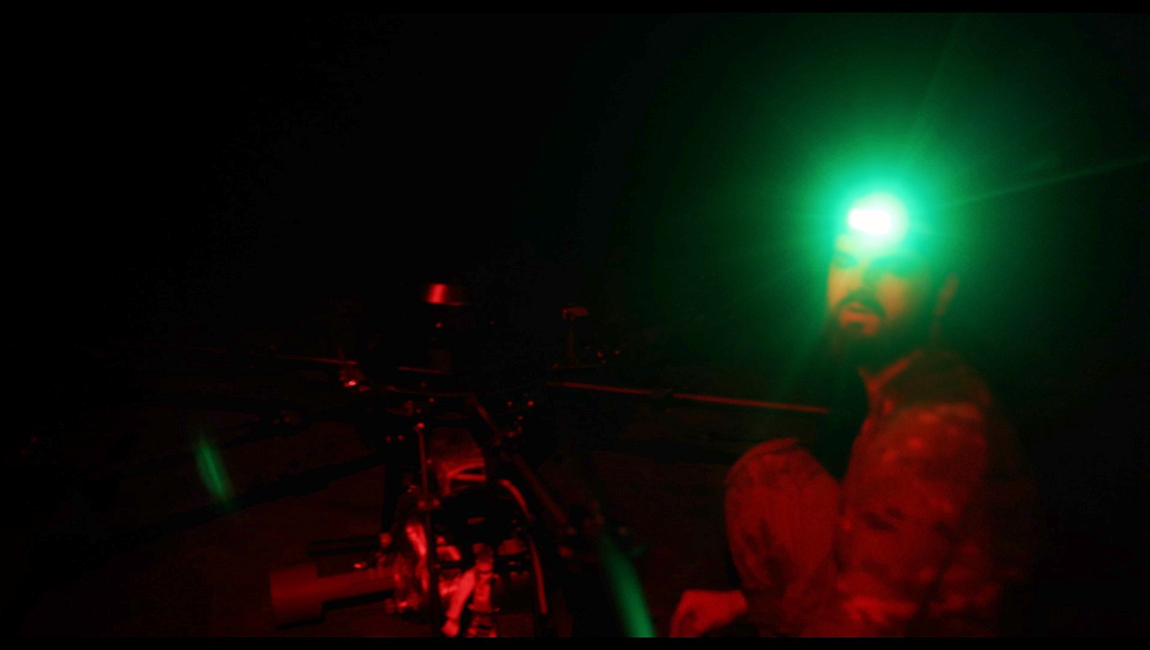
The redundant fatigue from the influx of Russo-Ukrainian war documentaries remedies itself if one begins to recognize their level of artistic excellence. One such effective cure is offered in The Illusion of a Quiet Night by Olga Chernykh, as she dared to embark on a rather ambitious task within the modes of nonfiction: to craft a crowdsourced documentary crammed into a strict temporal frame topped by an additional challenge of wartime routine. Shot during one summer night in late July 2025 by over 40 professional cinematographers alongside hundreds of civilians who submitted their clips via an open Google Form, this 70-minute documentary is a formally versatile and deeply humane voyage across Ukraine, which keeps screaming loudly against the illusions of quietness that the West has grown comfortable believing.
Russian attacks are notorious for mostly occurring in darkness — especially during the summer of the film’s shooting, when the aggressor perfected a ritual of launching at least three hundred drones per night. But the night has plans of its own, as do the civilians, who carry their stubborn adaptability for living out the mundane nonetheless. As the sun sets on panoramas of bustling city centers and rail stations where soldiers depart for the front, the film cuts to a feverish party in a busy club, with acid techno peaking at what would normally be played at 5 AM. A whole country’s worth of farewells, pleasures, and weirdly timed traffic bustles — it’s all crammed into whatever darkness falls before curfew sends everyone home at eleven. This emotional counterpoint — lurching between the melancholic, the frightened, and the festive — is the rhetorical register the film sets from the outset and dwells on throughout. It might be a formal necessity for any mosaic documentary at its core idea, but it is also exactly what life four years into a full-scale war looks like. The collective portrait here is about the rough coexistence of sentiments and events, bipolar in its vibe and seemingly uneven — and for precisely that reason so genuine.
Such lucidity owes much to the editing suite of Maryna Maikovska and Kasia Boniecka, who sew together this wildly disparate footage, including but not limited to digital cameras and phones, CCTVs, dashboard cameras, drones, and GoPros. This seamless flow owes much to their trust in associative editing — oftentimes amusing or surreal, if not outright psychoanalytic. Helmetcam footage of soldiers flushing enemies in the thick of combat roughly cuts to a retired veteran in bed, jolting from a PTSD-burdened dream. Thermal-vision footage of wild animals in the woods is cut against a close-up of a newborn’s eyes, equating each in their innocence. These sutures, however jarring, are ruthlessly honest in their revelation of tight unobvious bounds across destinies. The power of cinematic editing serves a larger metaphorical purpose, as by uniting those dimensions it proclaims Ukrainian sovereignty across the full extent of its constitutional borders. Illusion’s geography encompasses Crimea and Donbas, thanks to the bravery of volunteer contributors, risking their lives to provide such footage under occupation.
For Chernykh, the priceless quality of the poor image and the trust in filmic vigor to reach the unreachable grows out of something personal. Some may know her debut A Picture to Remember, which opened IDFA in 2023 and travelled on the festival circuit, collecting compliments for its slightly experimental, multimedial portrayal of feminine generations within her family — herself, her mother working in Kyiv’s morgue, and her beloved Donetsk-based grandmother, whom she sees through the pixelated video calls. An essay film in its optimal function to reflect on trauma and fading memory, A Picture to Remember culminated with Chernykh using a screen recording of Google Maps to virtually reach her grandmother’s doorstep when no physical path to the occupied city remained. The Illusions of a Quiet Night, then, an ever richer kaleidoscopic canvas, is a striking follow-up within her authorship that works as a political statement and aesthetic standout in equal power.
What also charms about the director’s latest is how it tries to resurrect the fragile intimacy of night, as something humanly universal, catching people at their most vulnerable and treating them with tenderness and hope in return. That veteran, first glimpsed waking from his nightmare, returns by the end of the film to step onto the balcony for a cigarette with the woman behind the camera — and as the sunrise fills the frame, she becomes the trusted company he can unburden himself to. What is more, the film dares to capture the simple nocturnal wonders. Early on, we see a woman preparing for labor while her husband paces the room in anxious excitement, and by the film’s end it circles back to celebrate the arrival of a new life. The elliptical tendency became one of the strongest structural signatures of Ukrainian war documentaries, devoted to exposing the renewal and acceptance as an inextricable choice but to push through. The country wakes up and returns to the routine, until the next night of miracles and horrors to come.
Published as part of Visions du Réel 2026.
Comments are closed.