
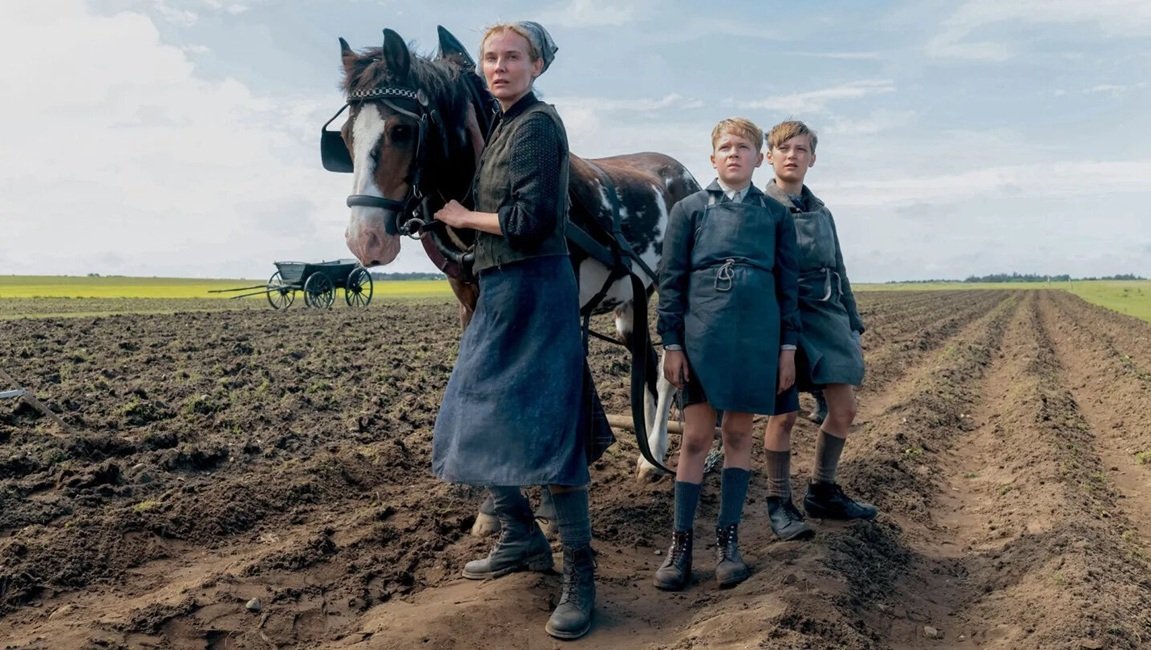
Can there be any reward for tolerance in an intolerant world? Fatih Akin’s Amrum opens with the arrival of German refugees to the titular German Frisian island in 1945, displaced by the advancing Allied troops as the Second World War nears its end. Though its natives’ affinity for their national cause may be patchy, or perhaps drained by the cost of a six-year war on their way of life, these refugees aren’t exactly welcomed with open arms, victims not of national pride but of regional pride. One local boy, Nanning (Jasper Billerbeck), is himself bullied by his schoolmates despite his family’s long connection with Amrum, due to his recent relocation there from Hamburg. Later in the film, some of the child refugees attack and steal from Nanning. His tolerance is of little consequence to these kids, downtrodden and betrayed by their country and their new community.
Nanning is a member of the Hitler Youth, his father a Nazi lieutenant, his mother a party supporter so staunch that, when she hears of the Führer’s death, she refuses to eat or to care for Nanning’s new baby sister. A world in which she has invested all of her hopes has vanished before her, and she wonders what kind of a world will this be in which to raise a child? All she wants to eat is white bread with butter and honey, none of which are particularly easy to come by in this remote place at a time of scarcity. So Nanning determines to source what his mother desires, despite her cruel indifference to him.
This act of tolerance from a young boy, not yet so old as to have allowed his fascist indoctrination to fully shape his moral compass, is quite the test on someone so inexperienced in the ways of the world, not least a world in such turmoil. Akin, working from a script he wrote with the late filmmaker Hark Bohm based on his own childhood on Amrum, confines said turmoil to the psychological and political states of mind of his characters, depicting this world as idyllic and perpetually forgiving in its essence, captured by cinematographer Karl Walter Lindenlaub in limpid, vibrant sunlight and shimmering moonlight. As Nanning strolls along the beach, Akin’s camera observes birds mating and feeding, oblivious to the present political turbulence. “What kind of a world?” Life goes on, and this kind of a world still turns.
With a physically absent father and an emotionally absent mother, Nanning must find a place for himself, in this place that has only been home to him for a short time. His quest, far more fraught with difficulty than one would normally expect of a hunt for bread, butter, and honey, is an act of a service for another, but eventually becomes a formative act for himself. Through his interactions with locals of various ages, characters, backgrounds, and political leanings, he learns about himself through learning about his own history, other people, and what he’s capable of. It’s a coming-of-age story in quite a classical style; Bohm’s straightforward compassion softening Akin’s edge, though some of the director’s more aggressive qualities show through in certain shot compositions and editing decisions. The blending of their styles is effective, perhaps due to Akin’s reverence for Bohm’s story, giving its sentimentality a little roughness — one scene, where Nanning’s visit to the mainland results in a disturbing discovery, is an especially memorable one, inviting reflection on the value of life and death at a time of momentous, imminent societal change.
Akin maintains a slight distance at even the most dramatic moments, his non-judgemental observance allowing for freedom of interpretation. We don’t wallow in Nanning’s mother’s misery; rather, we question its causes, how this person has come to be so spiteful and fearful. We don’t scorn the refugees for their act of theft; rather, we ruminate on how one ignominy after another has driven them to inflict ignominy on an innocent boy. The empathy that this distance imbues in the audience is essential — our protagonist is someone who can recite the mantra of the Hitler Youth on command. Unlike most coming-of-age narratives, however, his innocence is not lost the more he discovers, but gained, summoned from a sense of self he’s likely never known, and which his society (and immediate family) has never fostered.
For a filmmaker who’s never been shy of courting controversy, this slow, simple, and sympathetic story is an unusual one for Akin, its most controversial aspect arguably being its sympathy. But the hope it harbors for Nanning, that one can find a route out of an intolerant world through practicing acts of tolerance at any cost, is persuasive, most so when Bohm appears in the movie’s final image as an older Nanning, just as Nanning has heretofore appeared as a younger Bohm. Whatever reward the boy may receive for his efforts in finding and making his mother the bread, butter, and honey is beside the point. The reward he receives is more pertinent, and more personal — whether he yet knows it or not, he’s rewarded himself.
DIRECTOR: Fatih Akin; CAST: Jasper Billerbeck, Diane Kruger, Kian Köppke, Laura Tonke, Hark Bohm; DISTRIBUTOR: Kino Lorber; IN THEATERS: April 17; RUNTIME: 1 hr. 33 min.
Comments are closed.