
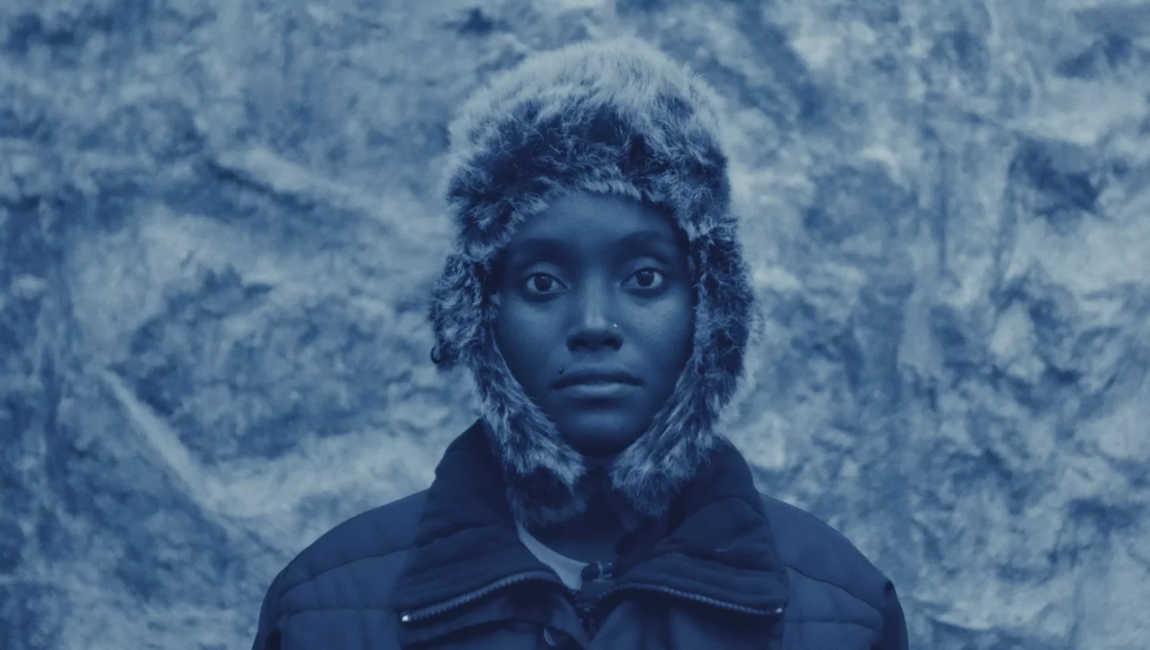
Jacqueline Zünd’s documentary Heat takes place across the Persian Gulf, one of the hottest spots on planet Earth today. Though not because of the ongoing war in Iran ignited by America, but quite literally: temperatures in these areas exceed 50° Celsius, and survival there is becoming increasingly unbearable under escalating global warming, already striking the people of these regions first. Swiss filmmakers certainly have an affinity for environmental docs, whether due to generous funding opportunities or a rather privileged geopolitical position in the absence of pressing crises. Yet in Heat, Zünd sidesteps the infamous risk of sententiousness within the subgenre, offering instead an exquisite and, to its benefit, alienated aesthetic excursion into the sensory experience of climate change.
Not much time has passed since the last edition of Locarno, where Zünd’s previous narrative film Don’t Let the Sun premiered, a futuristic drama about the crisis of interpersonal relationships under the climate collapse, whose landscapes are as sunburned as human faith in a better future. The director developed this film in parallel with Heat, and this reciprocity is quite vivid. Continuing her directorial dialogue in a dystopian tenor, here reality itself provides the accord. Heat emerges as a fictionalized 86-minute documentary that moves across the landscapes in the Gulf states, combining them into a kind of singular diegesis. It observes grandiose and deserted city sights, while abruptly registering the routines of several protagonists, and the way they desperately and inventively confront the temperature. The approach is visually immersive and structurally asynchronous, layering people’s off-screen factual testimonies and more anxious bordering-on-existential questions.
Among the most memorable figures is a woman introduced crying in her car, heartbroken over the suffering of stray cats. Upon learning about an emerging business that delivers big ice cubes to households, she manages to obtain some for the animals so they can enjoy cubes’ cooling vapor and drops of fresh water. The shot of nearly a dozen cats circling this melting cube is nothing if not bizarre, and the film’s nonfiction stance renders it harrowing. Moving across its protagonists of varying occupations, Heat unmistakably exposes class inequalities, now further intensified by something as basic — and yet increasingly luxurious — as air conditioning. Another protagonist, a delivery worker whose face remains defiantly obscured by his helmet, notes that restaurants are increasingly reluctant to let him enjoy air conditioning while he waits for orders. At some point, an off-screen voice asks: “What will happen if the electricity cuts off?” — a chilling inclusion that amplifies the tension of such suffocating panoramas.
It is arresting how a climate documentary can be so haptic, as Heat makes one genuinely feel its title. Zünd’s trusted collaborator, cinematographer Nicolai von Graevenitz, delivers expansive vistas filled with the toxic yellow layer of the Khamsin — the path of an extremely hot, sandy, dry wind — charging the shots with a phenomenological quality of heat radiating from the land and the incandescent surfaces of skyscrapers under blinding sunlight. The dystopian ambience, constructed through static wide shots — often psychotically symmetrical and eccentrically prolonged — productively evokes a disturbing sense of absence: of people in the streets, let alone hope for change. However, toward the end, as Heat returns to each protagonist, drawing closer to their homes and personal lives, it slightly loses this delicate balance of docufiction, ultimately relinquishing its earlier cynical restraint and yielding instead to a more humanistic proximity it had not initially promised.
Still, this sensorial approach at its essence leaves behind something enlightening. Returning to its Gulf setting as an overarching symbol, now overgrown with new connotations, the film suggests that, rather than presenting dry facts, the distribution of the sensible might be a better tactic for environmental documentaries competing for attention amid the urgency of war narratives on the festival circuit. Yet while the latter continue to multiply and escalate, the former are more often met with bitter unease than the sense of dire urgency required to provoke action.
Published as part of Visions du Réel 2026.
Comments are closed.