
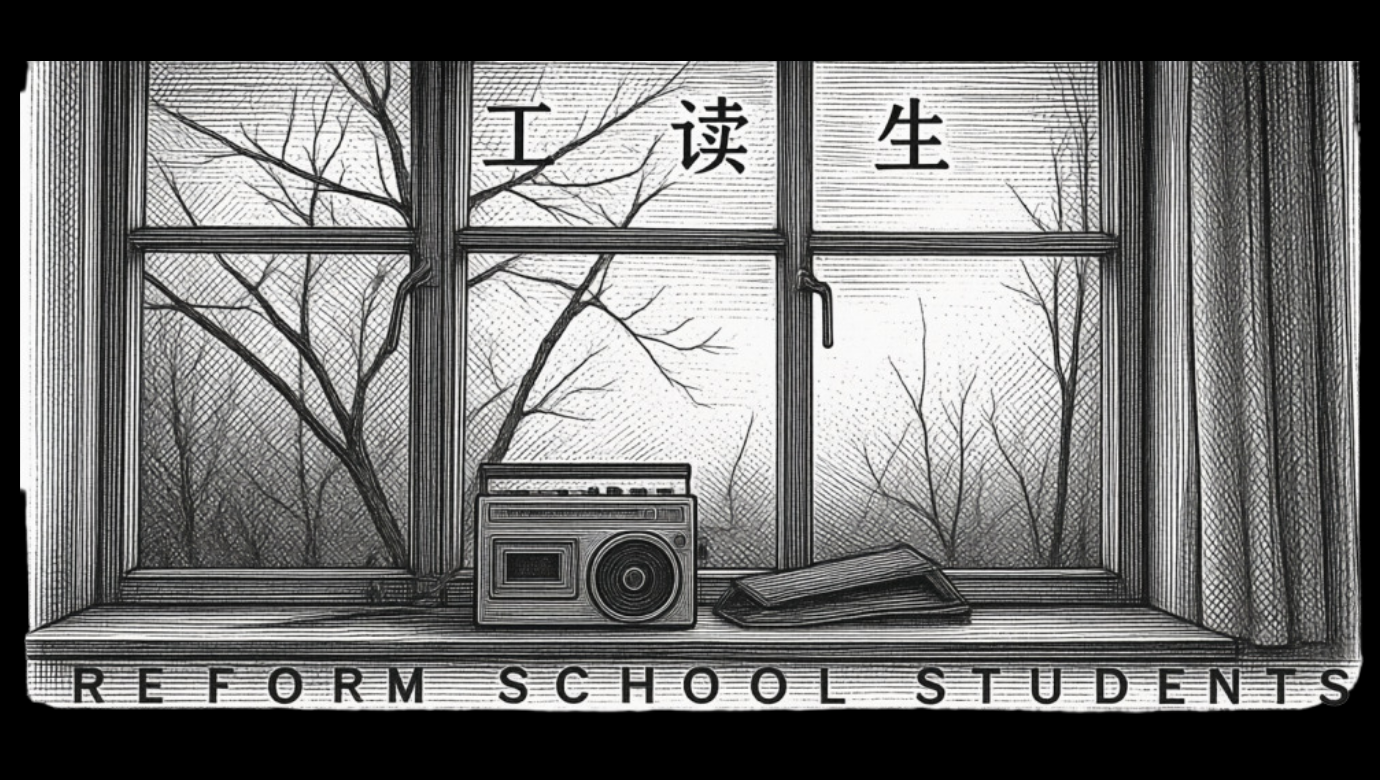
In some respects, the “officially sanctioned” of the SWYC Collective’s productions — it was scheduled for broadcast in China, before it was pulled by its makers — Reform School Students is a fascinating conundrum of a project. As the first part of the series takes great pains to explain, “reform school” plays a very specific role in Chinese education in the ’90s, one that most citizens seemed determined not to understand. Reform schools were for students who had gotten into some kind of trouble that made it impossible to attend China’s standard high schools. This trouble sometimes involved theft or violence, but other times it just came down to excess truancy. The one constant, however, is that these were students from challenging home environments. They were mostly poor, and some of them were orphaned. But in broader society, the dominant assumption about reform school students was that they were “bad,” and this created a stigma so severe that many would never be able to escape the cycle of poverty that put them there in the first place.
The first 20 minutes or so of Reform School Students entails the filmmakers, Wang Zijun and Wang Lan, talking with teachers and administrators, trying to find out if any students or parents would consent to being interviewed on camera. During a raucous faculty meeting, the teachers explain the catch-22 that binds the project, as well as their own careers as teachers. A documentary such as this could go a long way toward removing the stigma of reform school.
But in order to accomplish that, some people would have to be willing to come forward and put their reputations on the line. At first it appears that the whole project is a nonstarter, and after the meeting we hear Wang Lan explain that they don’t think it’s going to work. (We see a night shot of driving on the highway, scored with Kenny G.’s “Going Home,” China’s national “business hours are over” anthem. It almost implies that the Wangs are just giving up and heading back to the office.)
Gradually, the Wangs are permitted to conduct interviews and observe lessons. Certain facts about these students and their families begin to emerge. Many were the children of “sent-down” parents, forced by Maoist policy to leave the city to live and labor among the rural peasantry. Many sent-down women were forced into marriages or subjected to sexual assault. But the primary impact of this policy was a radical deskilling of a large swath of urban youth who were then destitute because they were unemployable. As we also learn when Reform School Students focuses on one young woman, Liu Yongmei, in its final chapter, a great many girls born in the countryside were killed, including her own older sister. To survive, Liu and other were sent away for adoption.
The upshot of this is that the reform school experience is necessary to attempt to repair the ruptured families and home life that were a direct result of the policies of the 1950s, ’60s, and ’70s. This explains the complex psychological origins of the reform school stigma. It is easier for the culture at large to blame these young victims — branding them as “bad” or “antisocial” — than for post-Mao society to come to terms with the generational damage wrought by the Cultural Revolution. Not unlike the American tendency to ignore the lasting impact of slavery, it is more convenient to presume that those who have been systemically underprivileged must have done something to bring the situation upon themselves.
Part of what is so startling about Reform School Students is the awareness of this generational oppression that the teachers and administrators bring to the discussion. They of course cannot openly condemn Mao’s policies, but they consistently refuse to hold these young people responsible for circumstances they did not choose. It is quite close to a Wisemanian institutional critique, and as such it is rare to see it addressed in a documentary that managed to exist through official channels.
Although most of the rest of Reform School Students avoids undue self-reflexivity, ceding the stage to the students, parents, and teachers, we are constantly aware of the subjective position of the filmmakers. In particular, Wang Lan’s slow, deliberate narrative emphasizes a desire to carefully walk the viewer through this complicated emotional and sociological minefield. It also emphasizes her own process of learning and discovery. Each chapter begins with data drawn from school files, detailing the backstories of various students who have moved through this system. Their names are changed, but we are assured that the facts are true. This provides us with context that would not always be evident simply from observing the students in their environment. Reform School Students attends to the specific lives and challenges of the students onscreen, while reminding us that they are metonymic examples of a much wider crisis.
As one watches Reform School Students, one notices certain tonal commonalities with SWYC’s Earth Day series Only One Earth. That program is bracing in part because of its faith in the viewer and in the power of images to illuminate. Its underlying optimism verges on naïveté, but is also rather revelatory because of the complete lack of cynicism, worlds away from the contemporary sensibility of ironic desensitization. Similarly, the tone of Reform School Students can strike the viewer as awkward in its credulousness. The students’ words and actions are generally taken at face value.
The second part of the series focuses on a thematic presentation by the girl students at one school, based on topic, “in a bad world, only a mother is good.” It is an agonizing presentation, in which the girls, many of them estranged from or rejected by their mothers, read pleading confessional statements, apologizing for their bad behavior or expressing a desire to do good and return to the fold. Throughout these statements, we are shown tears streaming down the faces of the mothers as well as the teachers.
There is nothing inherently deceitful about this segment, but it fails to account for the complex family dynamics in play, and the different levels of psychological damage within those dynamics. We know that the students do not want to stay in reform school, and we know that they are there in part because their parents were unable or unwilling to deal with them. So it is not unreasonable to expect that these confessions entail some performative element. (This assumption is even more reasonable when one considers the Maoist tradition of “self-criticism,” wherein politically incorrect subjects were forced to articulate their ideological failures and promise to mend their ways.) Part of what is so valuable about Reform School Students is that it frankly addresses the ruptures in these young people’s lives, and the difficult healing process, while also permitting the viewer to question exactly what it is we are witnessing.
After all, if these students are lying, or if their mothers are pretending to renew their parental commitment because the cameras are present, this offers us access to a different level of truth, one that speaks not only to the acknowledged failures of the individuals involved, but to the deep and lasting damage caused by Mao’s social engineering. What’s more, it provides a clear picture of the gendered nature of poverty and familial dysfunction. While the girls are given this forum for overt reconciliation, the boys are subjected to stricter, more militarized discipline, on the assumption that it takes force, not emotion, to make them proper men.
This, of course, only provokes more deception and more shame. In the third part, when the Wangs and a school administrator go to a factory to highlight a “success story,” a reform school graduate who is now a highly placed executive, they discover that the factory is closed, and no one has ever heard of this man. The business card he sent to his old teacher was little more than wishful thinking on both their parts. Where traumatized girls are “reformed” through tearful melodrama, we see over and over again that boys who have experienced nearly identical traumas have no place in Chinese society, and can only survive by disappearing completely.
Comments are closed.