
Although cinema is at its best when it gleefully breaks the rules, some operating procedures need to be in place when you embark upon an airplane-crash disaster movie — or a schlocky shark slasher for that matter. When up in the air and suddenly urged to fasten your seatbelt, the 747 should be piloted by a captain you actually care about, or at least populated by enough endearing passengers whose explosive demise feels more like a tragedy and less like a statistic of the faltering aviation safety procedures Nathan Fielder dissected in his mind-boggling The Rehearsal. Once at open sea, the crashed souls should then be more than a mindless walking buffet for bloodthirsty killer sharks. Otherwise, the toothy terror requires a degree of personality — yes, even sharks need personalities — that instills a deeper sense of dread lurking beneath the surface.
At first glance, Renny Harlin’s grand return to glorious B-cinema fails on all counts. His Deep Water is a plane-crash-cum-shark-snacking genre spectacle with a rocky take-off, populated by cardboard characters that inspire little confidence in the violent extravaganza soon to follow. Blame is easily assigned to a small legion of six (!) screenwriters, who presumably pieced the script together by committee, turning it into an untrustworthy Ryanair flight that probably wouldn’t pass a routine aircraft safety inspection. But leave it to the director of late-night syndicated TV-broadcast classics like Cliffhanger (1993) and Deep Blue Sea (1999) to squeeze some real juice out of stale material. Once Harlin has weathered the initial turbulence, Deep Water is truly his plane to pilot. With elite-level mastery of CGI and some nifty practical effects on display, he steers this mid-budget genre fare produced by Gene Simmons — indeed of Kiss fame — toward a more kinetic thrill ride, with occasional moments of brutal transcendence.
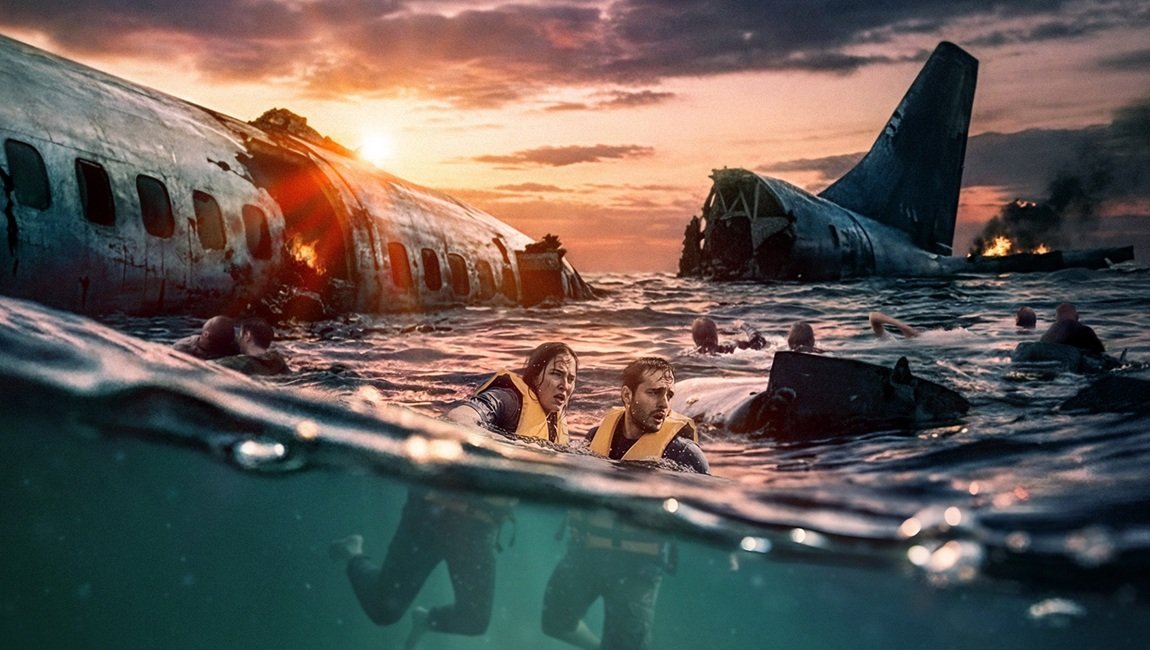
The clockwork precision with which an airplane breaks midair recalls the brilliant pilot episode of Lost (2004 – 2010), an critically underrated series if there ever was one and secretly one of the most important audiovisual works of the 21st century. Here the airbus is also suddenly transformed into a depressurized tin can, turning the carbon-fiber-reinforced plastic hull into lethal shrapnel that indiscriminately shreds through the passenger list. The narrative conceit of Deep Water is that the plane’s virtuosic discombobulation results in completely scrambled subgroups of survivors, hanging on for dear life, sans loved ones, in open waters. And that’s, of course, where the sharks strike with a, well, strikingly linear brutality. It’s admittedly funny that a violently horny couple leaves their infants behind in an attempt to join the Mile High Club. The fact that the abandoned children are soon after surrounded by sharks and without their parents is, however, painfully meaningless, as it’s hard to see these kids as actual people and not just as walking and talking plot devices. More meaningful is how meaningless the rest of the cast of characters is: geriatric ladies with an iPad and a Facebook addiction, a Chinese e-sports team embroiled in a naive romance plot, a generic American sports jock, and a handful of flight attendants are a far cry from the saved souls who survived a crash landing on the Hudson River in Clint Eastwood’s postmodern opus Sully (2016) or the guilt-ridden cannibals of the harrowing Society of the Snow (J. A. Bayona, 2023).
Thank god, one beacon of light emerges from the torn fuselage in the form of Aaron Eckhart, who, after assisting Sully‘s Tom Hanks toward post-disaster catharsis, easily slips into the role of the heroic co-pilot once again. Sitting next to what seems like a hologrammed Ben Kingsley, Eckhart’s typecast appearance at first glance feels uninspired. But once the completely redundant Kingsley has finally departed, Eckhart’s Ben is allowed to step into the limelight to skillfully ground this messy spectacle. His muted yet headstrong performance personifies a kind of 20th-century all-American dignity Eastwood wittily deployed in his humanist masterpiece, and he here serves as the only emotional life raft for all these forgettable characters drifting around the film as floating manflesh for the white death. This is what Harlin actually does best. If you can make a wistful mourner out of Sylvester Stallone with the mountaineering bonanza Cliffhanger, you can propel a tremendous actor like Eckhart to even greater heights.
His desperate rescue mission is also the only way we can even begin to care about the sharks swarming around the ensemble cast. Their relentless hunger occasionally hits, but more often than not it merely results in transforming an anonymous character into a slightly more anonymous pool of red in the deep blue sea. After the gleeful destruction of the crash — one that sits nicely next to Sam Raimi’s recent and more consciously pulpy Send Help — Harlin plays the monster-movie bits relatively straight, which feels like another dead end the film inevitably runs into. Deep Water is by no means a meme-ified faux-film like Sharknado (2013), but it’s no Jaws (1975) or Deep Blue Sea either. Harlin’s earlier shark film had its own share of absurd moments — never forget LL Cool J as a chef crawling in his own oven — to winkingly acknowledge its pulp pedigree, and yet it carried a physical weight to the way the calculated killer sharks laid siege to the doomed research facility. The veracity of the images Harlin produced at the peak of his genre auteurship was also palpable in Cliffhanger and, of course, in his quite spectacular airport-centric Die Hard 2 (1990).
Deep Water sorely lacks such convincing imagery. If anything, the film is exemplary of an era of filmmaking in which digital renders and pre-viz sets eat away at a type of authenticity genre films heavily relied on. To put it bluntly, Harlin was a master of movie-movies, self-conscious entertainment that was often silly but to some degree felt real and genuine. In contrast, the floating wreckage of Deep Water, surrounded by a vast shark-infested ocean, mostly resembles the conscious artifice of Life of Pi (2012), minus the philosophical framework that made Ang Lee’s digital experimentation sing. While the occasional kinetic pleasure of the aircraft crashing midair is still felt, the disastrous aftermath mostly betrays an apparently misplaced trust that B-film cinema can still deliver the adrenaline-inducing equivalent of bracing for impact and hoping for the best.
DIRECTOR: Renny Harlin; CAST: Aaron Eckhart, Ben Kingsley, Angus Sampson, Lucy Barrett, Molly Belle Wright; DISTRIBUTOR: Magenta Light Studios; IN THEATERS: May 1; RUNTIME: 1 hr. 46 min.
Comments are closed.