
Watching Resident Evil, I thought about choice, the force that presents differently in video games and video game adaptations. In the former, a spectator-player chooses where they go, and thus, what they see. In the latter, we watch or we don’t, but we can’t, Deckard-like, choose to go into or out of an image. Blessedly, this long-running pas de deux is complicated. For all the free will the player of games exerts over the avatar, they’re ultimately at the mercy of a designed world and all its ensuing tasks and levels, to say nothing of cutscenes. One cannot just watch a video game unless it’s being played by someone else. But then, what separates the full game playthrough video from the cinematic one? Crouched in a dark childhood bedroom while a friend navigated Resident Evil: Code Veronica on her Sega Dreamcast, I was every inch the cinematic spectator at the mercy of another’s image instincts. One always has the benefit of a few fingers splayed haphazardly over the face. “If it gets too real,” Jane Schoenbrun reminds us, “you can always turn it off.”
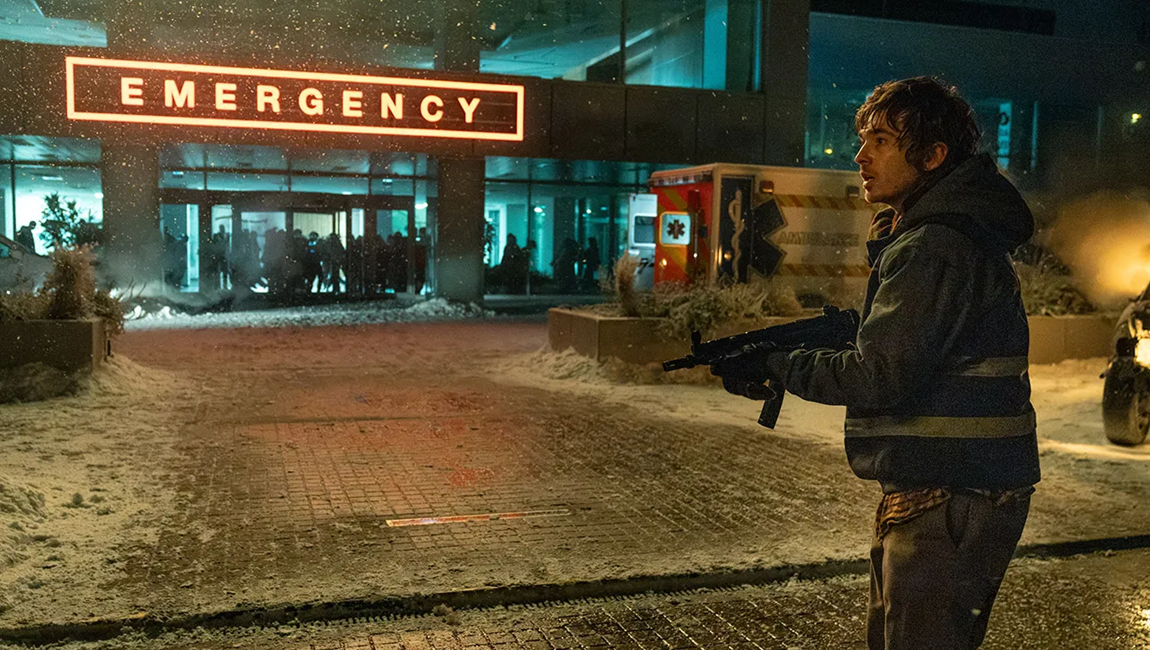
With Resident Evil — the new film co-written and directed by Zach Cregger — I often put my fingers over my face. I sometimes wanted to turn it off. It’s a film occupied by choice, a byproduct, I think, of being a little obsessed by its own relationship to being a “video game adaptation.” After making the last delivery of his shift, medical courier Bryan (Austin Abrams) elects to take on one last job, despite the drop-off being somewhere “up in the mountains,” despite not having a car equipped for winter weather, despite his girlfriend’s voicemail alerting him to their surprise and unplanned pregnancy. My RE bonafides are sparse — outside of peeping Code Veronica, I played 4 on GameCube and enjoyed a few of Stephani Danelle Perry’s paperback adaptations — but even I knew to shake my head when the destination of Bryan’s high-priority medical package is revealed to be “Raccoon City.” Sure enough, en route and swerving, Bryan slams into a woman of strangely hearty constitution skittering across the snowed-over road. His choice to follow her trail of blood into the woods, armed only with a phone’s flashlight, reminds us how a hallmark of horror cinema is the spectator’s vocal disagreement with their onscreen avatar’s tendencies — I wouldn’t do that. When Bryan ushers the chattering and bloodied woman into the passenger seat, we all sigh, knowing what comes next.
Despite presenting basically as a Kevin Smith protagonist so far — Bryan’s first reaction to the unwelcome pregnancy news is a mostly demur “your body, your choice” — this decision to drive his victim to the hospital indicates that our avatar for Cregger’s Resident Evil vision is probably fundamentally decent. It’s not an incidental character quirk: Weapons (2025), Cregger’s last feature (and the one whose success cemented the now standard “film by Zach Cregger” label), had a strange moralizing energy. Its chorus of characters was each of them neatly cucked by their own moral opposite: an elementary school teacher flailing back off the wagon, a hearty swagger-dad impotent in the face of his own son’s abduction, a police officer who can’t help harming people. A terminally ill witch undoes their brittle façades, steals the children from their community, and is summarily, bloodily undone when her weapons turn back on her. This is, maybe, how the soft violence of the American suburbs moves. Barbarian (2022) was the first sign that Cregger had fully morphed from sketch comic (he cofounded The Whitest Kids U’ Know) to horror auteur, and it operated along lines of similarly moral metaphor, if less over-ambitiously. There, the urban decay of Detroit reflects the rot of historically perpetuated sexual assault, the latter souring the earth of the former. In both of Cregger’s previous works, comeuppance comes for those who deserve it, mostly sexual predators and monsters. That both earlier films also have a lot of blood to spill from those experiencing addiction, homelessness, or inhabiting an aged woman’s body made for an unsettling aftertaste, and not always because of an excess of viscera. It was as if Cregger the writer of bits couldn’t fully forsake the punchliner’s capacity to keep going.
Resident Evil moves with clarity, in its story beats and camera swings. It’s handily Cregger’s best-looking film: once Bryan’s nighttime accident attracts a sheriff’s cruiser, the director and cinematographer Dariusz Wolski use their snow setting to bounce ample police reds and blues around, a little Bava, a lot of negative space from which something gnashing could emerge. But the film’s structure — wherein a scrambler slacker historically consigned to the background of moving (video game) images must use his limited wits to survive an increasingly bleak situation — allows for the further propagation of that previous moralizing line. Every decision, we start to understand, yields progress or promises death. Cregger and his collaborators have adeptly translated many aspects of Resident Evil gameplay into a cinematic container — Bryan hunts for scant bullets, trades in his weapons for increasingly larger guns, peeks around corners, apprehending what awaits. POV shifts to flat out replicate a first-person shooter, the barrel of a gun poking into the dim surroundings. But more than merely its aesthetics, it seems like Cregger sees in this reproduced video game logic confirmation that narrative unwinds in binary. This Resident Evil is a testing ground for the moral soul running through it.
For instance, for avoiding a hit-and-run, Bryan is rewarded with relinquished custody of his most-definitely zombified passenger, and it’s the mustachioed cop who’s driving her around when she warms up enough to take a bite. Following the flashing lights as a hopeful escort to Raccoon City, we watch the police car flip, the zombie running in full tilt from the dark corner of a frame (an image quickly becoming a visual crutch for Cregger), the bumbling courier desperately struggling while grunting relatability as quips. “Oh,” he says. “Fuck FUCK,” he says. “Interesting,” he says, watching two dismembered zombie bodies pull themselves together by emergent tentacles. It’s been reported that Cregger cut many of the script’s jokes based on early audience feedback, but the final cut maintains an aversion to taking itself too seriously. In Barbarian, at least, Long gives a deliberately comic performance in a universe whose sense of irony expressed itself equally in absurd humor and dread. That Resident Evil aspires to treat its characters and audience with genuinely cruel regard is refreshing in theory, but its scripted tics and dalliances with cuteness feel uncalibrated. Taken on their own terms, fantastically terminal images — as in Resident Evil: Afterlife (2012) — indicate something about how we see our eschatological times. Indeed, most of Anderson’s experiments in Resident Evil are about how images turn and return, how readily we commodify them. They are lessons in respawning. Here in 2026, bleakness coupled with bits is like showing off at the apocalypse.
As Resident Evil pushes its “I’m not even supposed to be here” hero into increasingly nightmarish situations, I thought less about other slick night odysseys like After Hours (1985) or Good Time (2017) and more about Disney’s Pinocchio (1940). That film, too, pits an unwitting boy against a woggling world, one of increasing darkness but that protests to be run along a moral line. “Prove yourself brave, truthful, and unselfish,” the Blue Fairy cautions, “and someday you will be a real boy.” Quickly realizing that his mysterious package is essential to stopping whatever is forcing people to not only zombify but evolve and devolve with reckless spurting and gooping, Bryan doubles down on his playthrough quest. If he acts with similar bravery, doesn’t tell a lie, and delivers his glowing vial to a cadre of scientists waiting for him atop a burning skyscraper in Raccoon City, maybe he too can walk away from one long night’s work a little transformed.
The road-show format of Resident Evil showcases a host of impressively gnarly creatures, and one must applaud Cregger and his collaborators for coming up with some real nasties. (The less said about a sewer sequence and what rodentry awaits the better.) In Cregger and co-writer Shay Hatten’s adaptation, whatever is unleashed on the public mutates its victims with little scripted explanation. When Bryan finally gets to the burning Raccoon City, a harried suit from the Umbrella Corporation (Paul Walter Hauser) explains to Bryan that somebody made a mistake, that some evolutionary formula their scientists were developing got out and started messing with the populace’s bodies. But even as the script doesn’t labor to explain Umbrella’s gene follies, the forms its myriad nasties take clearly echo something inherent about them: an ex-watchdog splits its head open to reveal tentacles and teeth to drag you in, a former hospital patient belches up some noxious radioactive sludge, and the once lone woman Bryan hit with his car accumulates limbs and flesh to become a rolling, snapping, metaphoric thing haunting and hunting the beleaguered courier. Late in the film, shouting down at the limb-thing an apology for hitting her (it) with his car, it becomes clear that the bone-lean runtime and chippy, chirpily nasty tone have not alleviated Cregger’s penchant for slickness. When the last thing standing between him and his delivery is a blood-caked maternity ward, it’s revealed that the horror at the heart of Resident Evil isn’t the zombified corporate malfeasance of Paul W.S. Anderson and Milla Jovovich’s visions, but a kind of sub-Eraserhead anxiety over growing up and finally becoming a parent. It’s not exactly subtle: a few scenes earlier, Bryan tearfully records a voice note as a message in a bottle for his phone-wife. He regrets his “your body, your choice” first reaction. He’s ready to have a child with that offscreen girlfriend. He wants to be a real boy, to have a real boy.
Surely, Resident Evil is not a political film. That it stumbles — briefly and inadvertently — through territory at least adjacent to daffy pro-lifeism seems more a failing of thematic execution than any desire to stake that earth. Its avatar is, after all, a slacker who struggles to articulate his desires, who claims all he knows about guns he got from video games, who triumphantly exclaims “video games!” when he finally gets one good shot off late in the film. That success is short-lived, even as Bryan finally reaches the top and delivers the crucial vial — the last part of a theoretical antidote — to a few harried lab coaters. He’s navigated a night from hell so well. But he didn’t tell the scientists about the bite he sustained from — who else? — the little girl he stopped to try and help. He did not disclose his blackened tentacle of an arm. The last punchline is that our would-be final guy didn’t walk the moral line all the way to the end, and so gets subsumed by the horror. His nose (and everything else) growing, a maw, too many eyes, a cyclone of digital viscera, Bryan is finally the metaphoric man-child monster. He ends the film infected and mutating, and rather than Anderson’s xerox apocalypses, we get a stunningly self-absorbed jab at what fate awaits those arrested and un-final boys. It’s not an observation about anything much really, so much as it’s one last bad joke.
DIRECTOR: Zach Cregger; CAST: Austin Abrams, Zach Cherry, Kali Reis, Paul Walter Hauser, Johnno Wilson; DISTRIBUTOR: Sony Pictures Releasing; IN THEATERS: September 18; RUNTIME: 1 hr. 30 min.
Comments are closed.