
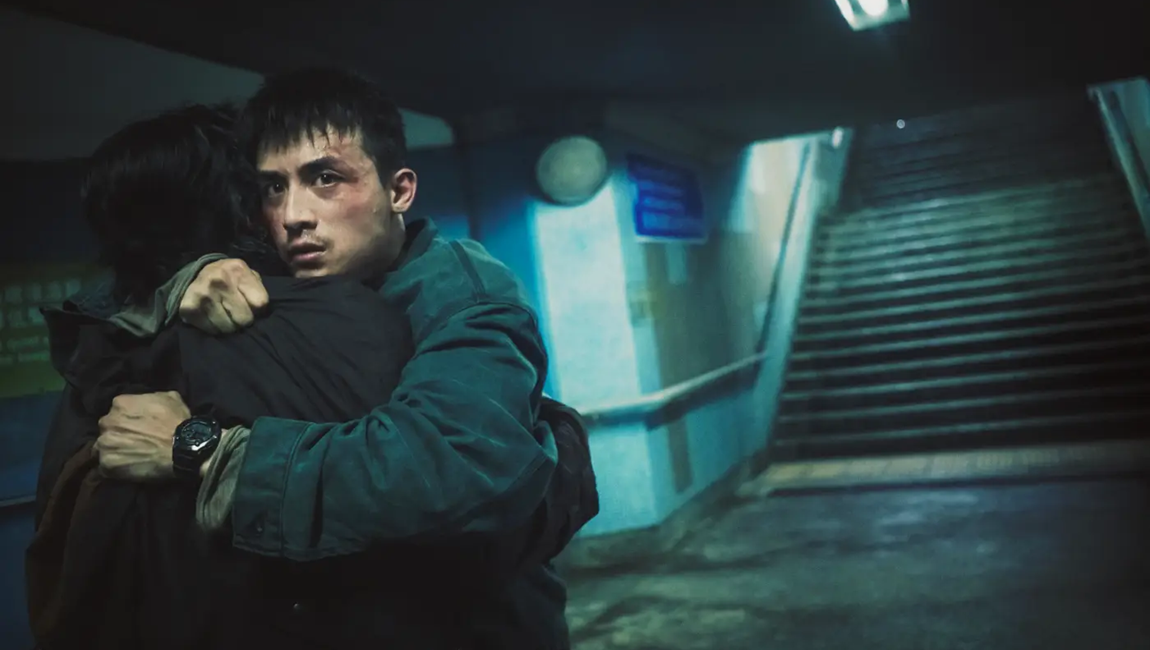
Though Western cinephiles are likely most familiar with Herman Yau through the grisly Category III shockers he made with Anthony Wong (Taxi Hunter, The Untold Story, Ebola Syndrome), the director has always been a filmmaker who plays in the bigger pool. Even in the ‘90s, his filmography included plenty of comparatively anodyne mainstream entertainments alongside his angrier cinematic howls. The ratio was never quite “one for me, one for them,” but over time, and especially in the decades since Hong Kong’s handover to the mainland government, the scales have tipped even more in favor of “them.” But among the Ip Man biopics and Andy Lau action blockbusters, Yau still occasionally manages to make smaller, angrier, more personal films, even if, as is the case with We’re Nothing at All, he has to finance and distribute the movie himself.
The inciting incident of We’re Nothing at All comes across as knowingly subversive for a filmmaker whose output has been increasingly concerned with computer-generated explosions. On Valentine’s Day, a double-decker public transit bus explodes and retired forensic investigator Lung (Patrick Tam) is asked to assist the police with picking through the rubble to solve the case. The charred remains of the bus are surrounded by the far-flung corpses of the deceased, and Yau lingers on melting, eviscerated flesh — not to gawk, but to reflect on the human toll of an event, giving the lie to the action violence of his lightweight mainstream efforts. From the scattering of body parts and the size of the hole, Lung is able to determine where the bomb went off and which of the deceased was responsible. Later, after bodies are identified, two remain unclaimed. Then, in flashback, these two — already identified as the perpetrators behind this attack — take center stage, and the film takes the shape of a slow-motion tragedy.
Ike (Ansonbean), a busking sketch artist, meets Fai (Anson Kong), a construction worker, when he draws him on a basketball court. The two begin a romance, with Ike moving into Fai’s rented room when his family kicks him out of their home after he comes out as gay. As the film goes along, Ike and Fai disclose histories of surviving abuse, all while facing violent homophobia and the indignities of poverty. Each man attempts suicide at one point. Meanwhile, in the present, Lung continues his investigation, unearthing his own personal connections to the case. We’re Nothing at All can be relentless in its accumulation of misery, and the effect is often suffocating.
It would be wrong, however, to identify Yau’s film as misery porn, as the filmmaker resists the urge to aestheticize or ennoble the suffering on display. There are no pretensions toward art. This is a social issues melodrama in bleak but honest form, centering two characters we are asked to empathize with even as we know their final act to be heinous. Yau can neither justify nor explain their final act, inspired by a real bus bombing in 1998, but he seeks to understand the larger social tragedy that can lead to flashpoints like this. Why does homophobia remain so rampant in a supposedly progressive society? Why, in an apparently economically ascendant Hong Kong, does the underclass endure unreasonable working conditions for little pay? Whatever is endured by those whom society casts off is the responsibility of the greater population, and tensions inevitably explode.
Yau’s approach also has its drawbacks as well. Those looking for nuanced queer representation are probably better off searching elsewhere as, despite the pop star leads’ strong performances, there’s not much to these characters beyond what is inflicted upon them. And the funereal monotone can sometimes feel like a cudgel. We’re Nothing at All is raw and messy, an imperfect movie that offers no easy solution to its anger. But that Herman Yau can improbably still find time and money to make hard-to-like movies like this is something worth celebrating.
Published as part of NYAFF 2026 — Dispatch 1.
Comments are closed.