
There’s a spectrum of certain psychologically- or chemically-rooted qualities that most people who participate in extreme sports must have in order to succeed. But others, to be blunt, just seem… dumb. For every Alex Honnold with a clinically diagnosed underactive amygdala, there’s a George Mallory, climbing Everest “because it’s there.” The historical accuracy of Mallory’s quote aside, there are certain athletes who don’t appear to think about their endeavors beyond ticking another box off the first-to-do-it checklist. As you read this review, Ash Dykes is preparing to navigate the Congo Basin in an inflatable kayak as part of six “challenges” he plans to complete in the next year. When these athletes — some perhaps better described as survivalists — succeed, the “why” question typically fades into the background, overshadowed by the impressive quality of the feat. But when things go wrong on these expeditions, that why often becomes sole focus of the discussion.
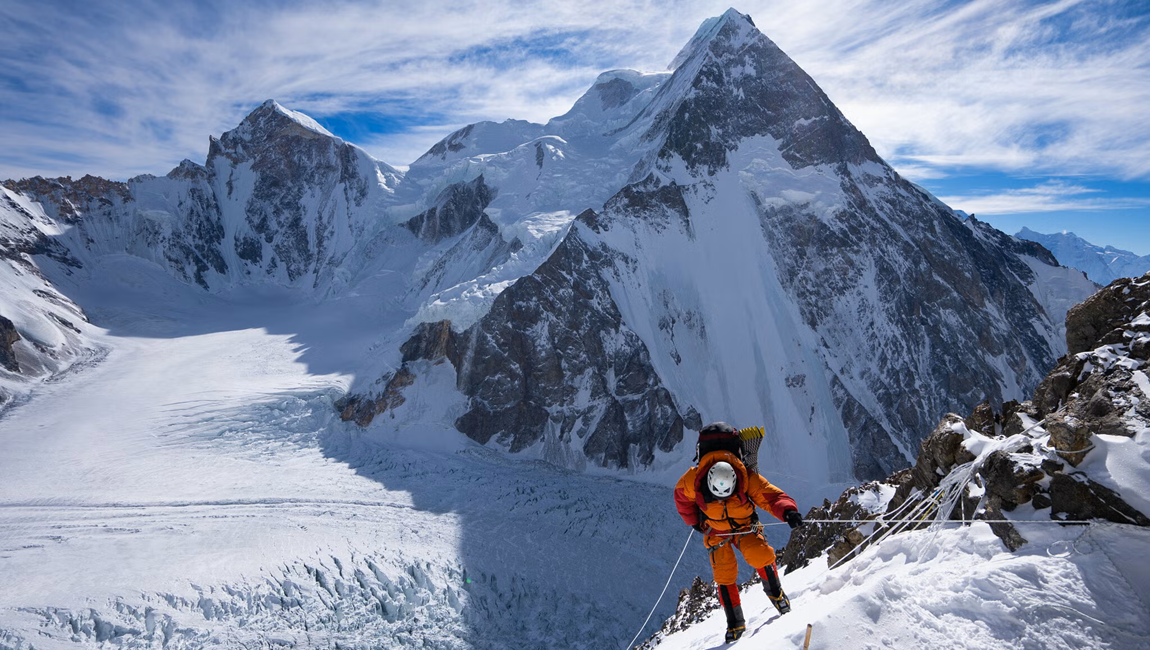
A few thousand miles away from Dykes’ “ambitious” effort, on the border of Pakistan and China, sits K2, the second-tallest mountain on Earth. Mountaineers are quickly running out of firsts to claim, so they’re getting more creative. In the 2020-2021 season, multiple groups set out to summit K2 in winter, a feat rarely attempted and, at that point in history, never accomplished. K2, unlike Everest in the late ‘90s through today, has not historically been a tourist destination. There aren’t established camps, ladders, fixed ropes, or multiple companies to choose from to guide you up the mountain. When John Snorri Sigurjónsson, Ali Sadpara, and his son Sajid Sadpara began their attempt that year, they were essentially alone on the mountain — but not for long. In The Last First: Winter K2, director Amir Bar-Lev details the series of events that led to the accomplishment of that last first, and the chaos that came in its aftermath.
While Snorri and the Sadparas were the first to arrive on the mountain, they were quickly joined by Seven Summits Treks (a commercial climbing company), influencers, and a contingent of world-famous climbers from Nepal, including Nirmal “Nims” Purja. Much like the well-known story of the 1996 Everest disaster, the combination of these people on a mountain much less equipped for such a crowd only foreshadowed disaster. The first glimpse of what’s to come can be seen in the quick devolution of the collective, as Nims — who after arriving agreed to work with Snorri and the Sapdaras — decides that he and his crew deserve to claim the first for Nepal, in honor of the Sherpas who’ve supported countless Westerners in achieving glory while being overshadowed. For a while in The Last First, then, we play witness to conversations and debates in cramped tents about who deserves the summit, as the famous adventurer gasses up his crew with patriotic speeches, until it’s clear there’s no going back — for better or worse.
Nims and his team ultimately reached the summit of K2 first on January 16, 2021, but the other climbers, having already spent weeks preparing, decide that they will make the attempt anyway. In the early days of February, Snorri, Ali, and Sajid, as well as a contingent of other climbers that included professional mountainees as well as the amateurs led by Seven Summits Treks, began making their way from base camp to the summit. A series of tragedies followed over the next few days, ending with Snorri, Ali Sadpara, and others dead.
As with the aforementioned Mallory quote, stories about what actually happened on K2 that winter vary. Bar-Lev is less interested in teasing the story for suspense than he in interrogating what led to this tragedy, in both a micro and macro sense. Sajid, who had turned around near the summit because of an issue with his respirator and left his father and Snorri to continue, survived, and it’s through his lens of his grief that the film posits the question of who was to blame for the deaths on K2. There’s discussion of the Seven Summits Treks crew causing the traffic jam because they brought inexperienced climbers up the mountain with no preparation and not enough guides, while others speculate that Nims’ team potentially cut the ropes that they strung to prevent others from being able to follow their accomplishment (despite Nims’ threat to do precisely this, it was later proved false). Or is the simpler answer that this is a mere inevitability, a byproduct of the deadly marriage of extreme sports culture and those with too much money and not enough people telling them no?
While Bar-Lev doesn’t necessarily answer the question outright in The Last First, it’s not hard for viewers to conclude that it was the combination of human stupidity (perhaps even a unique development of late capitalism) and Mother Nature’s unforgiving sting that led to the deaths. Talking heads with others who were on the mountain during the season, family members, and experts in the field lob opinions back and forth, swaying viewers this way and that on where ultimate blame lies. And while not necessarily offering the most profound argument, the debate does at least punctuate the film and prevent a tidy ending, making it somewhat more memorable and meritorious than the countless other climbing documentaries that have hit streaming in the wake of Free Solo.
But beyond the implicit weight of this larger conversation it raises, The Last First mostly settles in as rather standard adventure documentary fare. The true story itself doesn’t require much embellishment to be compelling, and Bar-Lev includes the required sweeping shots of the Karakoram range, but in our saturated era of 4K nature-centric documentarianism and with so many true-life exploits available to watch, no singular image or cascade of gorgeous interstitials will be enough to set a film like The Last First apart from the competition. In other words, there’s a clear ceiling to a film like this, on far lower than a mountaintop. For those content to take in the glory of starkly beautiful vistas while a drama- and tragedy-rich narrative plays out via low-ambition narration, there are far worse documentaries to take in. But in the absence of a more fully formed study — be that of the ethics of commercial mountaineering, the psychological excavation of extreme adventurers, or the majesties remaining to us in the age of climate collapse — there’s a a very clear ceiling to a film like The Last Winter, far below the mountaintop it depicts.
DIRECTOR: Amir Bar-Lev; DISTRIBUTOR: Apple TV; STREAMING: October 2; RUNTIME: 1 hr. 38 min.
Comments are closed.