
It’s hard to ignore the feeling that Małgorzata Szumowska and Michał Englert’s The Idiot(s) hates its subjects. The film purports to chronicle the events around Fyodor Dostoevsky’s writing of The Idiot, arguing that Dostoevsky’s wife, Anna Grigoryevna Dostoevskaya, played a more critical and creative role in the novel’s writing than she is often given credit for. It’s a noble endeavor that would be worthwhile or artistically and intellectually valuable were it not for the simple fact that the film’s directors and writers get the facts egregiously wrong. In an effort to offer a feminist reading of the past, in an effort to be radically incendiary like Sofia Coppola’s Marie Antoinette and Wash Westmoreland’s Colette, The Idiot(s) lapses into a bad-faith revisionism that travesties Dostoevsky and, paradoxically and by extension, dishonors Anna Grigoryevna, for the simple reason that it loses grasp of her story — her passions and concerns and loves. Neither Fyodor nor Anna deserve this.
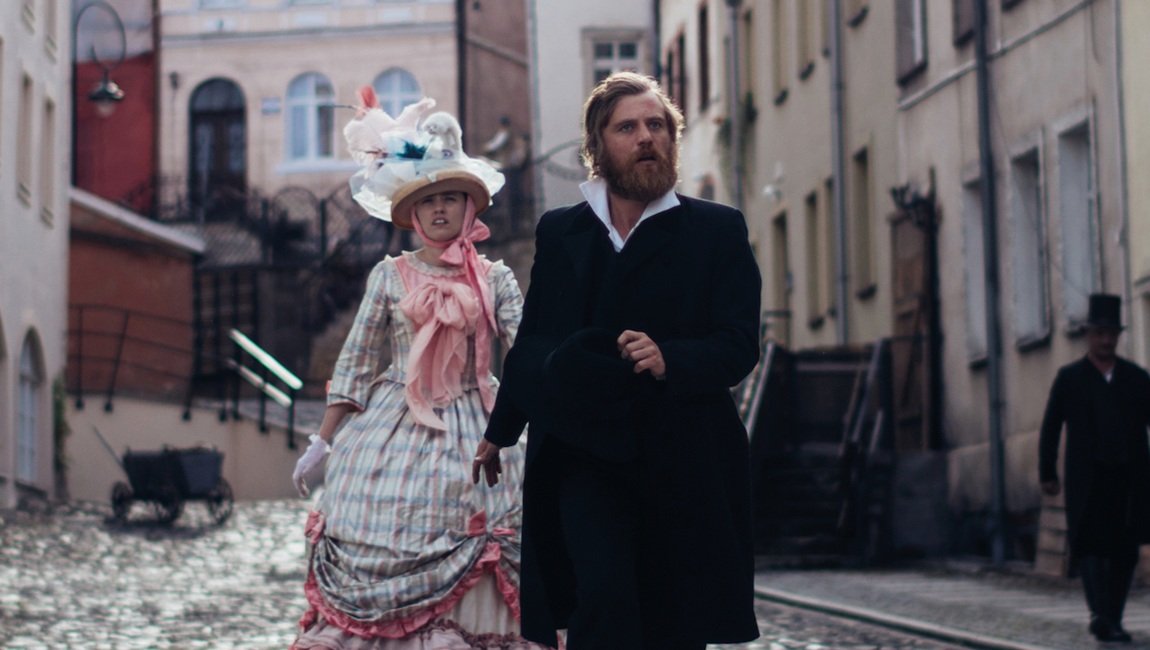
Johnny Flynn plays Fyodor and Aimee Lou Wood plays Anna. Anna was, and is in the film, Dostoevsky’s assistant and stenographer, and throughout the marriage grew increasingly in charge of the couple’s finances — this the film depicts with meticulous care. The couple are in Switzerland in effective exile from Saint Petersburg due to the enormous gambling debts Fyodor incurred while in his home city. (The historical Dostoevsky’s creditors filed charges against him, causing him and his young wife Anna to remain abroad for four years, from 1867 to 1871.) Fyodor hopes to write The Idiot abroad and mail chapters to his publisher, slowly making back enough money to guarantee a safe return home.
But Flynn’s Fyodor has trouble writing and can stay focused neither on his writing, nor on Anna, nor the need for work — he is constantly losing sense of the dire financial straits the Dostoevskys are in. Because he won’t write, Anna takes it upon herself to draft the first few chapters of The Idiot, mailing them off in secret, because she can’t trust Fyodor, and receiving enough money to keep the two afloat, again, in secret. The Idiot(s) instead argues that Fyodor is so carried away by gambling, is so busy indulging his senses among the well-to-do people of Switzerland, that Anna has no choice but to construct the foundational bones of The Idiot herself. Fyodor was such a drunk, gambling, and adulterous lout that he didn’t have the time to write, meaning that Anna is actually responsible for one of the world’s greatest novels. On the road to this ambitious argument, the film also suggests that Dostoevsky faked his epilepsy, falling to fits when the optics of sickness might absolve him of responsibility, did not have a serious understanding of his gambling addiction, and that he did not acknowledge the work that Anna did for and with him.
It would make for a commendable and courageous story were it not attempting to mirror fact, an attempt that in comparative relief renders the story a cowardly, cruel, and contemptuous thing. That is in no way to argue that Dostoevsky was a perfect man of unblemished morals, but it’s not hard for one to loudly argue for his mind, his care for his work, his aching sensitivity, and his love for Anna. That is also not to suggest that Anna played no creative part in the writing of The Idiot, but the suggestion that Dostoevsky himself played no part in the story’s writing is enough to leave me one beside themself with anger. It would be exhausting to pick through every instance of cruel revisionism this film deals against Dostoevsky, the extent to which it goes to render the writer a callous and deleterious enfant terrible who let his genius go to his head and thought himself above work after earlier successes. It would be much more worthwhile to recall The Idiot itself, a book so beautiful and sad and trembling with love that it feels a mighty tragedy that Szumowska and Englert don’t care enough to engage with it at all, don’t even seem familiar with it.
For the filmmakers, The Idiot offers mere plot points, a means by which Fyodor can make enough money to get back to gambling. The film doesn’t realize the work Dostoevsky put into his art, the amount of time spent thinking and forming logical and spiritual bases, all so clearly and amply evidenced in his letters to his niece and colleagues and in Anna’s memoirs. Prince Myshkin’s name is hardly uttered in the film. For one completely unfamiliar with the book, this film offers nothing by way of expressing the book’s aching autobiographical nature, how precious a matter it was for Dostoevsky to pass his epilepsy on to one of his greatest and personally beloved fictional characters, a soft, sweet man, overflowing with so much love it becomes naive, it becomes dangerous to himself and to others; instead, the film suggests that the writer faked his epilepsy.
“For a long time now I’ve been tormented by a certain idea,” Dostoevsky wrote to his friend, the poet Apollon Maikov. “But I’ve been afraid to make a novel out of it, because the thought is too difficult, and I’m not ready for it, though it’s a thoroughly tempting thought and I love it. The idea is — to portray a perfectly beautiful man. Nothing, in my opinion, can be more difficult than that, especially in our time.” To want to do an idea such justice that one becomes afraid to create, because it is not yet time, because one is not yet ready for the grandness of the idea, for the task at hand — this is such a beautiful and complex artistic experience, worthy of much exploration, and yet this film neglects, utterly refuses, to countenance it.
It’s such a tragedy that The Idiot(s) believes the man who actually articulated this feeling — this apprehension of doing justice to the task of portraying a perfectly beautiful man, which The Idiot does with preternatural grace and care and psychological perfection — to be too much of an “idiot” to harbor it in its filmic landscape; it’s such a tragedy that this film would believe Dostoevsky to be so completely indifferent to his own creation as to neglect writing the first few chapters. Again, the only word that comes to mind is cruel — this film is cruel for suggesting that Dostoevsky didn’t care about The Idiot.
It’s well-known now the painting that captivated the writer — Anna wrote about it with great detail, because she and Fyodor made a special stop to view it. “On the way to Geneva we stopped for a day in Basel, with the purpose of seeing a painting in the museum there that my husband had heard about from someone,” Anna writes in her memoir. It is Hans Holbein’s “Christ’s Body in the Tomb,” which depicts Jesus just after having been taken down from the cross — for all intents and purposes, a dead body. Dostoevsky was captivated by the painting because it had the power to shake a person’s faith — how could this dead body ever be resurrected, how could one come back from such a brutal and horrifying death? “The painting made an overwhelming impression on my husband,” Anna writes. “And he stood before it as if dumbstruck. […] When I returned some fifteen or twenty minutes later, I found my husband still standing in front of the painting as if riveted to it. There was in his agitated face that expression as of fright which I had seen more than once in the first moments of an epileptic fit. I quietly took him under the arm, brought him to another room, and sat him down on a bench, expecting a fit to come at any moment. Fortunately that did not happen.” Here we have a person exhibiting love for another, love enough that she guides him to a safe place, seats him, and is relieved when he does not have a seizure.
This moment — of Dostoevsky seeing the painting — does appear in The Idiot(s), but in starkly different and cruel tones. It’s sandwiched within a montage underscoring how exhausted Wood’s Anna is by Fyodor and his emotional extremes. The couple goes into the museum, Fyodor sees the painting, the lens zooms in onto Christ’s hand — which is sticking out its middle finger, the film turning here to grotesque humorous effect — and then Fyodor collapses into a seizure while Wood’s Anna struggles to pin him down, clearly exhausted and unimpressed. “F[yodor] admired this painting,” Anna writes tenderly in her memoir. “Wishing to have a closer look at it, he stood on a chair, and I was very afraid he’d be asked to pay a fine, because here one gets fined for everything.” This tender love, this seeing of a loved one, acknowledging their passion, understanding their desires, is horrifyingly spun by this movie to resemble a harried wife looking after her childlike husband.
It’s not hard to understand what The Idiot(s) is trying to do — it is trying to express that behind every successful man there is a hardworking woman who is overworked and underappreciated. This would be a perfectly fine point to make were the film also not infantilizing one of its subjects and depicting the other as worldweary and exhausted and wishing she were anywhere but near Dostoevsky, as though she had been forced into a bad marriage. The historical Anna made choices, had agency, and was creative; she worked, laughed, observed, collected, and intellectually sparred with her husband. She was dynamic. But The Idiot(s) depicts her solely as reluctant caretaker to a bumbling, stupid, drooling man, one whose work she does for him because he is just that useless. Though the historical Anna had her own passions, in this film she is able to write The Idiot with ease; in this film, her only passion becomes Dostoevsky, taking on his person, as opposed to being the full person she historically was. The Idiot(s) denies Anna the ability to be her own person. Despite this, there is a world where this particular version of the story, given the right handling, would have made a fine movie, a respectable one even, if only it didn’t pretend to care about fact, about historical people and the truth of their lives. But as it stands, The Idiot(s) is tone-deaf, cruel, stupid about its subject matter, utterly forgettable as historical drama, and not worth any sensible person’s time. Read Dostoevsky instead.
Comments are closed.