
It would be an exaggeration to call Julia Loktev’s previous documentary, My Undesirable Friends: Part I – Last Air in Moscow, a smash hit. Clocking in at nearly six hours, it was always destined to be a niche production. But a funny thing happened. Following its world premiere at the 2024 New York Film Festival, many around the world found Last Air in Moscow to be something along the lines of a criminal procedural. Through her intimate verite portrait of independent, opposition journalists in Russia, Loktev shows the screws of fascism being tightened in real time. Putin always made it difficult for these journalists to do their job, and it was clearly dangerous. But with the invasion of Ukraine, these “undesirables” were immediately marked for arrest, or worse. They did their jobs, feeling that things were bad but not unlivable, until suddenly they were forced to flee their homeland.
The sad fact is that fascism is on the rise all over the world, and Last Air in Moscow provided a kind of glimpse into how, slowly but inevitably, it takes over all aspects of life. The film won numerous awards and was picked up by MUBI for streaming, and in a sense its inadvertent prescience has heightened interest in the sequel. Once you “escape” fascism, what happens next? Part II – Exile picks up immediately where Last Air ended, with the various journalists moving from country to country, attempting to find a place from which to resume their efforts. Russian media is on a total blackout apart from state propaganda, which means that organizations such as TV Rain, the independent news channel outlawed by Putin, remain resolved to deliver true reports about war crimes and destruction in Ukraine. Over the course of Exile’s six hours, the channel reestablishes itself in Latvia, runs afoul of its state media regulators, becomes a YouTube-only entity, just to eventually end up working in the Netherlands.
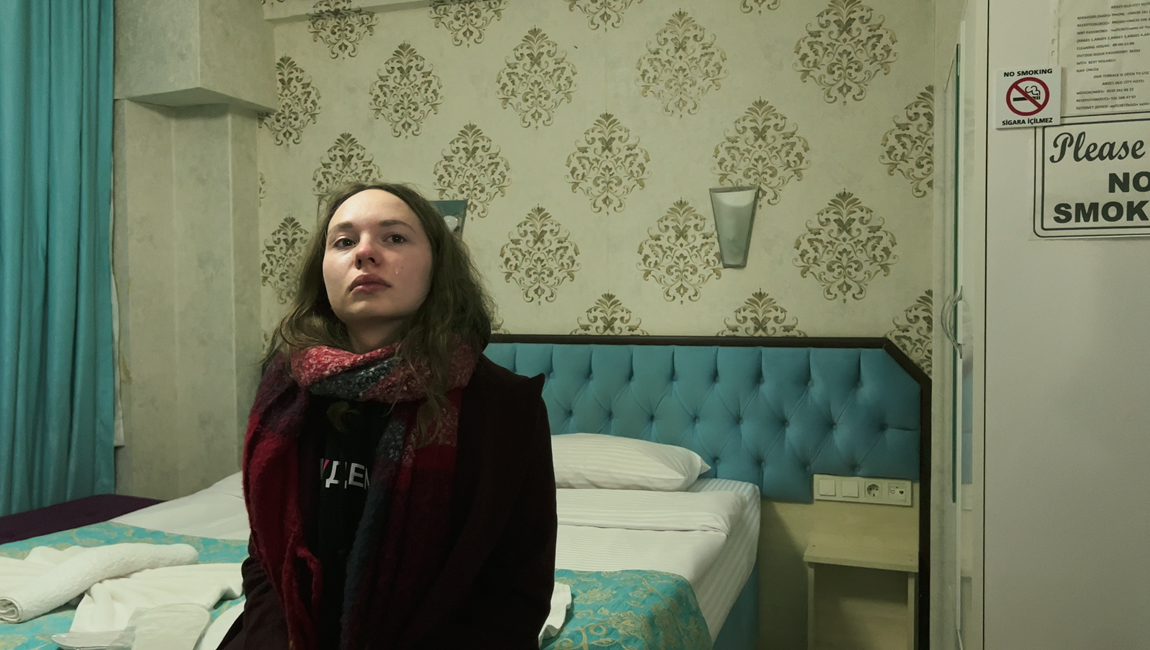
But TV Rain and its fortunes are but one thread in this complex global narrative. Exile is about diaspora and dispersion, as the tight-knit group of friends and colleagues are forced to various parts of the world: Georgia, Czechia, Austria, Israel, the U.K., and, for some, the United States. All of them must continually start again with nearly no resources, trying to eke out a living while producing world-class journalism in cramped, temporary lodging. But they remain at risk. One writer, Elena Kostyuchenko, was poisoned while in Berlin. And two of the women living in Prague — Irina Dolinina and Alesya Marokhovskaya — discover that Putin has operatives all over the world. They are safer than they were in Moscow, but they will always be looking over their shoulders.
Where the real-time developments of Last Air in Moscow often made it seem like a riveting drama, that same sense of immediacy can sometimes feel frustrating in Exile. This is because viewers know all too acutely how things are going to turn out. When a few of the reporters express a firm belief that the invasion of Ukraine will be over in a couple of months, it speaks to the limitations of on-the-ground analysis. But when others who are facing prison sentences actually consider returning to Russia to do their time, as Navalny did, it can be difficult to refrain from shouting at the screen as if you were watching a horror film. Loktev inevitably addresses this in the final chapter, when the world learns of Navalny’s death in prison. It is shattering for these young people so committed to the anti-Putin opposition, but one gets the sense of something larger dying within them. Many of them speak of being able to return “home” one day, holding out hope that Putin’s regime won’t last forever and that a different Russia, one committed to democracy and human rights, is still possible. We eventually see that hope extinguished, and several of the journalists begin to wonder whether their work has any purpose at all. (In fact, one reporter, Peter Ruzavin, quits journalism to join the Ukrainian Army.)
Over the long period covered by Exile, Loktev chronicles the last vestiges of a kind of alternative Russia, one kept alive through resistance and also through narrative. These dissidents believe that they carry the true nation in their hearts, and that one day they will see the triumph of truth, reason, and love. But the flipside of this counter-patriotism is that they see themselves as partially responsible for Putin and the violence against Ukraine. As Russian citizens, it is their nation that is perpetrating these crimes, and they take that responsibility seriously. At times this can be a reflexive sort of tic in their rhetoric, as someone will complain about having no money or no place to live, and then quickly state that Ukrainians obviously have it worse, and no Russian can see themselves as a victim.
But we hear this rhetoric a lot less as Exile goes along. One of the reasons TV Rain’s license was canceled by the Latvian government was that a couple of on-air personalities, including TV Rain’s best-known journalist Anna Nemzer, referred to Russian military forces as “our army.” This acceptance of guilt was paradoxically taken as a sign of disloyalty to Latvia, under whose governmental auspices Rain had been reincorporated. As their lives in exile continue, as these reporters face more hardship, they seem less concerned with apologizing for themselves, although none of them ever claims victimhood. And once Navalny is killed, a certain patriotic undercurrent in their spirits seems, if not to snap altogether, to at least become less pronounced. Many of them finally grasp that Russia may never again be their home, and to some extent it maybe never was.
This is of course analogous to the rise of Trump and MAGA in the U.S., something that was indeed implicit in Last Air in Moscow but that Loktev openly addresses in Exile, if only briefly. One wonders how one’s neighbors, family members, or loved ones could invite this kind of open authoritarianism into their society, and when faced with this dilemma, one can and should fight. But is it really “the nation” that is worth fighting for, or is that a big part of the problem? Patriotism is so easily twisted into jingoistic chauvinism, and it can be difficult to keep struggling to love a country that tells you in no uncertain terms that it does not love you back.
DIRECTOR: Julia Loktev; DISTRIBUTOR: MUBI; IN THEATERS: October 9; RUNTIME: 5 hr. 55 min.
Originally published as part of NYFF 2026 — Dispatch 5.
Comments are closed.