
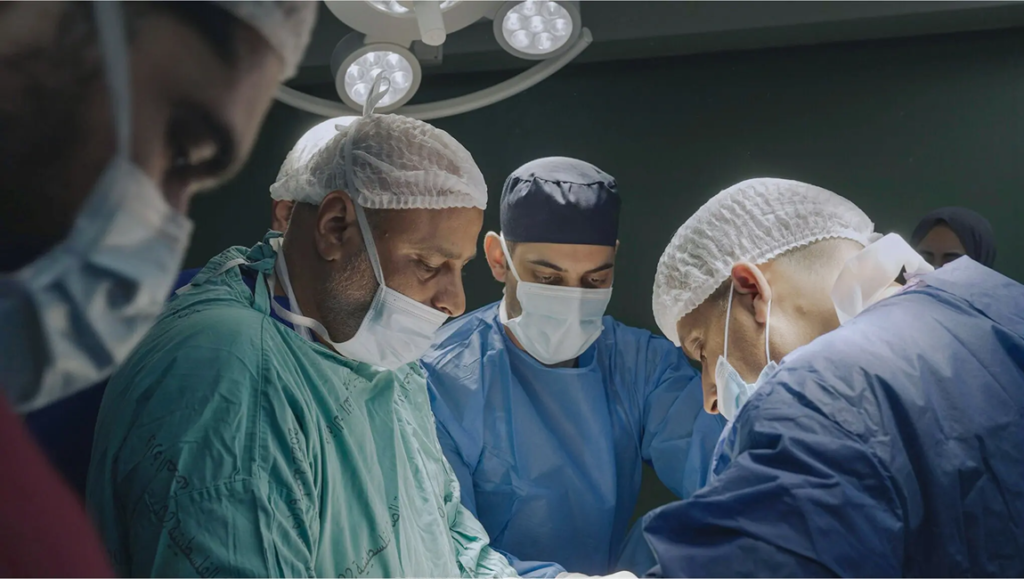
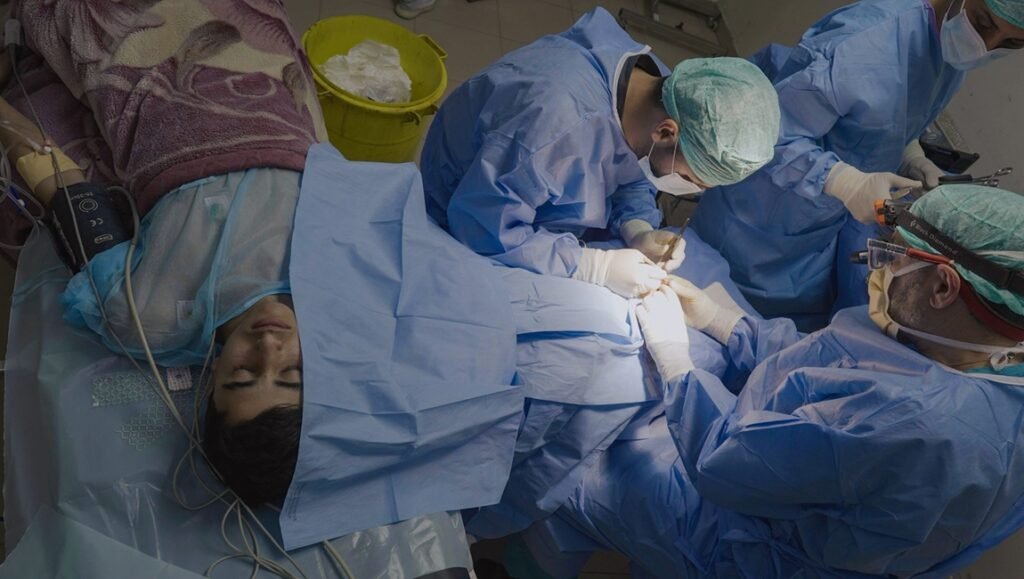
Imagine operating on near-dying people every day in the most horrific conditions. Droves of broken bodies arriving at your hospital after mass bombings of civilian infrastructure. Knowing a priori that many will not survive the procedure, while realizing that saving their lives does not put them out of harm’s way. Then imagine operating on a person you have already treated once before, because yet another missile strike has found them. And then consider that the very place where you try to save these people has itself become a target for a hostile military force.
Then imagine calling in to American talk shows and news channels, where cowardly hosts coerce you into mincing your words and swallowing your rage. How exhausting must it be to see, time and time again, that the media of your home country, complicit in and actively enabling these mass killings, is unable to call a spade a spade, or, in the case of Gaza, a genocide a genocide? This is the millstone borne by Dr. Mark Perlmutter, Dr. Thaer Ahmad, and Dr. Feroze Sidhwa, the three protagonists of Poh Si Teng’s sobering debut documentary American Doctor.
World-premiering in the U.S. Documentary Competition at the Sundance Film Festival, American Doctor is both a harrowing portrayal of the U.S.-backed genocide committed by Israel in Gaza and a character study of three doctors who risk their own lives to minimize casualties on the ground. It is a documentary suffused with so much urgency that it immediately explains why Teng quit her day job as a creative executive at ABC and raised much of the funds herself to obtain these images from the heart of darkness. And while she is far from a dilettante, Teng’s relative inexperience in the face of such an all-encompassing subject shows itself in transparent of ways. American Doctor‘s painful opening scene gets at the core of non-fiction’s responsibility toward what it makes visible, something U.S. media institutions brutally fail at, revealing how the director is put in her place by Perlmutter, who urges her to include even the most horrific imagery in uncensored and painfully explicit form.
Teng honors his wishes, resulting in an infuriating watch filled with jarring imagery of dying children and mutilated bodies. Let it be a productive anger, made more poignant by the contrasting calmness of the American doctors doing their job amid the chaos of this perverse violence. The same can be said of cinematographers Ibrahim Al Otla and Chris Renteria, who somehow manage to hold their cameras steady while bombs fall around them. Directing them remotely, Teng received their raw footage daily, with a mission to make the most effective and concrete documentary about one of the greatest crimes against humanity being committed in front of our very eyes.
I spoke with Teng over video in the lead-up to American Doctor‘s theatrical release in the United States, during a time that for most filmmakers would be jubilant. Teng, however, is pensive and weary, as Gaza and the Palestinian West Bank remain the target of Israeli aggression. Her work is also not done. Honoring the bravery of the people in front of and behind the camera of her debut, she means to push the film as far across the globe as it will go, in the hope that it hands its viewers the language she herself lacked, and the actions that should follow from it. “I hope our film can honor those who have passed, and that it can help others fight for the living.”
Hugo Emmerzael: The protagonists of your documentary are exhausted by having to tell the same story time and time again, to convince people that what they register daily is, in fact, the reality on the ground in Gaza. Convincing people to call a spade a spade, or genocide a genocide, seems painfully tiring. How tired are you, as the filmmaker who in the span of a year moved mountains and raised funds yourself to get this film across the finish line?
Poh Si Teng: To be honest, I try not to think about my exhaustion that much. Whatever I’m going through is still from the safety of the confines of the United States. I cannot compare it to what my colleagues and my team members in Gaza experience. So whatever exhaustion one may be feeling here in the West, I feel like: park it aside and continue. That is also our duty.
HE: You had to direct this documentary from a distance, trusting that your cinematographers, protagonists, and crew would face danger daily so their material could reach the world. What did that dynamic look like for you?
PST: No one single country could have pulled this together. It took a team that spanned eight countries: the U.S., Palestine, Malaysia — where I’m originally from — Qatar, Denmark, Jordan, Japan, and Canada. This international team is essentially the sum of our parts. Alone we are nothing, but together we can do something that’s very hard to pull off.
I knew very early on that it was impossible for myself to go to Gaza. Even Dr. Mark Perlmutter, the eternal optimist, said to me: “Poh, I can train you as my scrub nurse and take you in, but we all know who controls the borders in Gaza…” So that was never an option. Anybody who would do a search on my name would see New York Times, Al Jazeera, ABC Disney. That’s not a real scrub nurse, right?
Thank goodness I used to work at Al Jazeera English, alongside my producer Reem Haddad. Through it, I met an incredible camera person, Ibrahim Al Otla, and our co-producer Mohammed Sawaf. They were filming and living in the midst of a genocide, enduring blockades of all sorts, with no food going in. They were filming while starving alongside their children. That was very hard for us as a team, but they told us: “we will do this, but promise to take it to the United States, promise to take it to the West, where these governments have been complicit — or worse, responsible for what is happening.” And so we did that.
HE: How about the logistics of getting the material out of Gaza and into your editing bay?
PST: We would talk to them every day, and our strategies would change on a daily basis. Even though we were filming in a period of relative calm, the so-called ceasefire, we knew what that meant: absolutely nothing. Around March 2025, in the middle of production, there was a ground invasion of the Israeli military into Gaza, cutting the Gaza Strip in half. Our co-producer was suddenly separated from our director of photography, who was already separated from his family, and now completely alone. It illustrates the sacrifices that had to be made on the ground.
Sometimes we had to hold the team back: “No, you absolutely cannot film right now. You cannot go to the hospital. There are bombings. It’s too dangerous. We cannot afford to lose you.” That’s how committed they were to the work. So whatever they’ve given the film, we do not take lightly. With its theatrical debut in the United States this week, we promised them that we will push it as far as it can go.
HE: There is a shared symbolic value between how calmly your cinematographers film in the midst of all this violence and chaos, and the steadiness of hand these doctors have when they operate on the heavily wounded. How do you see that overlap?
PST: I love that you asked that question, and I especially love it as somebody who began my career as a cameraperson, long before I was a producer, while this is my directorial debut.
To your analogy of doctors and camerapeople in the midst of so much pandemonium, hardship, and horror, I’d say: “high stakes, low drama, do the work.” It becomes such an incredible focal point. They can just concentrate. I can’t speak for Ibrahim Al Otla or for the doctors, but it’s such a privilege to watch them work. And it serves as a lesson for me. When there is so much happening that you have no control of, focus on what you can do. Which is already a lot, whether it’s filming or trying to save a life. And even when it’s not possible, it is in the trying.
HE: Speaking of lessons: the opening of the film lays out a critical dilemma for non-fiction cinema. How blunt should the imagery be? How explicit should images of massacre, violence, and genocide be? You were corrected on camera by Dr. Mark Perlmutter, who urged you to show uncensored imagery of dying Palestinians. You decided to accept that lesson and include the moment in your film. What did that mean for you?
PST: As a filmmaker, when you’re really challenged, when you feel a great discomfort, you need to run toward it. Not run away from it.
HE: That’s the Sarah Polley book. Run Towards the Danger.
PST: Is that so? I need to read her book. I’m her biggest fan. I was just emailing her a few days ago. I always thought: run toward the discomfort. And this whole film has been about that. I think the biggest lesson for oneself in transformation — and if I may, also salvation — is to run toward discomfort. That’s when the biggest self-actualization as both an artist and as a person happens.
That first scene with Mark was my second day filming with him. We were still getting to know each other. And as a filmmaker, and as a journalist long before that, it’s always something one grapples with. How much do you show? Too much, and it’s gratuitous. People turn away, and so you’re not effective. Too little, and it’s not real. Why make a film if it’s not real? So to be confronted by Mark, and he was really, really upset at me, put everything in focus. I’m glad you cannot see my face, because the camera is just pointing at him. Because I’ll be honest, I was crying. It was a cry of shame. He’s confronting me with the harshest question: what is the point? Why are you even here?
HE: It’s a question I would love to ask you as well, because I know you put a lot of your own money into American Doctor. What made you run towards this discomfort in the first place?
PST: I come from an island in Malaysia. My father sold motorcycle spare parts. For a while, we lived above the shop, with my siblings and my grandparents. It was a very humble and modest upbringing. And so even for me, I feel like I’ve surpassed my own expectations. Because of that, it is very important to know that you should be able to let all of it go, and I mean everything. It is not for us to keep whatever money, whatever positions, we garnered. I come from nothing, and I can go back to nothing. I have no problem with that. But if we have a short life, then maybe the best way to honor that is to try to be good. Not even trying to be good, but trying to be true to yourself.
HE: That still does not explain the moment you snapped into action.
PST: I used to be a documentary commissioner for Al Jazeera English. At that time, this was the end of 2023, into early 2024, I was seeing how Gazan journalists I respected were targeted and executed. I kept asking, “what is the point in this?” It made me want to do something. To begin with, I had to quit my job, because I needed the mind space to think about what I wanted to make. So I spent the next months looking at other artists for inspiration. I’m Malaysian, but my family is also Indian, so I went to India to look for Mughal artists and political poets. Then came the realization: you can live a meaningful life, you just have to be ready to live with less.
I came back to the United States with that. But even then: make what? What is my contribution as an American? I’m not in Gaza, and a lot of films were being made by incredible Gazan filmmakers. That’s when I thought, okay, I do have a certain kind of positionality. As somebody who’s held all these different roles across the documentary ecosystem, and as a former journalist.
HE: Meaning you could raise money for a film that, within the framework of Gaza, could not be raised?
PST: Money aside, I could build a team. And we could frame the message very clearly. We’re not just making a film that points at the horrible things happening in Gaza. No, no, no. We are going to make a film on what the United States is doing to the people in Gaza. That is the film. Which is a very hard pitch, financially speaking. In the early six months, literally nobody wanted to fund it. And even as somebody who has raised funds for a living — I was a grants director for the International Documentary Association — I ran into walls. After I shot in Gaza, they said: “You’re very brave.” I’m like, “I’m not brave. Feroze, Mark, and Thaer are brave, as the Gazan doctors are brave. I am just asking you for your help.”
HE: You could say it’s the spiritual purpose of documentarians as archivists of a time: to be slightly ahead of the curve, to dissect the American psyche vis-à-vis Gaza and give it back to the world. You need films like this, or No Other Land, for people to adjust the intensity of their thoughts around this subject.
PST: When you’re really in the trenches of the making of it, I had everything you say at the back of my mind. But more than that, I guess I just wanted to help myself. I was lost. I was full of despair. Then full of rage.
One of the videos that really broke me was of a cameraperson named Samer Abu Daqqa who worked at Al Jazeera. He had decided he was going to go back to Gaza to film. And he was killed by the Israeli military. After he died, I remember seeing these videos of him embracing his family before he left. That just destroyed me. Making this film has helped me a lot, as it gave me the language that I lacked. I owe everything to Thaer and Mark and Feroze. They have shown me how to be, all while being very different people.
HE: After despair and rage, what do you feel now?
PST: The day we are having this chat is the day we go out to theaters. I hope our film can honor those who have passed, and that it can help others fight for the living.
HE: I remember how No Other Land struggled to find a big screen in America, even after its multi-award-winning festival run and its Oscar for Best Documentary Feature. Did that struggle help you secure this theatrical release?
PST: When we made the film, it was certainly my hope that it could go far and wide, but I wasn’t banking on that. I wanted to make a film for me, and use my resources and experience over the past two decades to see how far it could go.
But now, two-plus years into the genocide, society has somewhat shifted. All that said, it’s still hard. But our film is lucky, because very early on, Hamza Ali, the co-founder of Watermelon Pictures, reached out. Watermelon came in as an “in association with,” not as distributor, which meant the doors were still open to anyone else. His support was everything to me, especially when everybody was running away from us as though we had the plague.
Come Sundance, it’s a different story. There was another offer. But here’s the thing, and I want to tell filmmakers this: it is very important to remember those who were with you when you were nothing. Ride with the people who backed you from the beginning.
HE: Ride or die.
PST: Honestly, Watermelon and Hamza Ali were that for our film. We see eye to eye on so many things, and I couldn’t have dreamt of a better theatrical release. We’ve sold out, I believe, the first three nights, and this is just New York. It is both exciting and comforting. When you pick the right partner, there’s so much that can be done. You don’t have to wait. And for something like Gaza, we shouldn’t wait.
HE: As far as feature-length debut documentaries go, this one is an insane trial by fire. I assume, in ways we cannot yet foresee, it will shape you for the rest of your life.
PST: Yeah, I think so as well. When it’s really dark, and these are very, very dark times, whatever light exists is still very bright. And you want to be in that light. I wanted to be in the light of these doctors. Whatever happens, I have benefited tremendously from learning from them.
So I hope, if this film can offer anything to anyone in the world, that it’s a path forward. To help you choose. You can be like Thaer, strategic and political. You can be like Mark, to wear your heart on your sleeve, not mince words and say whatever needs to be said. You can be like Feroze, a very smart and cerebral person you cannot argue with, as you will be convinced afterward that he is right. So if there’s any doubt, any confusion about how to be in this time: here are three options. They are not perfect. We are not perfect. But just do it.
Comments are closed.