
Cinema has a unique capacity for depicting time, as we all know. But this plasticity — turning “time” into a physical ribbon of pictures and sounds — is not always explored to its full potential. Longitudinal filmmaking, the ability to traverse very long strands of time, is one of the most significant interventions that cinema can make in our awareness of existence. This significance can be seen by considering the profundity achieved by those rare film projects that have exploited this longue durée approach: Michael Apted’s Up series, Richard Linklater’s Boyhood, or James Benning’s landscape remakes, such as One Way Boogie Woogie / 27 Years Later.
Currently, moviegoers have the opportunity to compare Ross McElwee’s autobiographical film Sherman’s March (now in re-release) with his most recent work Remake, in which the director looks back on his relationship with his late son Adrian. Diary filmmaking offers a very acute, sometimes unnervingly personal ability for us to look back over the past and reassess our assumptions, analyzing history so that we can learn and move forward. This approach is rare because most filmmaking is based in commodity logic, meant to be enjoyed and thrown away. But it is also inevitably painful, and not everyone is prepared to locate meaning in the scars that life imprints upon us.
Robb Moss’s 2003 documentary The Same River Twice took its name from a now-common statement by the pre-Socratic philosopher Heraclitus, a remark that one can never step into the same river twice. This expresses Heraclitus’s view that constant flux is the universe’s sole constant, but it is also a fairly self-evident expression of the nature of time. We are caught up in the flow of forward propulsion, and it’s never easy to know exactly where we are when we’re swept up by the current.
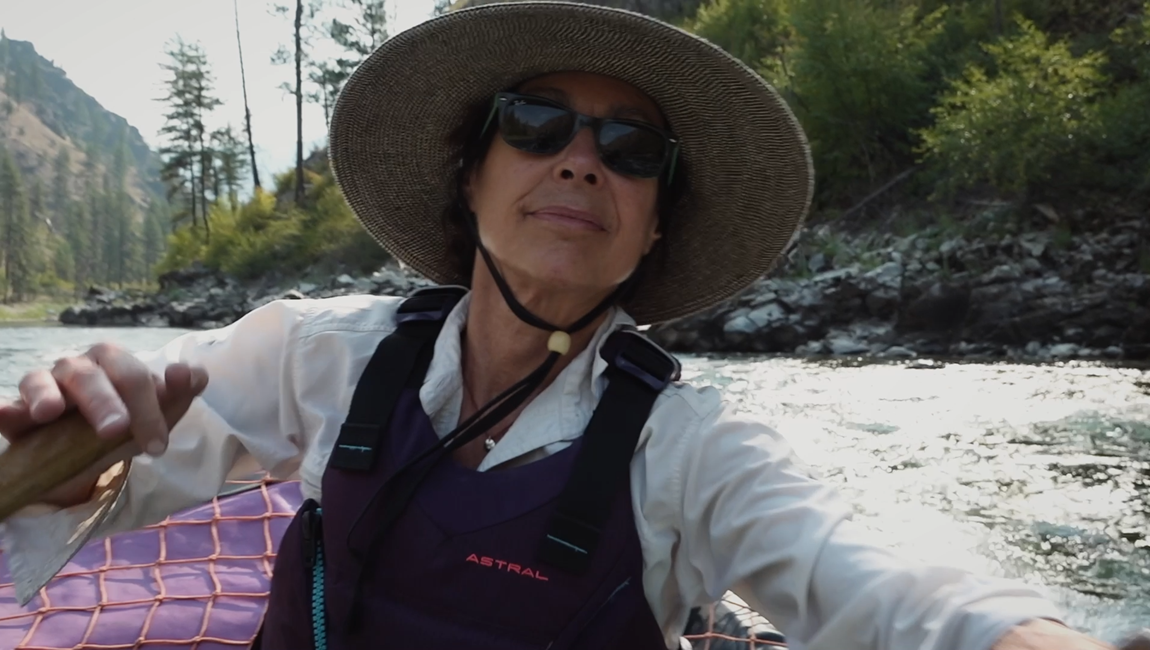
Moss’s film, however, examined this problem in the context of an actual river. In 1982, he shot the short film Riverdogs about a trip he and his friends took, a 35-day vacation along the Colorado River, and that film depicts a group of young social idealists — we might at one time have called them hippies — as they whitewater raft, innertube, frolic naked, take drugs, and just attempt to be in the moment. That film was, to borrow Guy Debord’s phrase, a snapshot of “the passage of a few people through a relatively short period of time,” and The Same River Twice was Moss’s attempt to look back at Riverdogs and the people in it, to reflect on that period and see where the intervening years had taken all his rowdy friends. And now, in his latest film The Bend in the River, Moss once again examines those formative relationships, to see who and what have changed in the intervening twenty-plus years since The Same River Twice.
The first thing one notices on a formal level is the complex time structure of the new film. Simply put, there’s a huge difference between The Same River Twice’s then-and-now comparisons and Bend’s negotiation of distant past, somewhat more recent past, and the present. The visual distinction between Riverdogs’ 16mm film and the digital photography of the newer material is a bit harder to parse this time, which is part of the point. We see Moss’s friends in 2003, initially thinking we are in the present moment, but then Moss cuts to the actual present, the participants now in their seventies and reflecting on their lives in their fifties.
Some of Moss’s subjects seem to have achieved their happiest state. Danny, a former genetic researcher, is a Zumba instructor who also works part-time in a restaurant. She finds her life more rewarding than ever. Some are still striving toward new goals. Jeff, a candidate for State Senator in Oregon, runs into trouble during his campaign because a PAC uses out-of-context clips from The Same River Twice to try and paint him as a sexist. Cathy, his wife who served as mayor of Ashland, works as Jeff’s campaign manager, and they argue over the best response to the YouTube ad. And still others, like Jim, the alpha-male of the group’s younger years, have never really grown up, giving the sense that the larger world is leaving him behind.
But in the final third of Bend, Moss introduces a different sort of change. One of the precepts of the two earlier films, and the friends’ lives in general, was that while they themselves may change, the river was eternal. But now we see the deleterious effects of climate change, and the fact that as these people enter the final years of their lives, they must reckon with having been part of a generation that left the earth far worse than they found it. Granted, these environmentalists and outdoors enthusiasts were never part of the problem. But even still, they wonder whether they did enough, and if it is too late.
The Bend in the River is a title as evocative in its own way as The Same River Twice. Where the earlier film was about the forward rush of time, the new film is about the unforeseen, those unexpected hazards (or joys) that are only recognizable once you’re in the midst of them. Barry, another of the film’s subjects, had a cancer scare 20 years ago. We see a clip from Same River while he is undergoing treatment. (He makes a very funny dark-comic joke about his support group that prompted an out-loud laugh.) Looking back, Barry reads a birthday email from his daughter and remarks, “I’m glad I didn’t die.” It’s not always smooth sailing, but if you can negotiate the bends, at least your craft remains afloat.
DIRECTOR: Robb Moss; DISTRIBUTOR: Netflix; IN THEATERS: August 14; RUNTIME: 1 hr. 22 min.
Comments are closed.