
Nothing stays buried under the snow forever. In the early ‘90s, Chile was a country eager not just to move forward, but to prove it to the rest of the world. The Pinochet regime still in very recent memory, the newly democratic nation still bore the scars of years of turmoil and brutality, scars that its new, progressive political identity needed to conceal. Better not to dwell on the hurt, after all, but on the hope instead.
Manuela Martelli’s The Meltdown takes place at a ski resort in Chile, 1992. It opens with an ominous shot: water running down the drain of a basin, followed by blood dripping amongst it. A child’s tooth has been pulled out — fairly innocuous stuff, but as the blood flows through the water, the camera zooms in on the drain, and it begins to resemble the pupil of an eye. Bury something down here and you may be able to forget it, but the drain itself has borne witness.
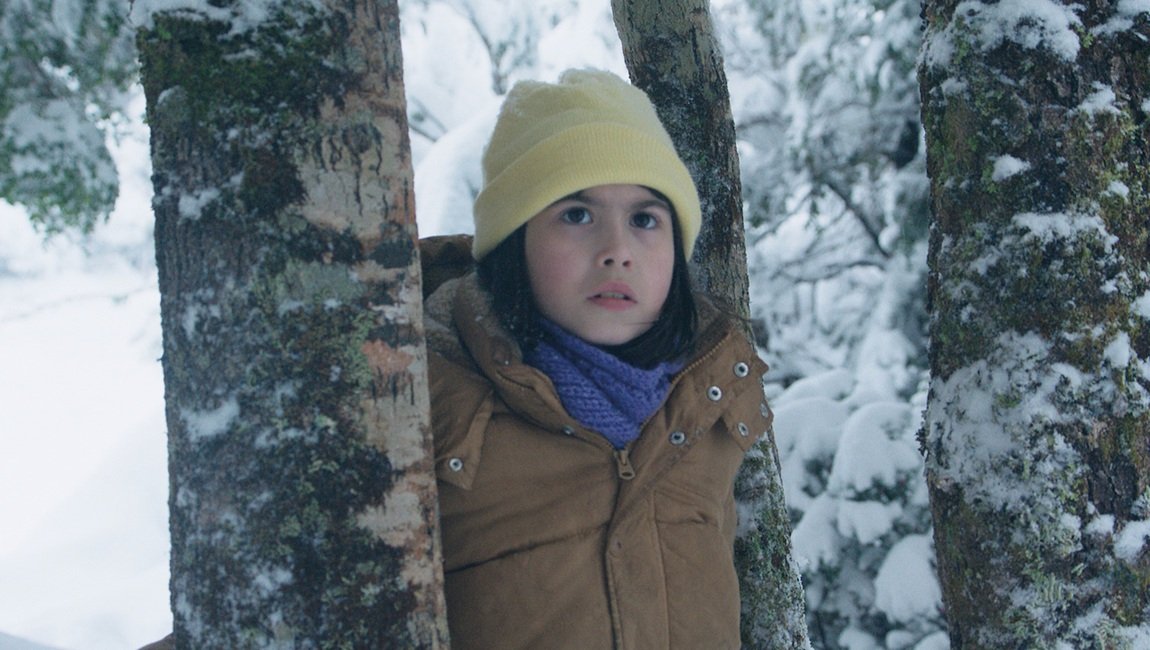
Who chooses to forget, who cannot forget, and why, are questions at the centre of Martelli’s mystery. Inés (Maya O’Rourke) is an eight-year-old girl living in her family’s hotel at the resort. Her parents are out of town at an international conference, representing their country with an art installation of an iceberg from the local area. Lacking a direct parental figure, Inés sources maternal guidance and nurture from various women around her: her grandmother, aloof and evidently untrustworthy, the hotel’s staff, kind but busy with work, and Hanna (Maia Domagala), a talented 15-year-old German skier training with her team.
Both girls are far from family, surrounded by only boys their own age, and strike up a friendship between Hanna’s gruelling practices. Inés, bored and rootless on her school vacation, revels in the opportunity to forge a meaningful bond with someone. But then, one night, Hanna goes missing. Inés’ curiosity, combined with her closeness to Hanna, makes her uniquely qualified to assist the police and other locals in uncovering what happened in the hours preceding her disappearance. But her grandmother advises her otherwise, insinuating that divulging too much would be bad for business — and, by extension, for the family.
When Hanna’s mother Lina (Saskia Rosendahl) arrives to join the search, Inés knows too much but has already said too little, and buries her secrets beneath the same desire that drew her close to Hanna. Lina becomes yet another temporary mother to her, their strange, tense relationship founded on an uneven dynamic in which Lina is older but Inés is more authoritative, knowing both the region and more about the circumstances around Hanna’s disappearance. Unspoken dynamics of power drive The Meltdown, like that between Hanna and her patently suspect coach Alexander (Jakub Gierszal), or between Inés and her grandmother, who’s unabashedly less interested in finding Hanna than she is in courting the Spanish investors staying at her hotel. But the main unspoken drive is the political environment, informing not just what is said and what is suppressed, but who has the freedom to speak at all.
It’s a potent atmosphere for a mystery, so it’s a shame the mystery itself isn’t handled better. In eerie shots, like Alexander walking away from Hanna’s room late at night, or Inés’ cousin Sebastián (Lautaro Cantillana) kissing Hanna in the doorway of her room while Inés pretends to sleep, one can’t help but make disturbing inferences. Yet Martelli insists on giving proper form to these inferences, diverting from Inés’ perspective for several scenes between other characters that, arguably, reveal too much, yet never the full picture. She gives us neither a glimpse nor a comprehensive assessment, stranding the story in a limbo between implicit horror and explicit revelation.
The Meltdown thus works better in concept than it does in practice, the extended focus on narrative details that are ultimately unresolved (and, frankly, unimportant) draining the movie of intrigue and some of its beguiling atmosphere. Its limbo is shared by its characters: Lina is described as hailing from “a country that doesn’t exist anymore,” Hanna is at an age where she’s neither a child nor an adult, and Inés wanders the hotel corridors, breaking into guests’ rooms, on a search of her own for comfort that might stay longer than just a few nights. It’s a comfort she can’t even find in her own mind, troubled as she is by the lingering sorrow and confusion over what happened to Hanna. What she knows she can bury in her memory, but, unlike those around her, she can’t forget it.
Comments are closed.