
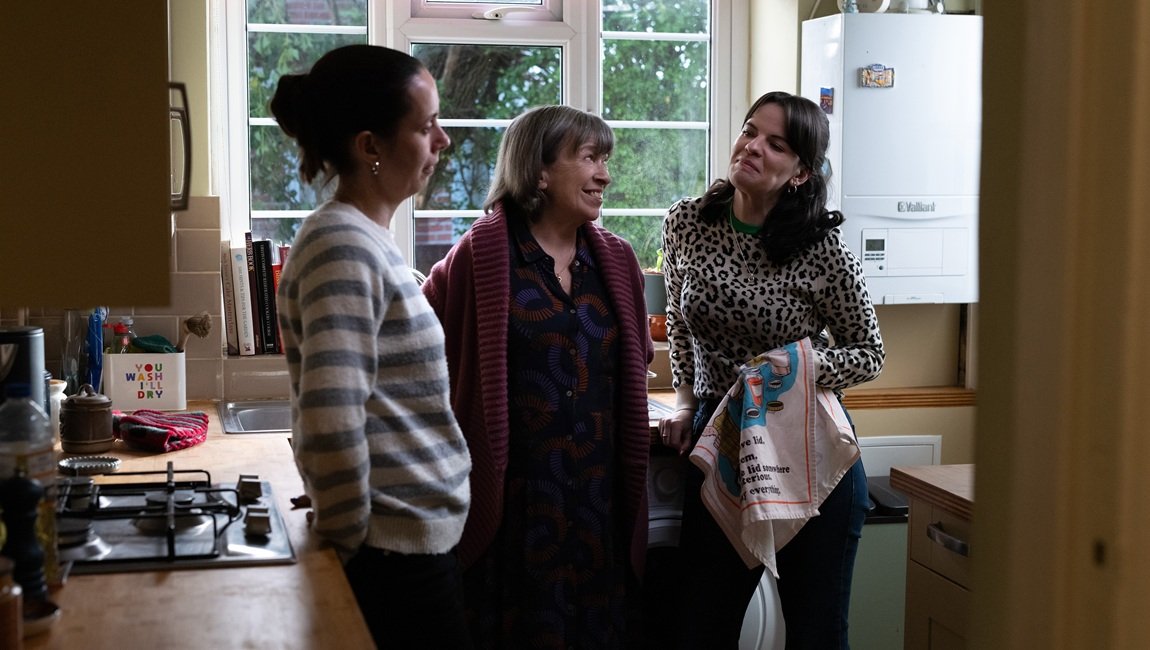
It is perhaps inevitable that a higher number of films are going to be focused on the difficulties of aging as birth rates decline and the world’s population generally starts skewing older, and Mike Leigh’s self-conscious finale Tender Loving Care is one of the leading transmissions from someone who is currently undergoing it. As is often the case for Leigh, the protagonist of the film is frequently just part of a community portrait, and the director begins with a bait-and-switch: it’s technically the story of late-30s committed child protection social worker Amy (Kate O’Flynn), but we open on her closest friend and roommate Rosie (Alice Bailey Johnson), an elderly services worker, dealing with a homeless man named George (Alan Williams) who has become incoherent after a recent heart attack. Rosie is functionally a sister to Amy and is lending her a place to stay after a recent bad breakup, but only Amy’s parents are in the picture, and she’s not inclined to give them more than the bare minimum of information about why it came to an end. Birdie (Marion Bailey) wants grandkids, and Geoff (Paul Jesson) just wants Amy to be happy, but the four are ultimately content to simply spend time together and enjoy bantering about the highs and lows of the past times they’ve shared. It’s easy enough to gloss over the tough issues of the present day when it’s just the two women’s unhappy romantic lives (Rosie is dating a firefighter whom she finds attractive and not much else), but aging is unavoidable, and it’s about to land on the family doorstep.
Side characters who only make a single appearance tend to be the skeleton keys to Mike Leigh films, and Tender Loving Care has quite a few thanks to Amy and Rosie’s profession, alongside Birdie/Geoff’s own bonds: an alcoholic mother who’s lost custody of her children and can’t understand that Amy wants to help, an increasingly paranoid and belligerent old woman who thinks her neighbors are leaving dog feces on her doorstep, and a friend of the family who recently lost her husband and is suffering intense regret about how she ruined her relationship with her son, who didn’t come to the funeral. The central foursome provides plenty of affection to them and to each other, but you’d never come away with the sense that this is enough to compensate. (The fact that Amy and Rosie’s own bonding tends to involve drinking entire bottles of white wine together and goofing off is both an uncannily accurate portrait of white middle-class women’s friendships, and a sign that they’re only marginally better at coping than the average person.) Leigh’s own anger about how Margaret Thatcher began torching the United Kingdom’s social net is expressed very explicitly by Birdie and Geoff in one scene, but it’s the point where Geoff begins having clear signs of cognitive decline of his own that spells out Mike Leigh’s fears for the future even more clearly: if Geoff didn’t have the affection of the title from so many people to keep him in relative comfort, he’d be no better off than the clearly less fortunate.
Tender Loving Care lends itself fairly easily to being compared with Mike Leigh’s sole other 2020s contribution to cinema in Hard Truths (2024), with both coming after Peterloo’s undeservedly disastrous run in 2018 made the prospect of financing Leigh’s typical pre-filming actor’s workshops much less appealing to most studios. Both are small and contemporary productions, and both found the director’s recent struggles with the autoimmune condition myositis playing a role in both the subject matter (Hard Truth’s central woman who seems to be perpetually in pain) and in the form. Hard Truths was the final Mike Leigh film shot by Dick Pope and Tender Loving Care looks to be the only Mike Leigh film shot by Lucy Bristow, but neither one makes much of an impression visually — the job gets done, but there’s a slight sterility to the lighting and the blocking is only as memorable as how the lines are performed. The scoring by Gary Yershon also possesses a certain eccentricity in both titles, with Tender Loving Care’s curious score being performed almost entirely on the marimba. Much more interesting is how Leigh is still finding new ways to demonstrate the different ways that British people communicate with one another. Some of the final scenes of Tender Loving Care are particularly instructive in this regard: after a bittersweet sing-a-long that suggests Leigh’s departed peer Terence Davies if he had made films for the present day, we quietly turn away from the family to return to George for the first time since the start of the film. He’s sitting outside in the cold, and says nothing as people pass him by, but he stares and stares. Mike Leigh’s final message through cinema is both indecipherable and clear as day.
Published as part of NYFF 2026 — Dispatch 3.
Comments are closed.