
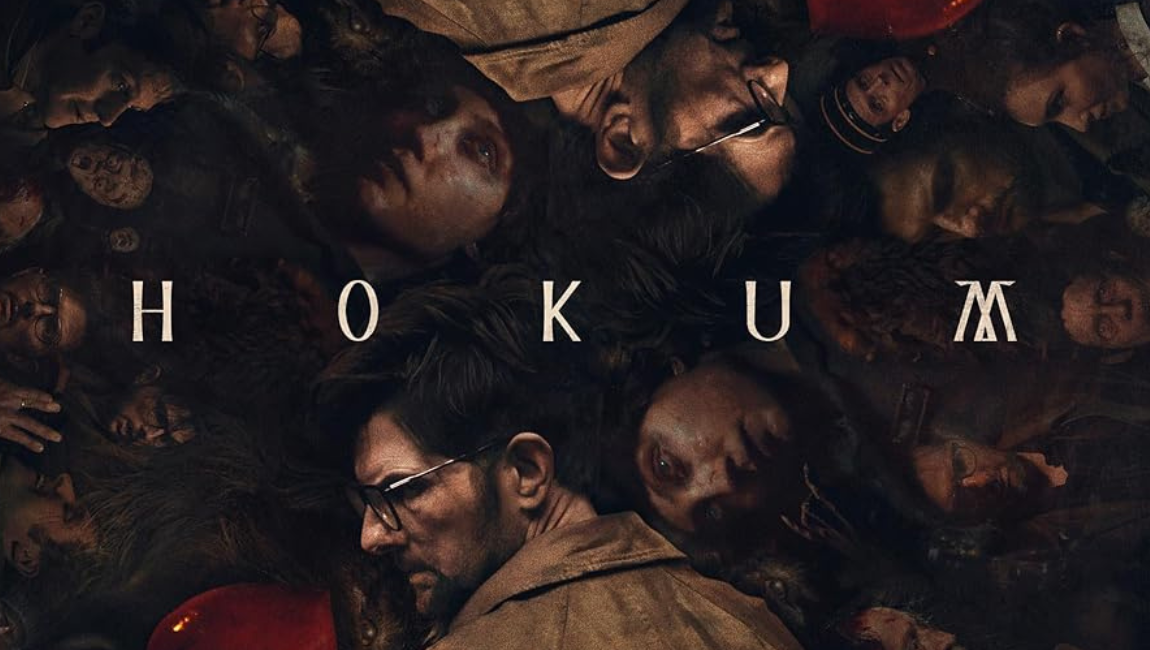
Sometimes you just want to be scared. Is that too much to ask? Not if you’re Damian Mc Carthy. Across three features, the Irish director has carved out a nice space for himself in the horror community by making films that are actually scary. It’s become a little rote to complain about “elevated horror” or “it’s about trauma/grief/etc.” The former doesn’t really mean anything tangible, and the latter has been true of horror long before we started making movies. There is, however, a frustrating tendency to pull back on scares and creeping dread to make way for thudding, on-the-nose metaphor.
In Mc Carthy’s worlds, there are certainly existential horrors to overcome, but in the end, he’s just interested in scaring the hell out of you. Take his latest delight, Hokum. In a Stephen King-esque premise, a bitter, haunted writer heads across the ocean to Ireland to scatter his parents’ ashes near the hotel where they honeymooned. Ohm, played with an excellent mix of snark and real, deep-seated pain by Adam Scott, may write popular fiction, but even as horrors unspool in front of him, he refuses to believe them. An obvious parallel to being unable to let his own tragic past go, Ohm’s refusal to engage with the myths around him (“Hokum,” in his words) leads him to the deepest pits of the hotel and his soul.
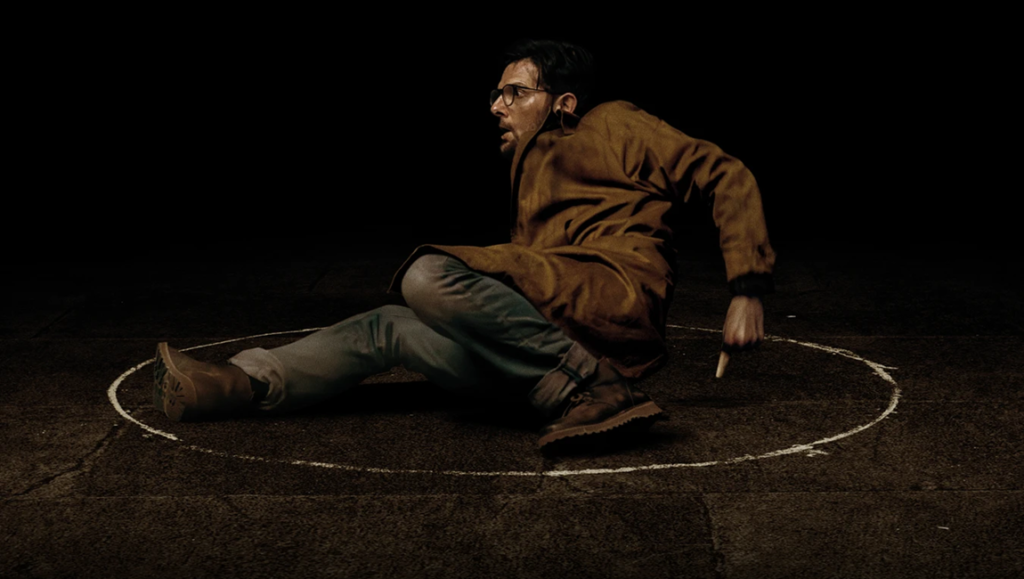
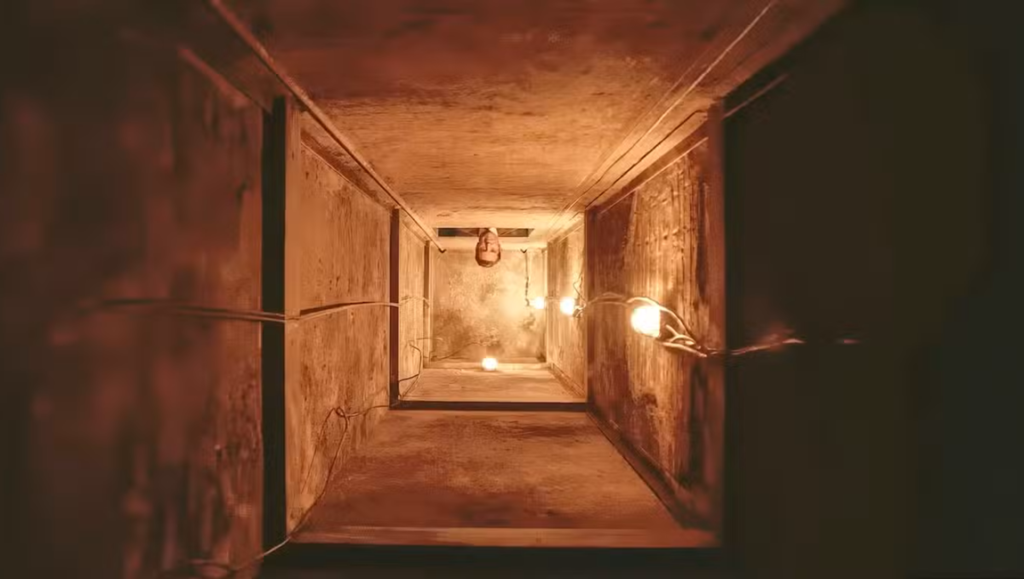
Mc Carthy’s excellent use of blocking and innate understanding of what to focus on within each frame lend his folk horrors a stamp of eerie dread. A trinket with a devilish smile here, an anthropomorphic rabbit TV host there, Hokum lingers on these uncanny images just long enough and just off center enough to unmoor your brain. Before you know it, you and Ohm are tumbling down dark hallways and ascending ghostly elevators into an unknown where witches and spirits exist. For his part, Scott has rarely been better. A perfect vessel for Mc Carthy’s hope masked by cynicism, he’s just so good as this coiled, venom-spewing dick with a clear heart of gold. Mc Carthy would be the first to tell you that he’s standing on the shoulders of King, and Ohm fits right into the master’s laundry list of haunted writers.
Ahead of its release, I sat down with Damian Mc Carthy to unpack his fear of rabbits, making horror scary, the great Adam Scott, and the current New Wave of Irish Horror.
Brandon Streussnig: I have to ask: between this and Caveat, where does your fear of rabbits come from?
Damian Mc Carthy: I’ve been trying to dig into it. It’s like going to therapy because I don’t know why this bothers me. It probably all comes back to very early things. I’m sure Watership Down was probably something I saw as a child, which is a very frightening, disturbing film that features rabbits, particularly the one evil hare. Then, as a film student, films like Donnie Darko, Harvey, and Jim Henson’s Wonderland. There were some very disturbing animatronics, and they featured rabbits. Švankmajer’s Alice, another Alice in Wonderland movie. There’s something about it. There’s something about a rabbit, just the outline of it, and it leads somebody into some kind of otherworldly experience or portal. It just keeps finding its way into my stories.
BS: Animatronics were a big fear of mine as a kid. Going to places like Chuck E. Cheese’s and being terrified of the robots and the jerky movements. I think they’re of a piece with the children’s show you feature throughout Hokum, hosted by Jack, an anthropomorphic rabbit. It’s all so uncanny.
DM: It’s very much that. That Chuck E. Cheese-type animatronic. You see old, strange footage of these things from long ago, and you’re like, “That doesn’t seem suitable for children at all. It seems like nightmare fuel.” I’m intentionally trying to lean into that. I’m trying to capture the feeling of this, which would once have been entertaining for kids, but now it would be terrifying to look at. I think a lot of the inspiration for Jack, too, was that idea of the Pinocchio cartoon, where the boys are half boy, half jackass. I always remember that being really disturbing as a kid.
BS: Oddity and Hokum lean heavily into folklore. This is absolutely ignorant of me, having never been there, but there’s something that feels mystical about Ireland. There’s a deep, rich history of mythmaking. Can you talk to me about your experience with that and how it informs your work?
DM: In school, you would’ve learned about all these old Irish folklore and myths. Growing up, too, everybody seemed to have a ghost story or something their grandparents used to tell them. There are some very old rural parts of Ireland that you would hear strange stories about. I always found that stuff fascinating. I always remembered these things and gravitated toward them and soaked them up. I think I have always tried to lean into the idea that Ireland has so much folklore and myth, and to weave it into my stories because I’m telling them here now. I’m trying to take advantage of it.
BS: There seems to be a moment happening in Ireland right now, specifically with horror. You have Lee Cronin doing his thing. You had Sea Fever and Let Us Prey. You’re carving out your neck of the woods. Has there always been this horror community in the Irish film scene? Are there any older films that you wish had more shine?
DM: It’s funny. I’m trying to think of any Irish horror films I saw growing up, and I can’t think of a single one. I love horror films, but it’s lovely to see that we’re actually starting to make more of them at home. Lee Cronin, Kate Dolan, and Ciarán Foy, all these people, they’re all finding that audience internationally, which is great. It’s probably the fact that all those people are kind of in their 30s, 40s, so they would’ve grown up watching John Carpenter movies and all these cool horror movies coming out of America, and probably were really inspired by that. I know I was. My parents had a VHS shop when I was growing up, so that was always the stuff that I was watching.
I suppose as you get older, you really want to get into the film industry, or you start channeling that love of movies into your own stuff. That’s probably where it comes from. I can’t think of anything from before us, though. We really don’t have a history of making horror films here in Ireland at all.
BS: As a part of this new wave of horror in Ireland, you’ve put your own spin on a few different subgenres within the genre, and Hokum is your haunted hotel film. I think The Shining looms so large that there’s this idea that the haunted hotel is a well-worn trope, but it’s really just that, 1408, and The Innkeepers. What excited you about taking a stab at it?
DM: I think anybody who’s making any kind of horror movie is just in the shadow of Stephen King. I mean, he’s so prolific. He’s done so much. No matter what you want to tackle, he’ll have done it brilliantly already. Obviously, The Shining is the best. I don’t think he cares for the movie, but The Shining is probably the best haunted hotel movie. I think it always will be. So it’s really just, “how would I do this if I were to approach this? Here would be my take on that.” I love horror tropes, haunted items and objects, and spooky dolls and all this kind of stuff. I love all of that. I don’t know if there’s anything super original about anything that I’m doing, but it’s just my take on it.
If somebody else were to come along later in the year and make their version of this script, it would be a different film again because it would be how they see it and how they would design these things. So yeah, I think it’s just about trying to put your own stamp on it.
BS: I think that’s what I love so much about your work, though. I don’t want to get in the weeds of “elevated horror” or “it’s about trauma” and stuff like that, but I like that you’re genuinely just trying to scare people. Yes, there’s something that your characters have to overcome, and the horror is maybe representing that, but at the end of the day, you’re trying to scare the shit out of them and us. How do you approach that balance?
DM: Sometimes I think that I’d like to make a slasher movie, but instead of them getting killed one by one, it’s just someone scaring them to death. I don’t know how scary that would be, though. With anything I’ve made, I try to tell a story first. You try to have your characters attempting to achieve something, or resolve something, or whatever it’s going to be. Then I think you start to get into the horror because it just makes it so much scarier. If you find the characters interesting, even if they’re a villain, you want to see more of them. You’re like, “Oh god, this guy’s terrible, but I want to keep watching him. I hope he makes it all the way to the end and then reaches some kind of gnarly demise.” It’s a balance.
Again, it’s a horror film, so nearly all of the scariest ideas win, and it’s something that I’ve gotten criticism for. But, this is horror first. Yeah, I’m intentionally trying to do that. I’m trying to make the film entertaining and as scary as possible, but then hopefully there’s a good enough story and interesting enough characters that an audience will get something from it and then come back to dig into that on repeat viewings.
BS: A big part of what makes your films so scary is your direction and blocking. You know where to frame something within a room or how long to hold on to it. I know you’re a big storyboarder. How much of the film lives there versus in the script?
DM: Well, I think I would go so far with the script, and then it’s like, “okay, I think this feels like the blueprint for it.” Then I would start storyboarding it. Then the storyboarding always tells me how I need to finish the script. That’s when I draw everything. I’ll even draw the little items or whatever cutaways I want. I’ll try to be as detailed as I can. I think they do go hand in hand. The storyboarding will bring me back into the script.
BS: You talked about how Stephen King looms so large in horror, and I think you have the quintessential Kingian lead here. Adam Scott is perfect as this bitter, broken writer. He’s just snarky enough without folding entirely into comedy, and he can really get under your skin when he needs to be emotional. How did casting him come about? Was this always an American in a strange land story?
DM: Yeah, definitely, it’s always going to be an American coming to Ireland. My intention with the film was to try to make a Hollywood movie or something that would feel like the movies that I would’ve grown up with. If I’d seen this when I was younger, I would’ve loved this movie. This is the kind of thing that I was like, “Oh, it’s really cool. It’s like this American character coming to Ireland, and it’s the country through his eyes, meeting all these oddball characters and learning about the folklore and dismissing it.” Getting Adam was just luck, really. Sometimes these things just line up. I would never write with an actor in mind because if you can’t get them or they don’t like the script or they maybe don’t want to work with me, whatever it would be, it can be disappointing.
It just seemed to line up that I had the script finished, and I was watching Severance, and the film was going to happen around that same time. We started asking, “Well, who could play Ohm?” Everybody had an idea. In those very early days, I was finishing Severance, and I was like, “My god.” I was always a fan of Adam.
Then I was storyboarding, and the drawing started to look a little bit more like him as I was going along. I was going, “Yeah, he’d be really good.” This is where the luck comes in. He had seen my film Oddity, and he liked it, and he was just curious, “Oh, the guy who did Oddity, what’s he doing next?” The script went to him, and he liked it, and we met, and we hit it off. He liked that the character was a little bit prickly and not the most likable guy. He was totally into that. He wasn’t like, “No, we need to make this guy so much nicer, and he needs to save a cat at the start. We need to get the audience on his side.” It was like, no, he was on board with, “Let’s make this guy quite unlikable and then see if we can win the audience back.”
[SPOILERS FOLLOW]
BS: The framing that bookends the film focuses on a conquistador in the desert having to make a tough decision. It looks like what might be a vast, giant epic. Is something of that scale you’d like to take on at some point?
DM: There are certainly things like that that I’ve written that are just kind of sitting around, but I wouldn’t dare tackle them for a couple of years. They’ll find their way back into later films if I ever get the chance. I think the idea of those bookends was just to show how what he’s writing has gotten a little bit more positive because it’d be too easy to write very bleak horror movies. It’s going to be the easiest thing in the world, but I don’t know how re-watchable they’d be. Even in earlier drafts, Adam’s character dies in that basement, and it was a much heavier, bleak ending. It was going to be the ending for a very long time.
I think the idea of putting that out there and going, “Well, is this all that positive? Why would anybody enjoy this?” the film would end with a bit of a shrug. I thought the way to show that his mind had changed was to tell it through this conquistador story, and my own feelings about the script, trying to end on a more hopeful note.
[SPOILERS END]
BS: You tend to pull the rug on our expectations for certain kinds of people. Whether it’s in this or Oddity, you introduce folks who appear one way and veer into a different direction of good or evil. What do you like about subverting those expectations?
DM: There’s something nice about watching when a character comes into any movie, and you’ve no idea, is this guy good or bad? Sometimes they feel like an archetype where it’s like, oh yeah, this is clearly the villain, and then they’re not. It’s just something I like to explore. I think something is appealing about that for actors, too. They can be set up as something that’s like, “Oh, great, I’m just the villain.” But then, they can turn out to be heroic or someone who has more going on than just that. It’s definitely something that was explored with Oddity, which I really liked working with my cast on because everybody seemed to be one thing, but then they were really something else. It’s just something I find interesting.
BS: I typically find a question like this a little hacky, but we’re talking on the day Curry Barker’s been announced to direct Texas Chainsaw for A24. Lee Cronin just took on The Mummy, and before that, Evil Dead. Is there a property that you think you’ve got a killer idea for? What’s Damian McCarthy’s “X?”
DM: It’s funny. I mean, I’ve had conversations, which is wonderful, where people will offer you things, or they’ll ask me that very question, “if you could do anything…” I don’t want to do any of it. None of it at all. Ever, I don’t think.
If I had to say one, maybe, I think an interesting one now we’ll say would be They Live. It’s such an excellent movie. I sometimes wonder, “Why has nobody ever had another stab at that?” Because it feels topical, and there’s something about it, you could imagine it translating quite well to modern day. Then you kind of stop and go, “No, the movie’s told. It’s done.” I think one day I even started jotting down little ideas, “Oh, how would you approach They Live?” and I said, “What am I doing? The film is amazing.”
The problem with taking on any kind of franchise, sequel, or whatever it would be is that it’s just going to end up being compared to something else. Whereas if I make something like Hokum, for better or worse, it’s its own thing. People can say, “Oh, it’s similar to The Shining,” or that it’s similar to 1408 or other haunted house movies. That’s fine because that’s just that subgenre of horror.
I have so many scripts that I want to make that, again, they’re my stab at a haunted house movie or a conquistador film, whatever it’ll be. I’d really like to see if I could get my own films made first before ever trying to do anything that’s somebody else’s property. I think that when I’m done, I want to stand behind a body of work that feels like, yeah, there are hits and misses here, but they’re all trying to do something that’s their own thing, or at least that they came from me.
Comments are closed.