
The Kinshasa-based media group known as Collectif Faire-Part takes its name from their 2018 debut featurette, Faire-Part, about Congolese street performers. Earlier this year the group was given a spotlight section at the IFFR in Rotterdam, showcasing their work to date. This program included the world premiere of their newest short film, What We Said to Brussels Airlines, a work that offers a fairly succinct introduction to the Collectif’s aesthetic ethos. Invited to screen some of their work on the airline’s in-flight entertainment channel, a gesture meant to celebrate the carrier’s anniversary of conducting the oldest direct flight from Europe to Kinshasa, CFP offered the company 2022’s L’Escale (“The Stopover”), a film about how two of the group’s members, Paul Shemisi and Nizar Saleh, were detained in transit in Angola, unable to board their return flight because the airline refused to accept their passports as real. As we learn from What We Said, the airline was a bit uncomfortable with this film. Did the group have anything, um, less political? Maybe something uplifting, like a documentary about street performers?
CFP’s latest film, Joy Boy: A Tribute to Julius Eastman, is the group’s longest work to date, and although it is quite a bit different from the Collectif’s previous efforts, it can be read as an oblique response to the Brussels Airlines debacle. The film is about a 20th century art music composer whose compositions, taken in isolation, might seem utterly apolitical. But when one learns more about the man and his music, one is taken aback by the radical nature of these thick sheets of sound. Eastman (1940-1990) was a Black gay man who studied classical composition and eventually became influenced by the post-minimalism of figures such as Morton Feldman and Rhys Chatham. His work tended to focus on loud, percussive use of the piano, with shifting but repetitive blocks of chords moving slightly in and out of phase with each other. Several compositions were confrontationally titled the “N****r” series, one of which we hear in Joy Boy, along with another of Eastman’s pulsating piano works, Gay Guerrilla.
Joy Boy is a cinematic suite in four parts, with CFP visually interpreting Eastman’s music while presenting the recorded voice of Eastman talking about his work. The first segment, “Evil N****r,” is accompanied by a densely layered experimental film that uses footage of a dancer to generate waves of abstracted movement, the performer rendered in spare, echoing colored lines. This section has much in common with the graphical cinema of Norman McLaren (especially his Pas de Deux), but the bright neon color scheme suggests a fantasia of neon city lights in the darkness. Part two, “Many Many Women,” employs rounded visual forms that present a variety of physical textures against a black background. It is a dance of shapes that eventually resolves into the Palestinian flag.
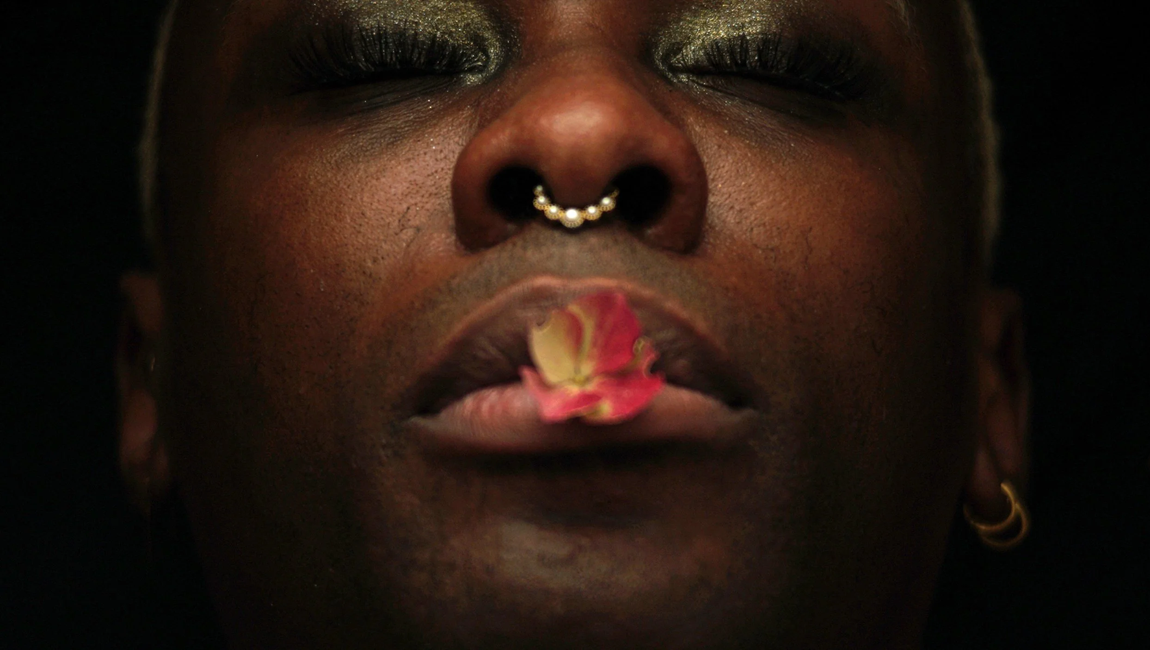
Part three, “Gay Guerrilla,” is in some ways the most striking segment in Joy Boy. Initially a solo dance, the performer is joined by three other dancers in queer-inflected dress, dancing in the middle of a busy Kinshasa street at night. As cars move past them, these dancers’ presence alludes to queer sex work, but in a bold conceptual twist, they move in the street rather than beside it. There is a defiance in this section that is reminiscent of Khalik Allah’s cinematic prose-poem Field N***as. These people are not offering themselves, but aggressively taking up space for fierce, self-expressive movement. The final section, “Joy Boy,” consists of images of hands on a Black male torso, fading in and out in tandem with Eastman’s titular composition. The images moves to the performer’s face, alternating with close-ups of plant matter, a series of snapshots that recalls Jodie Mack’s organic collage films.
Joy Boy is not a documentary in any conventional sense. Rather, it finds this current iteration of Collectif Faire-Part — three new members working alongside original members Rob Jacobs, Paul Shemisi, and Anne Reijniers — working to think alongside Eastman’s music, tapping into its radical abstract force. Eastman, who died of AIDS at the age of 50, was never fully appreciated in his lifetime, and is still not very well known even in new music circles. This is the Collectif’s first film that does not directly address the history of Belgian colonialism in the DRC, and in a sense Eastman serves as the perfect subject for this broadening of scope. His music was an attempt to compose one’s way out of a colonized subjectivity, taking the traditions of Bach and Beethoven and moving that European tradition to the streets of New York, on the assumption that this legacy belongs to anyone who wants to claim it. The Eastman compositions we hear in Joy Boy convey a restless but hesitant energy, a force that slowly but inexorably lurches forward, fighting its way into the listener’s consciousness. Joy Boy is both an overdue appreciation of Eastman’s contributions and an exciting new direction for this vital group of film artists.
Published as part of Prismatic Ground 2026.
Comments are closed.