
The Quran states that “whoever saves a life, it is as if he has saved all of humanity.” The Station, the debut feature from Yemeni director Sara Ishaq, takes this sentiment a bit further. Those who save one young boy from violent Islamic fundamentalism are, in essence, saving their nation and their faith from the patriarchal death cult of martyrdom. In a war-torn nation that demands that boys as young as 12 years old join the fight against the enemy, the protagonists of The Station work to protect their little brother from becoming just another dead body in a shroud. In a historical moment when reactionaries of all stripes tend to decry the “feminization of culture,” The Station very clearly believes that only women can defend their culture from wanton self-destruction.
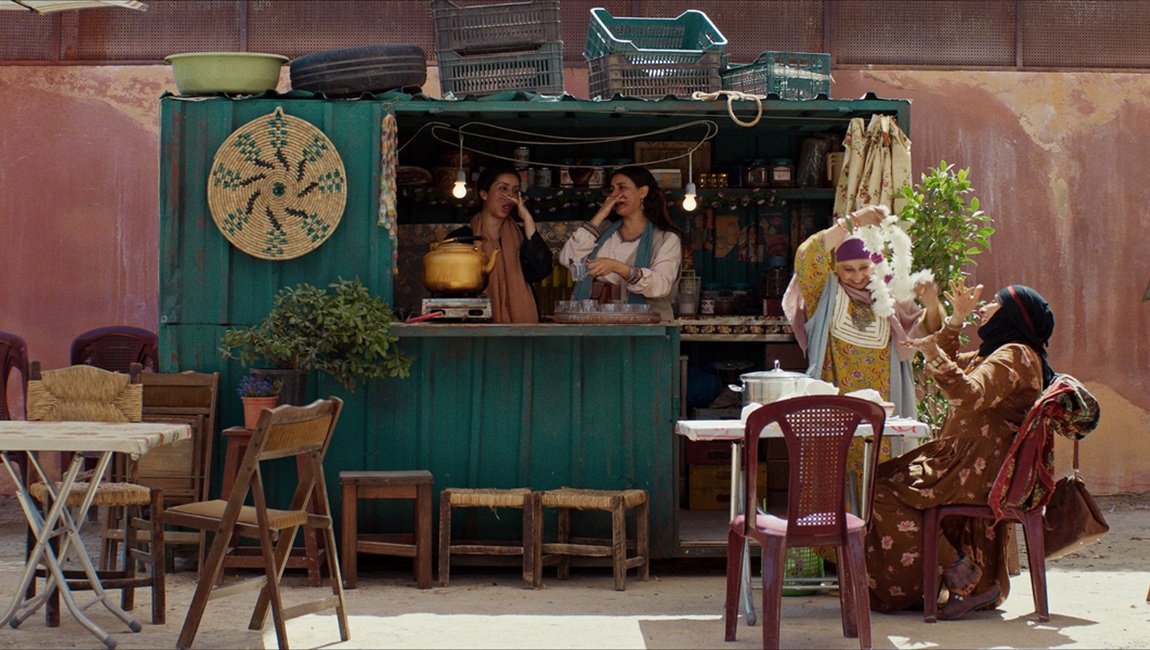
The station of the title is a fuel station run by Layal (Manal Al-Maliki), and with tenuous protection from the wife of the local sheik, she is able to conduct business within a relative oasis. The gas station is a gender-segregated space, a place where women are permitted to work and bond without the immediate threat of violence. (A sign on the gate reads, “no men, no weapons, no politics.”) There is only one male in this space, Layal’s little brother Laith (Rashad Alrajeh), who has just reached the age at which he is expected to pick up a gun and join the local militia. But Layal is devoted to keeping Laith away from that, arguing that he is exempt as the last male in the family. Eventually, she must pay exorbitant bribes to keep Laith safe within the station’s walls.
In an opening text, Ishaq informs us that she has taken the liberty to depict the Yemeni civil war in a somewhat abstract manner. “While inspired by real-life experiences, the story’s events, locations, and rival groups are depicting a parallel world.” The two warring factions are the Sanadeed, who fly a blue flag, and the Maghawir, whose flag is orange. Ishaq is relatively careful to depict both groups as roughly equivalent in terms of ideology and bloodlust, which emphasizes the degree to which the women of the area see themselves as bonded against the entire enterprise of the war. But this safe zone is an illusion, one that is allowed to persist only so long as it is useful to the various parties involved.
What The Station makes clear is the fact that Laith is a normal boy amidst a conflict that thrives on brainwashing and a warped view of masculinity as driven by hatred and aggression. Living at the station, Laith is a sensitive young man who likes to play pretend, and cares for his pet lizard named Mr. Khirmish. Almost all the other boys we see are part of a taunting mob who beat and belittle anyone who fails to measure up to the standard of aggression that defines what it means to be a man in this place. And while Layal does her best to protect Laith from these messages, the walls of the station cannot prevent these dangerous messages from seeping in. The eventual arrival of Layal and Laith’s older sister Shams (Abeer Mohammad) only makes matters worse.
The Station is an intriguing combination of specificity and universality, with the sisters’ familial struggles mapping uneasily onto the larger national conflict. It is one of only a handful of dramatic features to have been produced in Yemen, and in this respect, Ishaq clearly feels a burden to accurately represent the crises that have torn her country apart. At the same time, there is very little in The Station that feels surprising or revelatory. The film follows the unwritten rules of international festival cinema, highlighting a geopolitical hot spot for global edification, without necessarily offering the local audience much more than the benefit of having been seen. There is certainly nothing wrong with The Station — it is well made and frequently engaging. But it does prompt a critical viewer to question what it means to accomplish as a work of art. One of the defining plot points of Ishaq’s film is the scarcity of resources, and so while the film is admirable by virtue of its very existence, it also forces us to wonder exactly who and what it is for. In 2026, surely we no longer believe that awareness of a tragedy necessarily leads to corrective action. So the ultimate takeaway from The Station is as diffuse as the Islamist factionalism it depicts.
Comments are closed.