
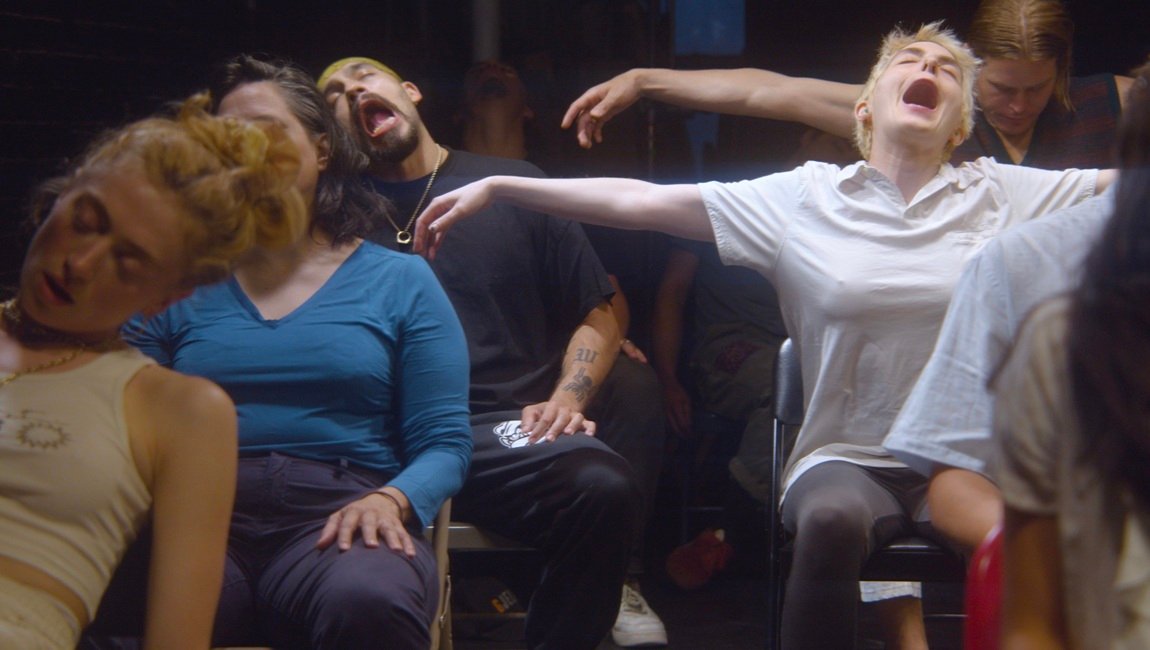
Charlie Birns, by his own account, set out to direct a documentary that would re-capture his transcendent experience in an acting class taught by self-styled Method guru Tony Greco. His primary filming techniques in this quest were to re-convene the class within a compressed timeline and film it from beginning to end, and to interview an eclectic array of scientific and spiritual experts, counting among them a professor of mathematical cosmology, a Buddhist monk, and a tarot psychic. Birns’ completed project, the meta-cinematic documentary The Whole World Is a Lie, shows with excruciating detail how these techniques — and Birns’ own search for meaning — unraveled completely during the documentary’s chaotic production. The result is both an enthralling depiction of a process that goes completely off-the-rails and an intimate self-reckoning with childhood trauma and existential anxiety.
The brewing conflict behind the scenes of The Whole World Is a Lie is apparent from early phone conversations between Birns and Greco. Greco seems uncertain about Birns bringing cameras into his classroom, and he places an unwieldy condition on his participation: if Birns is to film the class, then he must also participate in the class as an actor. The limits of this approach quickly become clear, as the class is first wary of Birns, then openly hostile toward him.
Greco is portrayed as a domineering character who exercises firm control over his class and inspires devotion from his adult students, some of whom have been taking his class for upwards of 20 years. Birns’ encroachment on Greco’s territory clearly provokes him, and Birns resultantly finds himself the frequent object of Greco’s forceful displays of anger. The students, seeming to pick up on their teacher’s emotional cues, rail against the presence of cameras in the classroom and a perceived lack of directorial clarity from Birns; Greco vigorously joins in this collective tirade, denigrating Birns’ skills as a filmmaker and later subjecting him to humiliating acting exercises and withering, acutely personal feedback. As the soft-spoken Birns struggles to defend himself or to assert power in the room, it quickly becomes apparent that not only will he fail to replicate his supposedly transcendent experience, but that the class’s participation in the project is in jeopardy.
Greco and his students are morbidly fascinating to watch; the manipulative, voluble Greco abuses his unquestioned authority, while his students lash out emotionally with very little prompting. Take, for example, a scene in which Greco specifically requests to have the camera crew film a one-on-one conversation between himself and Birns, only for Greco to spew vitriol at Birns’ working methods and repeatedly demand that he “shut the fuck up.” Or another episode in which a student calmly informs Birns that he wants to “destroy” him for bringing cameras into class. The fundamental irony — remarked upon by members of the production crew, who are depicted as subjects in their own right — is that every person involved has willingly consented to their classwork being filmed and can withdraw their participation at will, yet they take every possible opportunity to ream out Birns on camera for his apparent invasion of privacy.
Interspersed with this slow-motion collapse is Birns’ interviews with experts and mystics, and crucially, with his own parents. These scenes allow the viewer to see Birns outside of the pressure-cooker context of the acting class, and thus to ascertain different facets of his character and the particular nature of the quest he is on. Birns’ father is an especially central character, and while he and Birns have a close relationship at the time of filming, Birns incrementally reveals that his father’s behavior in his childhood was tumultuous, even dangerous. The three strands of the film — the class, the talking-head interviews, and Birns’ conversations with his parents — thread together to reveal the roots of Birns’ relentless search for meaning, and prompt Birns (and thus the viewer) to question whether mediated versions of reality, like acting classes or experimental documentaries, can truly help any one of us to access buried truths about ourselves.
Notably, The Whole World Is a Lie includes a disclaimer that the film is an “edited account in which some events are condensed and re-arranged.” The slipperiness of what is “real” is inherent to Birns’ project, and some sequences see Birns deliberately playing with fiction; for example, he hires actors to re-enact and perform alternate versions of past events from Greco’s acting class. Scenes like this may bring to mind Nathan Fielder’s docu-comedy series The Rehearsal, and Birns’ cinematic techniques and onscreen persona are certainly reminiscent of Fielder’s. Yet whereas The Rehearsal depicts Fielder vainly attempting to create immaculately detailed simulacrums in order to control reality, Birns shows himself attempting to transcend reality and reach a spiritual plane, only to bump up against the artificial constructions that constitute the world as we know it. Whether one can uncover truth from within artifice is a question that cannot be definitively resolved, but in The Whole World is a Lie, Birns succeeds in his formally ingenious and emotionally resonant search for an answer.
Published as part of First Look 2026.
Comments are closed.