
Austrian-born, U.S.-based filmmaker G. Anthony Svatek has an interest in human systems, and how they are put in place to manage forms of chaos that cannot ever be completely controlled. His 2017 film .TV, for example, is about the island nation of Tuvalu, believed by scientists to likely be the first nation destroyed by human-made climate change. As the polar icecaps melt, and the Pacific Ocean continues to rise, Tuvalu is gradually being swallowed. Quite by chance, Tuvalu came to possess one valuable resource that allowed it to garner some income with which to relocate its inhabitants. At the dawn of the World Wide Web, Tuvalu was assigned the Internet country code of .tv, which they were able to sell to advertisers who wanted a catchy domain name. Not even the country’s name, but a mere two letters of it, has proven to be more valuable to the world than Tuvalu itself.
Svatek’s newest documentary essay is considerably more expansive, but the filmmaker has employed his own system for organizing his data into a manageable set. Humboldt USA is in part about the German traveler and ecologist Alexander von Humboldt, whose impact on the mid-18th century was so wide-ranging that he became the namesake for towns, mountains, rivers, and all manner of natural formations. As Svatek tells us in the film’s narration, Humboldt’s importance to intellectual history may have waned, but his name and, by extension, his ideas haunt our world and suggest an alternate path in terms of humanity’s relationship to nature. “Everything is interconnected,” Humboldt professed, but as Svatek notes, Humboldt’s relational thinking quickly gave way to the later theories of Darwin which, much more in line with 19th century attitudes, understood life to be a competition for scarce resources, a battle for survival.
Humboldt USA examines environmentally related activity in three different places — Nevada, Northern California, and Buffalo, New York — that are named after Humboldt. Much in the same vein as James Benning’s Four Corners or Deborah Stratman’s The Illinois Parables, Humboldt USA uses the legal and historical designation of place as a kind of heuristic, affording himself a comparative method that is able to observe relationships that might otherwise go unnoticed. Place names, like borders, are somewhat arbitrary, but not entirely. They represent the traces of history even though, like Humboldt’s own ideas, that history can be forgotten, evolving into its own self-referential signifier. (“This place is Humboldt. It’s just always been that way.”)
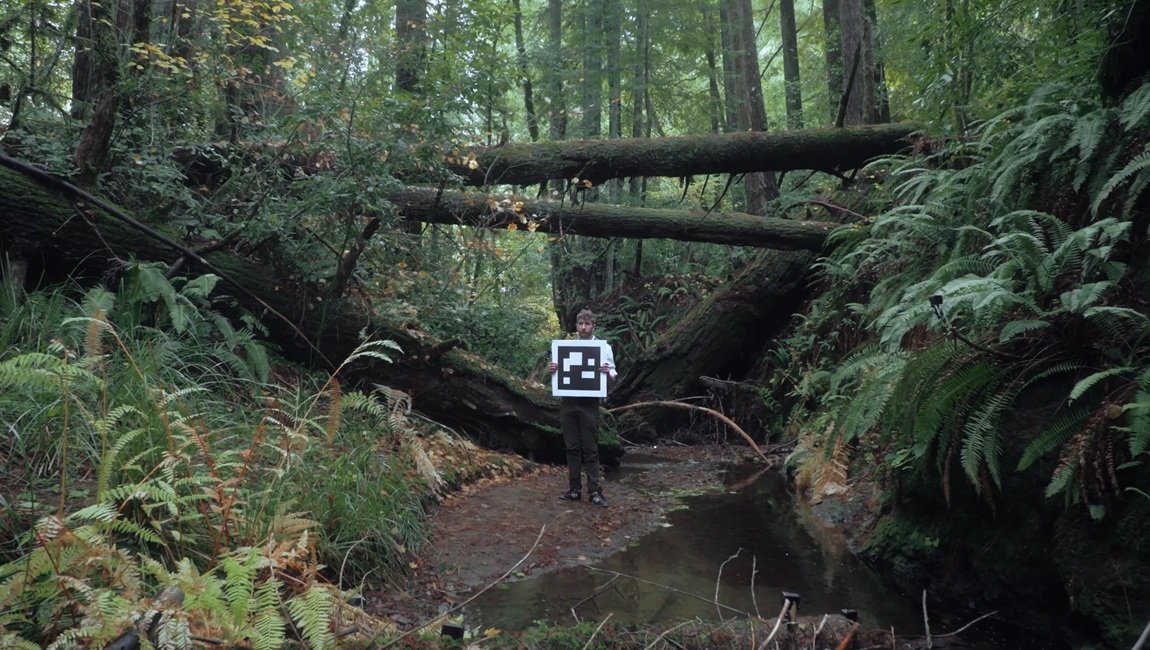
What Svatek finds in these three locations differs in the details. In Nevada, we see a team of people from the state wildlife authority releasing bighorn sheep into the Nevada mountains. This was the sheep’s original habitat, but encroachment dwindled their number to virtually nothing. In California, a pair of researchers enter the old growth redwood forests to mount digital cameras that aim to provide a 3D rendering of ecological movement, including animal activity, erosion, lichen growth — things that a human presence would disrupt or that evolve too slowly for the naked eye. Meanwhile in Buffalo, an elderly couple live along the city’s Humboldt Parkway, once a green space but now a four-lane underground highway. They are part of a movement that hopes to force the state of New York to reclaim the highway and reestablish it as green space. But the state has a less ambitious counterproposal, roofing off a large segment of the Parkway for a High Line-inspired urban park.
One clearly sees that these different scenarios have several things in common. In the most basic sense, people are striving to restore parts of the natural environment that have been damaged by human intervention. However, we can see something a bit different on the metanarrative level. In making these plans, many of these activists and environmentalists are subjecting the landscape to different forms of control. For example, the Nevadans who are repopulating the bighorns are dedicated hunters, and the project was mostly paid for by sportsmen who intend to go into the mountains and hunt the same sheep they are depositing there in the first place. Svatek refrains from any commentary, but he lets these folks speak for themselves, and what we witness is a specifically conservative brand of environmentalism. It’s not just good for the sheep; it’s good for the people who want to hunt them. Nature is not its own justification. There must be some human benefit.
In California, the two researchers talk about how their cameras will be able to see the forest from an unbiased, nonhuman perspective. They speak of “seeing like a tree,” or adopting the “point of view of a rock.” But their project will aggregate and analyze all this data using artificial intelligence. The pair are techno-optimists, believing that the less influence human beings have over such a project, the better for the environment. They don’t seem to recognize that they are the ones establishing these parameters and composing the algorithms that will drive their preservation efforts. This is not even to mention the massive ecological toll that AI and data centers cause around the world, depleting water sources and despoiling their immediate environment.
In Buffalo, the activists are a bit more levelheaded, working to mobilize against what they see as a token gesture on the part of the state. As they note, maintaining the Humboldt Parkway but essentially throwing a lid on it will trap and concentrate auto emissions, making a bad situation even worse. Where the Nevada hunters work hand in hand with the state, and the Californians cast their lot with Big Tech, the people of Buffalo rely on old-fashioned grassroots activism. What Svatek indicates through careful juxtaposition and comparison is that, while the actions in Nevada and California will produce change relatively quickly, the folks in Buffalo most likely have a hard road ahead of them. And yet, that dedication is the correct way to meet nature where it is. There are no quick fixes for saving our planet, and perhaps instead of trying to technologize our way out of the crisis, it’s best to work small and plan for a generational timeline. Thinking ecologically entails cultivating an imagination beyond one’s own lifetime, devoting oneself to a future we will most likely never see.
Published as part of First Look 2026.
Comments are closed.