
Back in the ’90s, Ken Jacobs came to the San Francisco Bay Area for a week of programs and seminars. When attending one of the screenings at the Pacific Film Archive, I was accompanied by a Berkeley professor who was curious about Jacobs. It was a program that focused on Jacobs’ work with early cinema, which included a Magic Lantern performance and two of his better-known films from the decade, The Georgetown Loop and Disorient Express. While discussing the program afterward, the professor expressed a general lack of enthusiasm for what Jacobs was doing. They referred to his practice as “pre-theoretical,” meaning that as an artist he seemed more interested in exploring various effects than telling the audience what they meant.
This comment has stuck with me over the years because in some sense it was correct, only not in the way it was intended. One of the other works Jacobs presented during that residency was his Nervous System performance Ontic Antics Starring Laurel and Hardy, and in some respects that title perfectly explicates Jacobs’ art and philosophy. His is an ontic cinema, “pre-theoretical” only in the sense that phenomenology insists on a moment of pause, where we attempt to discern and experience what is actually there in our perception, before situating it into our prefab conceptual categories. It is an art about breaking down our perceptual habits with respect to cinema and the world itself. What are we looking at?
The other part of that title, antics, is what really gives the game away. Having our perceptions toyed with is fun. When you think you know what something is, and upon further inspection it is something else, there are two basic responses. The fascist gets pissed off, since for the fascist, the world is there to serve a function and to confirm prejudices, not to surprise. By contrast, the free mind responds to surprises with wonder and, quite often, laughter. Being surprised entails discovery, and for the unafraid, learning is pleasurable. It means we are not yet finished with the world, and vice versa, that an eternity of ambiguities lays before us.
Ken Jacobs died on October 5 of last year. He was predeceased by his beloved wife and creative partner Flo, who passed in June. There is no question that Jacobs was the maker of several canonical works of the American avant-garde. These include his early collaborations with Jack Smith, Little Stabs at Happiness (1960) and Blonde Cobra (1963); his feature-length deconstruction of a Billy Bitzer one-reeler, Tom, Tom the Piper’s Son (1969); his massive, years-in-the-making attack on American conformism, Star Spangled to Death (2004); and various later works that employed variations of his Nervous System and Eternalism processes, whereby the oscillation between two stereoscopic views, when combined with color manipulation and intra-frame editing, reconfigured the projected image into swirling, vibrating 3D illusion.
This exploration of the conditions under which the human eye would attribute three-dimensionality to a projected image was the project that Jacobs pursued for the final 35 years of his life and career. He never stopped experimenting or trying to apply new technologies to this fundamental goal. Jacobs’ final sets of Eternalisms were adaptations of .gif files, because where most people saw an easy way to excerpt popular films or circulate memes, Jacobs found a tool for turning the forms and spaces of urban life into rectangles of pulsating light, their throbbing energy pitched to the pace of Jacobs’ beloved New York City.
Jacobs was interested in pushing his medium to new limits, but not for the sake of high-modernist purity. His work remained curious and unsure, defiantly “pre-theoretical.” That’s not to say Jacobs was shy about his social and political views, or that he refrained from expressing them in his work. Sometimes his films were anguished affairs, like his 2007 diptych Capitalism: Slavery and Capitalism: Child Labor, or his 2002 threnody on 9/11, Circling Zero, Part One – We See Absence. But even at their most serious and when delving into the various tragedies of modern life, Jacobs’ films never lost sight of the need to surprise both himself and his viewers with the raw datum of vision. His work was about dismantling the categories of understanding that had led to these disasters in the first place, studying the evidence and attempting to renew our relationship to our shared world. After all, theories must follow the facts, and Jacobs never once took the facts of our seeing for granted. Surprise, astonishment, curiosity — these have always been the enemies of power and oppression. Jacobs’ cinema may not have been a machine for killing fascists, but it was absolutely guaranteed to stun the fuckers.
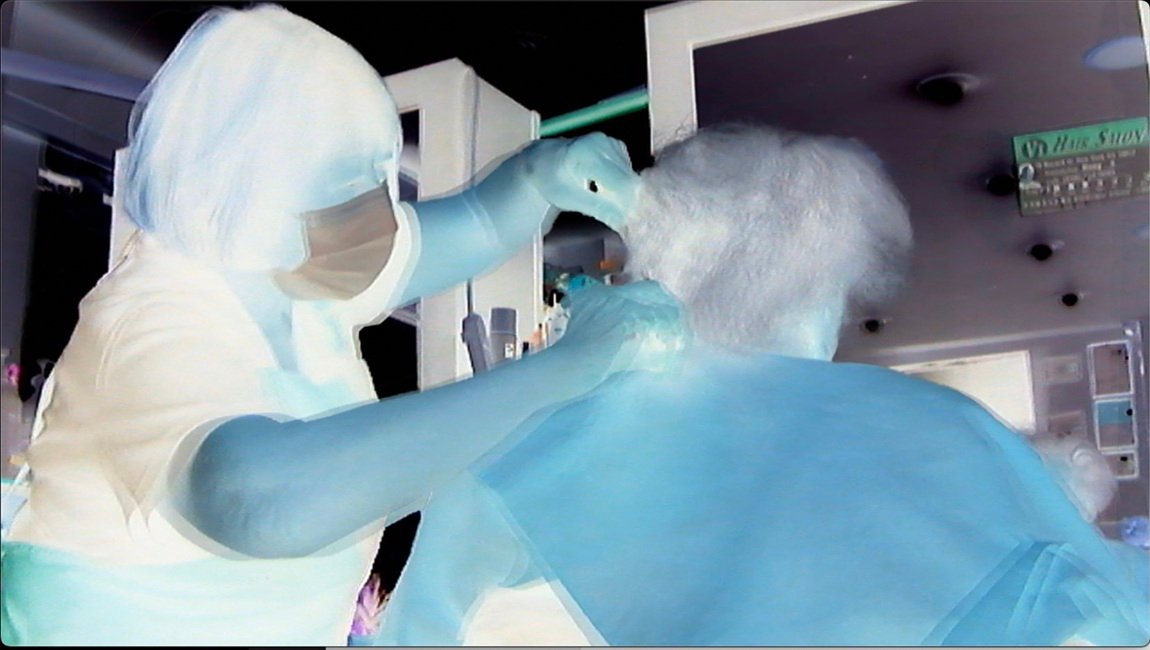
All of which brings us to A Date with Shirley. Shot in 2025 and completed earlier this year, this is Jacobs’ final medium-length project. Over the course of its 48 minutes, Shirley unfolds in something close to real time, which in itself reflects a significant shift in Jacobs’ usual working methods. Most of his films seem to compress or protract time, on the assumption that ordinary temporality rhymes a bit too closely with our habitual ways of navigating everyday life. In A Date with Shirley, Jacobs has paid a visit to his haircutter in Chinatown. (Her telephone number is featured in the opening credits, so in a strange way this could be Jacobs’ first ever filmed commercial, his wry riposte to Peter Kubelka’s Schwechater.) Over the course of the film, Shirley gives Jacobs a haircut, and shampoo, and a blow-dry. At the end, his children, Azazel and Nisi, help him up and walk him outside. The end.
There are certain things that we recognize as viewers, quite apart from Shirley’s formal strategies. Jacobs is an elderly man, quiet and only tentatively mobile. We are witnessing a moment of familial elder care, a man being cared for by his two adult children, not long after the death of their mother and not very long before the man’s own death. There is a tenderness in this scene that anyone can recognize, and it is something most of us have experienced or will, eventually. The salon is a small urban space, bustling with activity, but our focus remains on Jacobs as Shirley plies her trade. As has always been the case for Jacobs, this is a socialist film about the value and dignity of human beings and their labor. But it is also about an ethic of care. An older woman gently grooms an elderly man, helping him maintain his aging body.
A Date with Shirley is also unusual in that, unlike most Jacobs films, it is a three-camera affair and features conventional “coverage.” Jacobs holds a camera in his hands, pointing from the chair into his reflection in the mirror. On the side of the shop, Nisi films her father in profile. And in the far corner, Azazel holds his camera aloft for high angles. The placement of mirrors in the shop redoubles these camera positions, so Jacobs is at the center of a network of interconnected viewpoints. Also, all three camera operators judiciously avoid capturing Shirley’s face until the end, when she agrees somewhat reluctantly to let Ken shoot her straight on.
Upon this familial home-movie canvas, Jacobs engages in his usual forms of play, and a couple of new ones. The image frequently freezes to allow the color-negative flicker and stereoscopic pulse of the Eternalism 3D mode. Some of these moments feature Jacobs prominently as a subject of self-portraiture, while others emphasize details within the shop or the arrangement of bodies positioned around Jacobs in the barber’s chair. These electrified freeze-frames allow us to notice the crowded shop in all its details, replete with bottles and tools, plants and chairs and cluttered shelves. This film also helps one realize Jacobs’ relationship to Ozu, how close formal attention to ordinary spaces can focus the viewer’s attention, renewing those forms perceptually like a Cézanne still life.
But there is something here that hasn’t been seen in Jacobs’ previous films. In his Eternalisms, Jacobs has often magnified certain parts of the frame, or used digital tools to crop or remove portions of the image in order to isolate others. But in A Date with Shirley, Jacobs uses something like the new “stickers” tech from our phones, wherein the camera reads the image as a set of bounded, recognizable objects and then lifts them out of the larger visual field. In various moments, Jacobs’ own image, that of his children, or just isolated pockets of space, become floating forms in a black field. Just as Jacobs détourned the standard use of .gif files, here he applies the visual gimmicks of Big Tech for completely different ends. What is designed to merely categorize and excerpt the image — “this is a thing, and now you can have it anywhere you want it” — becomes an iris, a close-up, a cameo, a way to instigate active part/whole relationships.
Over the years, when writing about Ken Jacobs’ work, I have sometimes compared him to Jean-Luc Godard. Although their projects were very different, both men shared a devotion to unpacking the image, manipulating it, politicizing perception at a fundamental level. In addition to this, both men shared a sense that each individual work, while having its own integrity, is also an entry from a much larger audiovisual encyclopedia — an excerpt from their entire corpus, yes, but also from the cinema as a whole. So as I watched A Date with Shirley, I thought about Godard’s final film, Scenarios.
That film ends with a shot of a tired, half-dressed Godard sitting on a bed, announcing, “I’m ready.” Godard knew full well that this was the last image he would produce, and the final words he would speak on film. Jacobs, though, was in no way making a “last film.” Clearly fatigued and increasingly frail, Jacobs’ body of work concludes with a very different image. He is not isolated like Godard, but instead surrounded and supported by loved ones. Azazel asks his father if he wants him to go bring the car around so they can head home. But Ken says no, he is not ready to end their outing yet and tells Azazel and Nisi that he’d like to go down the street to a bakery. The film ends suddenly, in mid-gesture, implying that it could have continued onto the next location, the next small but vibrant experience. With this abrupt non-conclusion, Jacobs suggests that the film never really ends. Rather than completion, he chose eternity.
Published as part of First Look 2026.
Comments are closed.