
For an artist whose conceptions of cinema constantly evolved with the developing technologies and audiovisual forms, it’s a bit of a shame that Ken Jacobs’ memory is enshrined by his playful, but relatively anodyne time capsule, Little Stabs at Happiness (1963), in a curated series of experimental shorts at the First Look Festival titled “Little Stabs.” Considered an avant-garde landmark at the time, the film is trapped in the specificities of its time, milieu, and the intimate circles of Jacobs’ avant-garde community — one that, in the light of Jacobs’ oeuvre, doesn’t do justice to his radical eclecticism, which relentlessly interrogated the multiplicities immanent to the image while imparting a sense of vibrant urgency and wonder even amidst his incisive polemics. However, to give First Look’s programmers, Genevieve Yue and David Schwartz, their due, the lyrical evocation of the title pays tribute to not just Jacobs, but to all purveyors of an avant-garde, termite cinema, one that expands the possibilities of the medium by nibbling at the boundaries of their subjects. Though many of the selections aren’t entirely successful in this aspect, the best of them reframe their audiovisual materials through their environments and perspectives to peel the layers of polemics, politics, and poetics lurking within.
Alexander Koberidze’s The More I Zoom in on the Image of These Dogs, The Clearer it Becomes That They Are Related to the Stars (2023) is among the more high-profile entries in this cinematic excavation. Filmed in response to Hungarian composer and one of Bela Tarr’s key collaborators, Mihály Vig’s melancholic, slow-tempo piano score undergirded by the subdued, yet eerie movements of a cello at a lower octave, Koberidze slowly zooms toward a low-res photograph of dogs in a balcony. With a title containing both the synopsis and a statement of intent, The More I Zoom in… is a more modest, yet integral entry into Koberidze’s investigations of the poetics of what Hito Steyerl calls “the poor image.” The pixelated imperfections, seen as awkwardly shaped building blocks assembled to form objects when viewed from afar, gradually dissolve into stellar abstractions with each infinitesimal camera movement, but Koberidze connects these pixels to stars not just in the abstract in terms of their shape and glints, but also in the sublime, ending with an upward tilt from a void of darkened pixels in the image to a region of overexposed brightness.
Janie Geiser’s Slideshow (2024) and Peng Zuqiang’s Afternoon Hearsay (2025) also turn their attentions to the materiality of the image, but their focus is geared toward film strips as opposed to Koberidze’s digital image. While the digital container allows Koberidze to leap into the cosmic, the fragility of the film medium and the haziness of their provenance bring the historical into play. Slideshow, another film title which performs the dual role of synopsis and intention, constructs its scenes around found film slides from a Berlin flea market of people unknown to the filmmaker. This unknowability certainly induces a historical vacuum, but it is this very unknowability that stirs Geiser’s imagination, aggressively subjecting the film slides to rapid and slow motions, fragmentations, chemical processes, filters, geometric transformations, and cutting, all to a dense, musique concrete score that combines gentle orchestration with the sounds of sliders, scanners, and projectors modulated to various speeds. The questions of who and what gradually morph into the how, where vacant sites are peopled with creative ideas.
The historical is much more apparent in Peng Zuqiang’s film, which looks at the 8.75 mm film format, one unique to China and for which no camera was made. Afternoon Hearsay therefore foregrounds the film strip itself, reviving a forgotten film format and the scattered histories associated with it. Having no vessel of its own, the 8.75 mm films are printed onto 16 or 35 mm films, and like Slideshow, the images are subjected to filters and patterns of their own. But the complications of projection are directly addressed through juxtaposed footage along with some voiceover narrations surrounding the 8.75 mm and its dissemination. Muddled histories are further muddled through our anachronistic lenses and methods, but, as these two films show, that is no reason to shy away from or dispel the haze.
History, in Basma Al-Sharif’s films, and especially in her homeland of Palestine, aggressively asserts itself, with fascistic narratives and actions increasingly obscuring historical and present injustices. In Old Masters (2025), Al-Sharif thrusts the Palestinian genocide and displacement onto the hallowed halls of art museums, institutions that seemingly offer a blissful retreat from the political. Al-Sharif does a lot more than simply assert that art is political, a point which sadly still needs asserting in public spaces, opening new ways of seeing and engaging with history, art, and politics. Two tracking shots in the museum are superimposed over each other, each following two different people in the museum and their gazes. As their paths gradually diverge, various artworks are displaced from their original settings, expanding the rooms and allowing art reflected through multiple perspectives to converse with each other. She repeats a similar superimposition in an orange orchard in Gaza, with only one person this time instead of two. But between these two scenes, Al-Sharif rewinds the museum-goer’s motions and superimposes it over an overhead shot of Gaza with bombed buildings. The past is dragged into the present tense, both obliquely and directly, where both privileged and bombed spaces reveal methods of engagement that are striking in their similarities and differences.
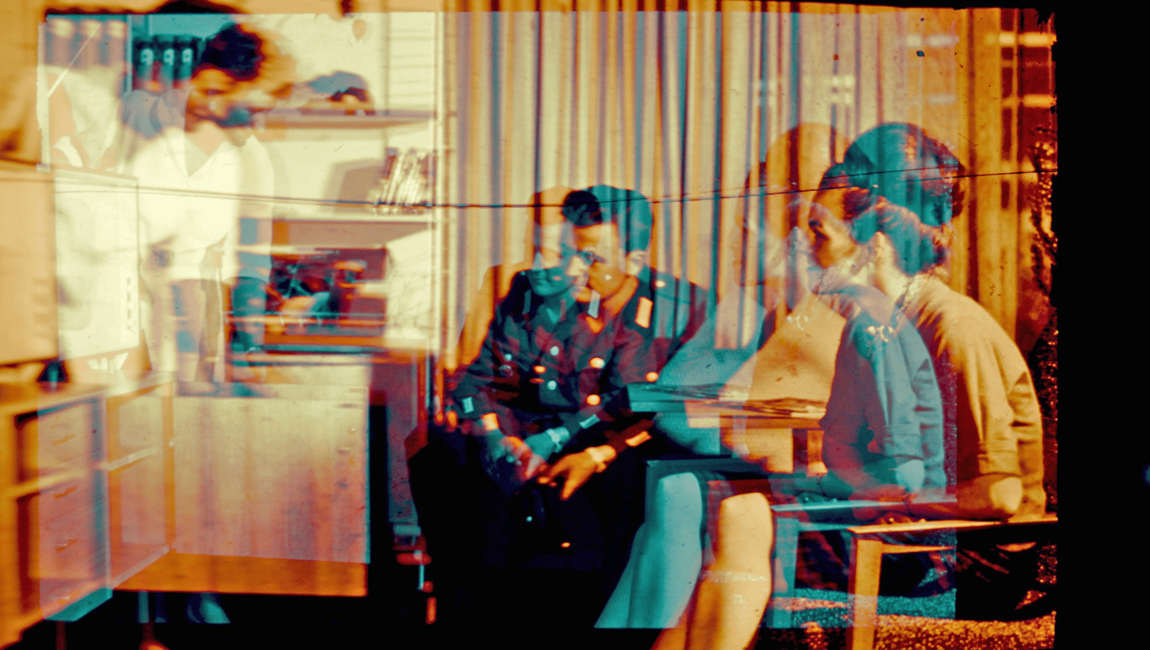
Jordan Strafer’s Dissonance (2026) opts to wrench the past into the present through an ‘80s style TV show pastiche, where a veteran dressed in military clothes asks his audience to close their eyes. Perhaps Strafer intended his movie to be watched and heard to accentuate the dissonance, but his film is insufferable to the eyes and the ears. (Another film in this program, Lewis Klahr’s Orpheus [2024], also instructs us to close our eyes, as colored lights flicker on our shut eyelids to The Byrds’ “Here Without You.” Orpheus posits a new way of engaging with cinema, while also giving one a better method to get more work done through its instructional intertitle, “Eurydice is depending on you.”) Strafer proves to be an expert at reality TV decoupage, though, with calculated reaction shots of teary audience members and outsized superimpositions of their faces. But with a film that is essentially dimestore Freud brought you by the U.S Army forces, Dissonance offers nothing more than expert reconstructions and psychobabble.
Instead of these smug pastiches, Callum Hill tries to critique the U.S by immersing her film, E Minor (2024), in the conflicting attitudes, ideologies, and contradictions of post-COVID USA, commingling footage shot on film and iPhones with archival footage. She extends her omnivorous approach to the aural as well, like many of the films in this program, overlapping sounds from different sources on the same frame, stopping, replaying, and speeding them up. But despite her relentless activity in the editing room, the images seem strangely anaesthetized, almost as if all these strong ideological passions are meaningless in the face of rampant neoliberalism. For a film that attempts to “journey into the sociocultural unconscious of western identity” (from the film description), the dominant feeling is that of enervation.
Among others, our time is characterized by both a heightened acceleration of climate change and a heightened awareness of our influence on the climate. Artists have always homed in on the tensions — productive and destructive — between human and “natural” landscapes, and Kyath Battie’s wonderfully titled Super, Natural (2025) can count itself among the bearers of this tradition. When “pristine” natural environments are being rebranded as retreats for the rich and zones are designated in forests for our consumptive, viewing pleasure, the already porous boundaries between nature and urban spaces are now marked by intrusion and transformation. Battie underscores these intrusions through the blatant artifice of his images, where rocks projected in the foreground are complimented by rear projections of light shows. Crickets chirping provide the background score for light shows in the city, while electronic scores are heard on the islands. This blending isn’t seamless, with Battie accentuating the distinctiveness of each of his elements, rendering all our distinctions as nothing more than our “artificial” constructions. Perhaps the horror of this prompted Marco Godoy to start anew in The System (2014), eliminating sound in the first two scenes by only showing a triangulated light source beaming across the ocean. But resistance and reimagining emerge from the tools we have, so he erects a large speaker on an island, with a voice reading Eduardo Galeno’s The System that asks us to suppress the past and colonize consciousness.
Kate Solar’s (for once I dreamed of you) (2025), where both visual and aural forms are deliberately obscured, isn’t exactly the start of something afresh, but is a film that retreats from our material reality. Scratches are both seen and heard in the narrative, with Solar accentuating the grains in her images. Slow motions enhance the vagueness of forms rather than clarifying them as the narrator and camera appear to roam across a field with water streams. Recalling Godard’s famous capsule on Becker’s Montparnasse 19 (1958), Solar’s film is a beautiful leap into the void, an oneiric construction that flagrantly violates all institutionalized cinematic norms. For a program that wishes to “reconsider our relationship to the images onscreen,” there can be no better end than a film which wishes to do away with the image altogether.
Published as part of First Look 2026.
Comments are closed.