
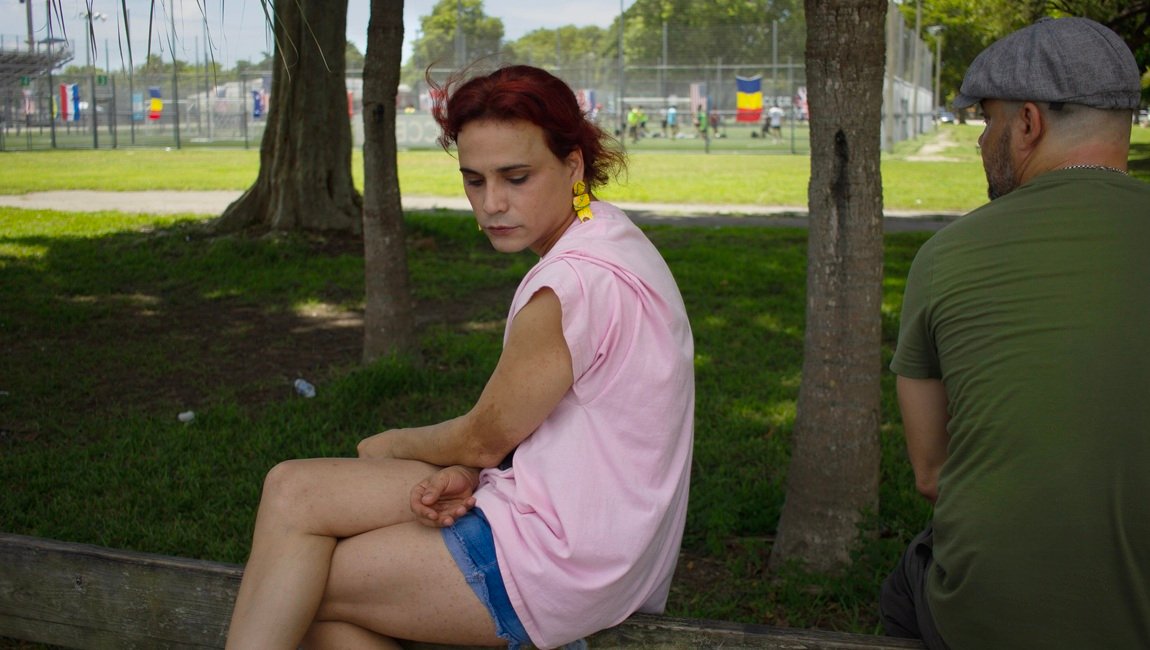
Hansel Porras Garcia’s sophomore feature Tropical Park accomplishes a remarkable feat in cinema. In any other film, the depiction of a fraught encounter between a long-estranged brother and sister would be, based on their characters’ backstories and experiences, the stuff of exquisite melodrama. Full of love, tragedy, missed opportunities, unfortunate mistakes, and serendipitous reversals, the lives of Frank, a conservative integrated Cuban immigrant (a large Trump flag festoons his front yard), and Franny, a trans woman and an immigrant as of one month ago, are instead conveyed in the most humble of forms.
Garcia conceived of the film without a traditional script. Instead, working with actors Ariel Texido and Lola Bosch, Frank and Franny respectively, they improvised the entire film based on a dozen-page treatment. Further still, the film is done in just one take, the camera fixed to the back seat of the disused car Franny has just inherited from her dead father, and with which Frank is taking her to her first driving lesson at the titular Tropical Park in the suburbs of Miami. It’s a formal conceit reminiscent of James Benning and Bette Gordon’s The United States of America (1975) and David Easteal’s The Plains (2022), but even more extreme.
The camera’s immobility is more than just a clever cost-saving technique. Because we rarely see Frank and Franny’s faces in full, the challenge Texido and Bosch face — and conquer — as actors is to convey the range of human emotion through the backs of their heads. The viewer, in this dynamic, is not a fly on the wall, clandestinely observing some secret drama, but a fellow passenger, albeit a passive one. Only the occasional glimmer of their profile or flash of their eyes in a mirror provide a more traditional entry into Frank and Franny’s psyches. Even when, after an argument about the conditions of Franny’s continued stay in Frank and his wife Erika’s home, they leave the confines of the car and face the camera directly, they’re far enough away that the viewer can’t focus on the details of their faces.
Paradoxically, though, Frank and Franny never feel far away, and it’s a testament to the supremely natural performances by Texido and Bosch that the collapse of emotional distance between performer and audience mirrors that of their characters. Perhaps a nod to the melodramatic elements of the characters’ backstories, Franny asks Frank to let her boyfriend — in Mexico, awaiting his chance to cross the border — stay with them, at almost the same time that Frank lets Franny know her time in his house is coming to an end. The expected bouts of anger and lashing accusations unfold in waves. Frank is at once cold and pragmatic, Franny justifiably upset and a little bratty. Over a 40-minute stretch while the car is at a standstill in the parking lot, we feel their pain double over each other’s.
Garcia’s political commentary is sly. While Frank’s conservatism and Franny’s trans identity are mentioned explicitly, they’re never the textual material of their conflicts. Instead, the film wades into what it means to make calculations around familial allegiance, in Frank’s case weighing a bond of blood that has been neglected against a bond of marriage that saved him. The result is a film without easy — or, really, any — villains, just the complicated, ambivalent foibles of people trying their best under difficult circumstances.
Published as part of First Look 2026.
Comments are closed.