
There was a time not so very long ago where, hard as it is to believe these days, East Asian cinema was commonplace among the hipper video stores and movie theatres of America. Hong Kong action films, Japanese horror pictures, Korean action and horror movies, and more were the cutting edge among genre film fans, Jet Li and Jackie Chan headlined Hollywood movies, and arthouse audiences thrilled to the colorful spectacles of Zhang Yimou and Chen Kaige, the austere minimalism of Tsai Ming-liang, Hou Hsiao-hsien, and Edward Yang, and the genre experiments of Takashi Miike and Takeshi Kitano. At the heart of that boom was a new flowering of Thai cinema, led in the arthouses by Apichatpiong Weerasethakul, whose 2010 Palme d’Or win marked both the culmination and end of the major distributors interest in East Asian cinema, and in the grindhouses by the elbows and knees of the remarkable Muay Thai star Tony Jaa.
Right alongside them, however, were filmmakers like Wisit Sasanatieng, whose remarkable ode to classic Thai melodrama Tears of the Black Tiger was distributed (and butchered) by Miramax (like most every other East Asian film the Weinsteins got their sleazy paws on), and Pen-Ek Ratanaruang, whose 6ixtynin9 was a stylish exercise for the genre crowd and whose Last Life in the Universe, an off-beat minimalist romance starring Asano Tadanobu as a yakuza-turned-librarian, was one of the very best of the era’s popular arthouse fare. But while Weerasethakul remains a major figure in world cinema, though he’s only directed one feature in the last decade, Sasanatieng and Ratanaruang have seemingly fallen off the radar for all but the most dedicated non-Thai followers of Thai cinema, though they’ve continued to work steadily. Their films show up at a festival here or there, or on a streaming platform among the churning slop, but rarely to the kind of fame and acclaim their earlier films enjoyed. It’s tough to recall anyone talking about a Ratanaruang film in the 15 years since 2011’s lackluster thriller Headshot, but he’s back in 2026 at First Look, with his latest feature Morte Cucina.
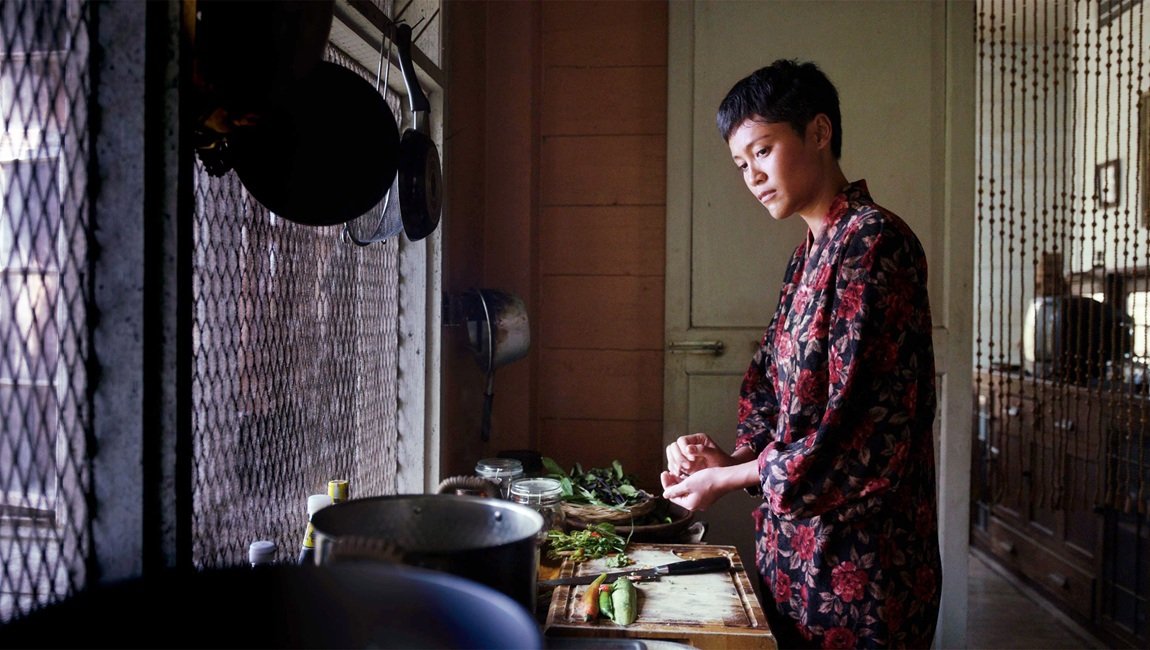
The film is a slow-motion rape-revenge film where a waitress at a nice restaurant (Sao, played by Bella Boonsang) recognizes a customer as the man who assaulted her some years before. Her revenge scheme plays out over several years: she seduces him away from his wife (an annoying dealer hyping the works of a silly artist played in a cameo by Asano), learns to cook, and does so in such a way that he cannot stop eating her food even though it is literally sucking the life out of him. One of his buddies suspects what she’s up to, and any tension in the film, aside from our trying to figure out exactly what she’s doing and how, comes from wondering whether or not he’s going to figure it out and put a stop to it before she gets away with it.
But as is befitting a film more concerned with mystery and allegory than clarity of plot and motivation — there are more scenes of corpse-fucking in Morte Cucina than straight-forward exposition — the atmosphere and mood is sublime. Christopher Doyle, who also shot Last Life in the Universe, serves as cinematographer, and his images of the lush landscapes and dilapidated homes of the Thai countryside are as luscious as his images of Thai cuisine. The early part of the film is confused a bit by a flashback structure that’s reasonably straightforward aside from the fact that the actress playing the young Sao looks nothing like the older version of the character. These scenes are desaturated, and hinge on the character coming from a particularly misogynist Muslim community, which seems a bit prejudicial, if not outright insulting. But the rest of the film is awash in Doyle’s characteristic colors, matched every step of the way by an enveloping soundscape of natural sounds (trees and water and insects) and the sizzles and boils of a first-rate kitchen. But to truly understand the quality of Ratanaruang’s film, all one need do is consider side by side with an American cooking-revenge movie like The Menu, with its thudding literalism and TV aesthetics. It’s depressing to see what we’ve lost in terms of craft and vision when we let Thai cinema disappear from our mainstream screens.
Published as part of First Look 2026.
Comments are closed.