
Museums always claim to be the home for lost religious art/anthropological objects — Alain Resnais’ and Chris Marker’s Statues Also Die tackled this patronizing and orientalist classification in 1955 — despite many of them being of dubious provenance, to put it rather mildly. Though I am not religious, a sharp dissonance overwhelms me whenever I see the religious idols of Hindu Gods I grew up with adorn the spaces of the museum. The religious object has now been secularized, but it has also been divorced from the space it was originally meant to be in, collapsing all the historical, traditional and (living) religious significance onto a few lines on the placard accompanying the object. Even objects from “dead” cultures emanate this loss, as an exceptional scene from Alice Rohrwacher’s La Chimera (2023) showed, where the protagonist, Arthur (Josh O’Connor), throws the statue of Cybele into the ocean because it was meant for the dead rather than the living. Some defenders might argue that museums allow us to appreciate these religious art objects better, individuating them and letting them breathe, rather than languishing in obscurity as one among many in houses of worship. Sometimes, these objects have no alternatives other than in museums to preserve them better, especially when their housing has been damaged. But thrown in an alienated space, these objects end up conversing with other alienated objects from different eras, histories, and aesthetics, lending a palpable sense of loss wrought by this severance of aesthetic, historical, and sociopolitical unity, a unity chiselled and molded by the vagaries of time, traditions, and cultures. They are now merely pretty art objects from a distant time and space, with their history and provenance being mere markers of their value as a commodity.
This rapacious colonial-capitalistic decontextualization in museums, subject to a small but insightful sub-chapter in Perry Anderson’s Imagined Communities, isn’t exactly unique to the Occident, with many countries following suit to showcase art objects as national pride. However, it does mask a power-differential when appropriating significant objects from oppressed communities in the name of preservation, science, and/or study. It is this injustice which is the subject of Zack and Adam Khalil’s Aanikoobijigan [ancestor/great-grandparent/great-grandchild], a film that documents the digging of tribal burials by archaeologists and the fight by a collection of Michigan tribes to retrieve them. Initially dismissing their concerns by branding Native Americans as enemies of science, the U.S. government finally ratified a law which mandated museums to return the remains of their ancestors to them. But museums, being cut from the same corporate cloth, played the bureaucratic loophole game on the tribes, shifting the burden of proof to the tribes while conveniently constructing dioramas of tribal life with information gleaned from these remains. And just like their corporate donors, they publicly bemoan their existence on “stolen land,” reducing repatriation to slogans of performative sentimentality. Zack and Adam Khalil dispel these illusions in their first few frames, showing tribal objects and dioramas reflecting off each other in their glass cages across different museums, immediately addressing the looting of objects and bodies through graphs that go hand in hand with their compositions.
Aanikoobijigan, which can mean ancestor, great-grandparent, or great-grandchild, is both a discursive film that addresses Native American concepts of time, nature, and space, the historical and political motivations of museums, and the biases and power dynamics undergirding “scientific” endeavors, and a heartfelt chronicling of the efforts of MACPRA (Michigan Anishinaabek Cultural Preservation and Repatriation Alliance) to repatriate their ancestors to their land. Zack and Adam Khalil are well aware that this is far from common knowledge, so they construct their film as a pedagogical tool, replete with talking heads, archival TV footage, and figures. Key points raised by the MACRA members and historians flash on the screen in giant caps bathed in a luminous glow to further emphasize them. This certainly embeds the ideas in the minds of the viewers, and while there is no denying the necessity of it, it certainly comes at the cost of the camera and editing being mere reinforcing agents, rather than conversants with the history. Their aesthetic ideas are sometimes cut short because of this approach, such as their rhyming tracking shots across museum vaults containing their ancestors’ remains and forests, accentuating the spiritual displacement wrought by the callous looting. The filmmakers did mention the need for centralizing the “content” in this documentary in an interview, but they also mention the felicity of cinema to handle this subject because of its malleability with respect to time and duration, concepts which come to the fore in dazzling, but alas, fleeting, shots of forests throttled by a vast array of colors and motions when a historian talks about the Native Americans’ fluid conception of time, where, as the title indicates, past, present, and future collapse onto each other. Though one understands the need to get these points across, such concepts need more room to breathe, and a pedagogical approach needn’t be incompatible with these aesthetic ideas.
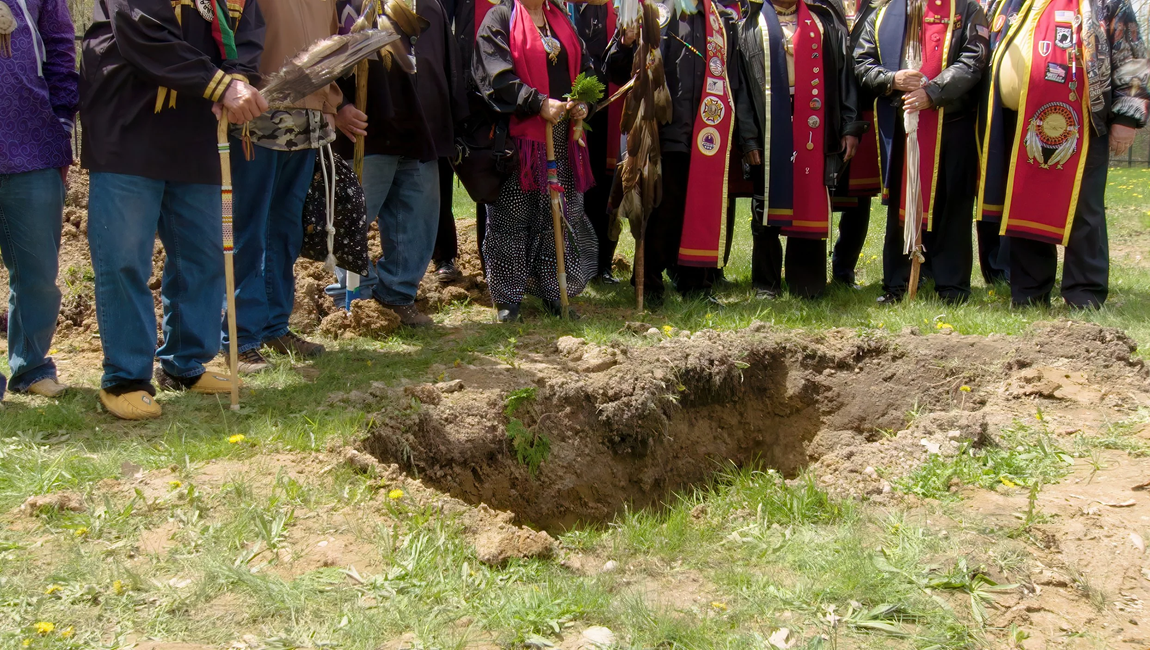
But as a chronicling of the struggles and, eventually, the small successes of the MACPRA members, Aanikoobijigan takes care to emphasize the emotional resonances affiliated with museum “objects” for the communities concerned, an aspect which most museums and museum-goers readily ignore. Their willingness to question “august” institutions and their operations certainly brings ideas seldom discussed to the fore, while also dismantling our assumptions and received wisdoms. The shots of the members finally burying their ancestors after their long drawn-out battle, though tinged with the feeling that more work needs to be done, are a beautiful reminder of the relations between objects, humans, and traditions, and how we callously and hypocritically disregard them whenever we encounter objects outside our own culture.
Published as part of Prismatic Ground 2026.
Comments are closed.