
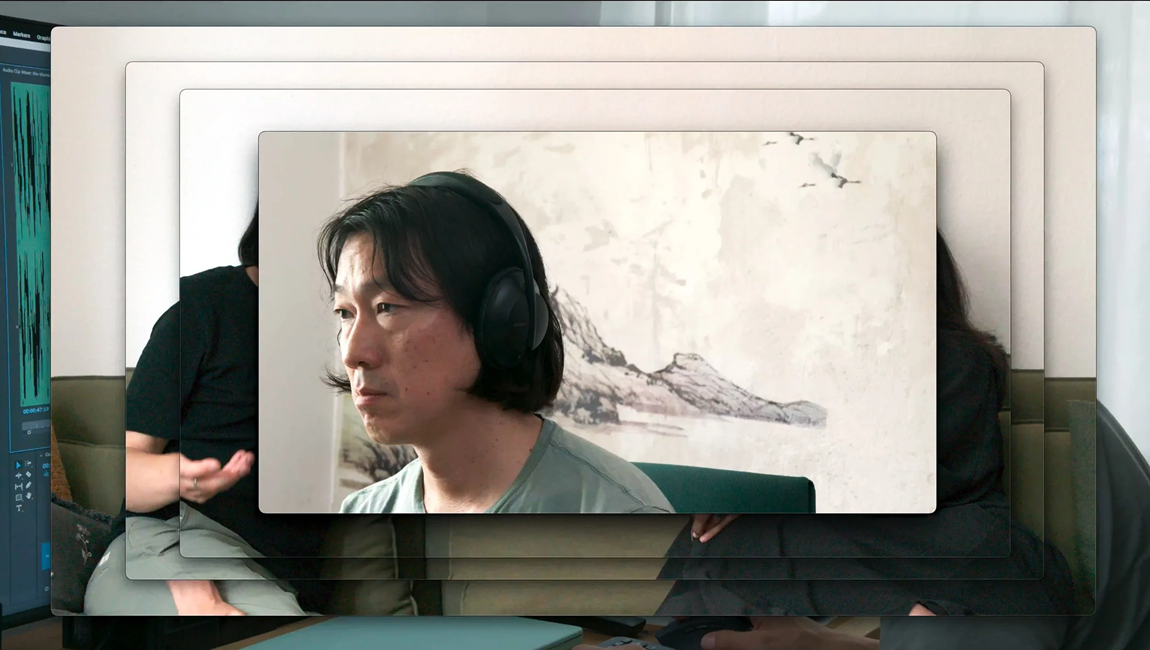
In 2020, Kevin B. Lee and Lého Galibert-Laîné released Bottled Songs 1-4, an epistolary essay film constructed via Lee’s desktop documentary method. Divvied up into 4 “letters,” or chapters, two by each filmmaker, Bottled Songs charts these artists cataloging and dissecting various extremist videos and other Internet-based images, attempting to make meaning of them and how they impact potential viewers. One of the chapters finds Lee investigating an Isis propaganda film that is purposefully designed to mimic the formal attributes of a mainstream Hollywood action spectacle, and which Lee makes efforts to interrogate via the language of a film critic. His new work, and his first feature-length effort, Afterlives uses that initial interrogation as a jumping off point for a much longer, more expansive look at the images and videos disseminated online by ISIS. Writing on Bottled Songs, critic Patrick Dahl said that “examining the production and consumption of horrific documentary imagery has gone from obscure academic study to basic life skill…. to work out some of the contours of a photographic regime that implicates us all.” Afterlives is Lee’s attempt to catalogue and make sense of this phenomenon, one that “implicates” not only the makers of these images, but also us, the viewer, simultaneously.
Afterlives is also a film very much about its own making; Lee is weaving together several different modes here. There is his own “desktop” style, where the flat, 2D surface of a computer screen becomes the film frame, and we see the step-by-step interactions of a cursor opening folders and navigating multiple windows of various images and text fields. There is also more traditional documentary footage, as Lee interviews subjects in typical talking head fashion, as well as a tour of an art exhibition that becomes a sort of fulcrum by which the rest of the film structures itself. Early scenes of Afterlives show Lee returning to the video Flames of War and his attempts to understand “the visual rhythms of terror.” But, as the filmmaker states “In trying to see through the violence, I only went deeper inside it.” Traditional formal analysis hits a brick wall when confronting such awful images. He then visits an art exhibit in Germany, where various still images and objects are arranged on a latticework of shelves, in effect mimicking Lee’s own desktop method but in a real, 3D space. Amongst the artifacts on display is a 3D-printed replica of a Medusa bust, an ancient bit of sculpture destroyed by ISIS in the efforts to obliterate Iraqi and Syrian culture. This Medusa bust is also an interactive hard drive that viewers are encouraged to plug into and interact with; it features numerous folders, each containing reams of digital images and information. Lee seizes upon the bust of Medusa not only as a physical object or even a symbol, but a broader metaphor of how we bear witness to the digital ephemera of the global War on Terror. As a curator states, the Medusa metaphor reflects how audiences become “petrified” when faced with images of terrorist acts.
Lee will go on to interview artist Morehshin Allahyari, responsible for the Medusa head, and two counter-extremism researchers, Nava Zarabian and Anne Speckhard. Allahyari speaks on the difficulties of rescuing destroyed culture, first making detailed files freely available so that anyone can reproduce her 3D-printed artifacts. But she soon changes course, concerned that her efforts to “collectively resist the act of forgetting” have instead turned into “digital colonialism.” She explicitly states her fears that such easy reproductions instead reinforce stereotypes of Western societies as “civilized” and Muslim societies as “barbaric terrorists” (Lee helpfully illustrates her point by juxtaposing her interview with a video of a politician unveiling a replica of the Arch of Triumph in London and referring to “barbarians in the Middle East”). Carrying on, Zarabian is a youth protection specialist, and is introduced speaking about a propaganda video made by some young boys praising the Islamic State. While showing this video on her screen to Lee’s camera (more images within images), she uses her hand to cover up the faces of the young boys onscreen, so as not to identify. She goes on to describe the difficulties in explaining her job to friends and family due to its extreme nature, but also how her colleagues have ingrained racist and sexist attitudes that cause them to miss certain signifiers — accordingly, Zarabian and Speckhard are both concerned with deprogramming.
For its part, Afterlives embarks on all manner of discursive asides, accruing more and more information as it proceeds but always careful to bring things back to Lee’s initial starting point. There are plenty of fascinating moments, like Lee pointing out while watching a German news program that they only show Isis footage on computer screens located behind whomever is speaking to the camera, as if to “contain” the images on a screen within a screen. He meets a researcher who develops PTSD from watching too much atrocity footage, who then in turn faces pushback from colleagues for “playing victim” because the researcher has a choice to watch these videos while the subjects on display do not. Ultimately, the lessons here become crystal clear: as the atrocities of the 21st century become more accessible than ever thanks to the proliferation of digital cameras, security footage, and social media, what are our responsibilities as viewers? How do we make sense of what we scroll past on our phones, images piling up on each other via a never-ending stream where everything becomes fleeting and ephemeral, a constant past-tense? Lee doesn’t have an answer, but he’s interested in giving viewers the tools to work things out for ourselves.
Published as part of Prismatic Ground 2026.
Comments are closed.