
About a million Russians have left their country since the beginning of the full-scale invasion of Ukraine, fleeing the draft and/or political repercussions for dissent. To put the numbers into perspective, if all those people were to settle in a single American city, it would be right near the twelfth or thirteenth largest city in the United States. The novelty of Patric Chiha’s Russian-Ukraine war documentary lies in using these expatriates as its vantage point. A Russian Winter is unlike any other film about the war.
The conflict and its human cost intrigued Chiha, but after spending time in Ukraine in 2024 for a film festival and meeting Ukrainian filmmakers, he left, understandably, with a conviction: “It’s up to them to tell their story.” That’s how he arrived at telling a story that he was more equipped to tell, one of migrants and refugees adapting to life in new lands while conflict bubbles at home. Chiha, who lives in France but was born in Austria to Lebanese and Hungarian parents, knows a little something about migration and the way it shapes one’s identity. His documentary focuses on the lives of young Russians abroad as a glimpse into the itinerant and dispossessed lives of these “traitorous” expats, and the director spends most of the time with two platonic friends named Yuri and Margarita.
A Russian Winter is destined for controversy. Some will dismiss it for merely centering Russians and Russian speakers with no material connections to Ukraine. (The closest we get to this is one of the young men discussing watching footage of the war captured by Ukrainian soldiers.) But Chiha doesn’t set out to tell that story — nor does he erase Ukrainian voices in the process. This isn’t really a film about the war at all. A bigger problem isn’t the kinds of voices or what language they speak, but the voices themselves. The four lead subjects are, to varying degrees, living good lives, lack the rhetorical skills to adequately voice a full moral clarity, and instead speak in vague anti-warisms. Even their psychological trauma, if it can be called that, remains untapped.
One of the film’s more trying moments takes place on the bourgeois beaches of Istanbul, where the beautiful images of luxury strip the dissidents’ words of their sympathetic potential. Yet it never feels as if the director is ever aware of this disconnect. The stitching of footage of Yuri’s rock music, from his band Anti-Utopia, and the long wordless stretches testify to this; they are distasteful reminders of the privilege of leisure time these dissidents find in great supply. They aren’t engaged in any sort of actual political resistance to the war that we see; they are the Russian equivalent of the Democratic Party: all lip, no bite.
“We are not victims, but we can rely only on ourselves and those close to us,” one character entrusts. In translation, the “but” denies the first clause. Grammatically, this is an apophasis (or a paralipsis): the subject is only brought up in the first place by being denied. Think of the manipulative partner or parent who protests, “I won’t even bring up that time you hit my car,” while, in fact, bringing up the subject of hitting their car. Nobody really wants to think of these Russians, soaking up the sun on beautiful Black Sea beaches, as victims — and they know that. That is why one of them insists they are not victims, which, of course, makes victims of them anyway.
The non-invasive, non-interview style damages A Russian Winter’s ability to cut into the characters’ psyches. As Chiha stated in an interview for The Upcoming, he doesn’t speak Russian and had to use a translator, who couldn’t always be present while shooting. There were entire days of shooting where Chiha had no way to effectively communicate with his interview subjects. When one man hypothesizes his own inclination to dissent, he does so by connecting it to his family’s history with regard to the post-October Revolution (another move to victimization). Members of his bloodline were shot and killed, he tells a friend. Just as this train of thought becomes compelling, the generational interrogation winds down. Why were they killed? Does he mean to draw a line between Putin and Lenin?
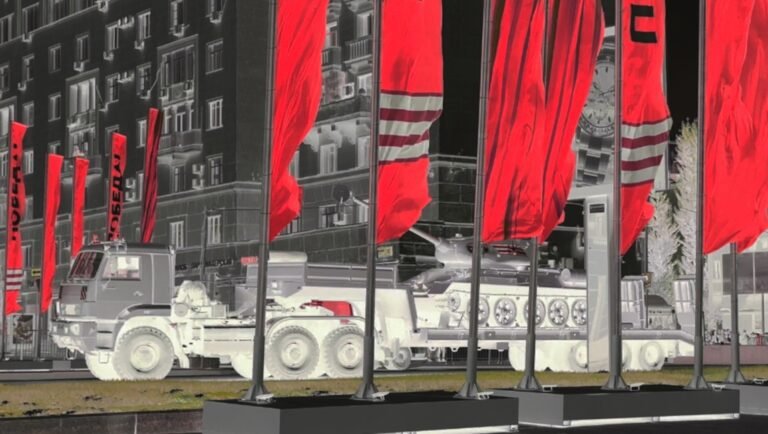
To his own disservice, Chiha’s flashy cinematography turns their individual stories into a meta-narrative about the war. Thermal or x-ray-like imagery of Russian streets with red banners that bleed through the monochrome black and white opens the documentary, and the only signage he translates is the writing on the banners, “Victory!”, as tanks crush dirt on the streets. The strange and experimental imagery sets up the premise of “seeing through” the jingoistic pageantry like an X-ray, and he also uses CGI to mask specific buildings, as if to make the film more ubiquitous, more universal (as well as to, according to Variety, preserve a semblance of anonymity of the subjects, as if that were still possible). Removing the specificity of the locations can also be interpreted as making generalizing statements, as if the film is suggesting, “This is Russia. This is political dissent.” It’s not. This is a film about boring, non-political, anti-war Russians. Silver lining: at least they aren’t Putin bootlickers.
Published as part of Cinéma du Réel 2026 — Dispatch 2.
Comments are closed.