
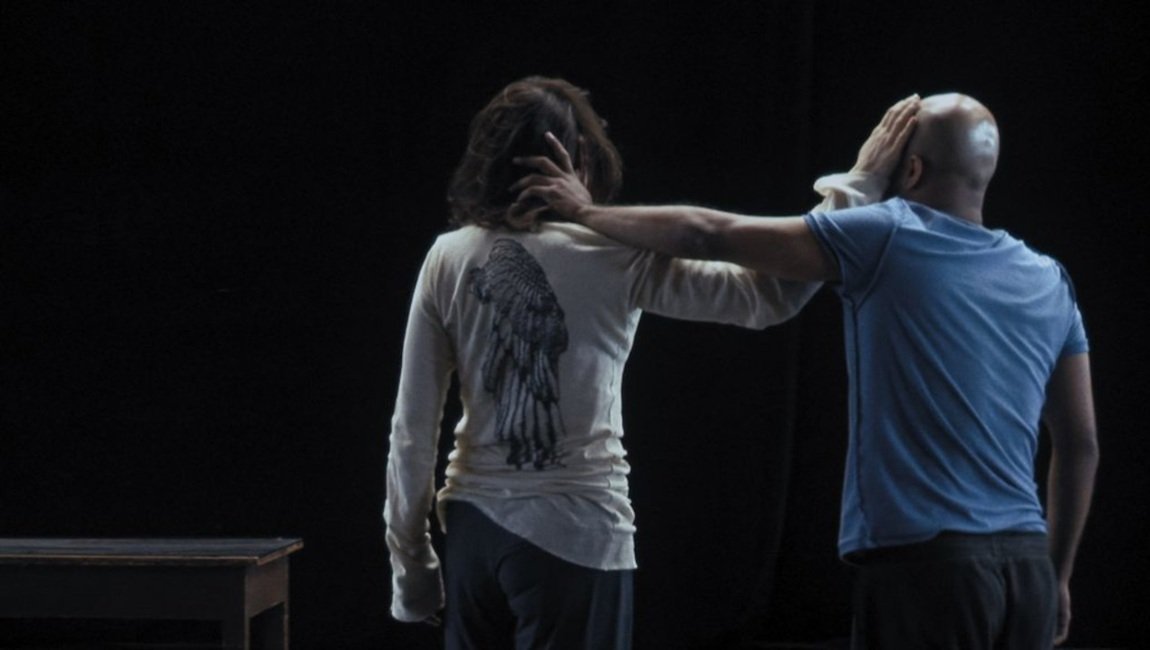
In-I In Motion
Where do you go once you’ve reached the top? By 2007, Juliette Binoche was running out of peaks to summit: she’d won international acclaim with Three Colours: Blue, bagged multiple Oscar nominations, including a win for The English Patient, and cast her lot for EGOT status with an acclaimed performance in Harold Pinter’s Betrayal. English-Bangladeshi dancer Akram Khan was enjoying similar levels of success: he’d toured the world in Peter Brook’s Shakespeare Company by the age of 13, performed original compositions internationally and launched his own dance company in London, and choreographed tours for Kylie Minogue. So, with little left in their respective fields to conquer, Binoche and Khan followed the lead of so many GOATs before them and took new paths.
In-I In Motion captures the fruits of Binoche and Khan’s respective and collaborative reinventions. The actor and dancer combined their trades to craft In-I, a choreographed theatrical production that toured internationally from 2008 to 2009. The show’s subject is straightforward enough — Binoche and Khan play a couple through the course of a tragic relationship — but its performance is demanding, an athletic feat that reduces both players to puddles of sweat by its end. Now, Binoche is adding another feather to her hat: that of director. In-I In Motion is both a making-of and a presentation of In-I’s full runtime, compiled exclusively of footage shot by Binoche’s sister, Marion Stalens. It’s an indulgent combination that offers little insight into Binoche and Khan’s artistic vision or the former’s directorial skill set.
At 127 minutes — reduced from a 156-minute cut that had initially screened across a handful of festivals — In-I In Motion can feel taxing. Its first half comprises behind-the-scenes footage of rehearsals in which Binoche and Khan hone their new endeavors and shape their performance. It’s gratifying to see a presence as magnetic as Binoche chop wood and carry water, especially when hurdles — distracting music, confusing notes from a dance coach — challenge the effortless precision with which she’s cemented her reputation. But these moments are rare enough to obscure themselves within In-I In Motion’s largely formless execution. Its documentary portion is nearly 50 minutes of placid exercise with barely enough conflict to yield a grimace or two along the way.
At times, it can even feel goofy. Binoche and Khan bring acting and dancing coaches into their rehearsals to help round out each other’s prowess. The former, Susan Baston, is the movie’s most kinetic presence: frazzled and boisterous, she commands the actors not as students but foot soldiers, barking commands like R. Lee Ermey and running deep emotional exercises with Olympic dedication. “Find her ass! Go for the knee!” she’ll shout as Binoche and Khan sweat ever more bewilderedly. But In-I In Motion’s edit renders her — and much of its documentary footage — a punchline. The movie crests a level of indulgence to feel like fodder for Christopher Guest; hard cuts to grunting and writhing sweep the legs of Khan’s catharsis after running through a scene about racial reckoning and Binoche’s breakthroughs on the dancefloor. Binoche and Khan are self-serious and wholly devoted to their production, but the footage is aimless and repetitive enough to threaten self-parody.
By the time Binoche’s movie transitions to the performance — nearly 70 minutes and shot with the utilitarian sobriety of a Broadway simulcast — In-I In Motion has spent the better portion of its good will. It’s a pity; In-I transcends the narcissism that dogs so many celebrity pet projects to arrive at a fully realized, formidable piece of theater. Both Binoche and Khan prove successful in their efforts to meet their partner’s expertise: Binoche matches Khan’s athleticism in each snap and pivot; Khan delivers a powerful monologue on the challenges a mixed-race relationship places on his character’s heritage. The set design — largely a single, spare red wall executed by British artist Anish Kapoor — is deceptively versatile and looms over its subjects with the command of a Rothko painting. But the performance’s placement within In-I In Motion demands more stamina than an audience is likely to wager, and the tedium of its documentary debits the impact of its final product.
It’s tough to divine why, after 18 years, Binoche decided to assemble In-I In Motion. Its footage is absent the talking-head or narrative reflections that often accompany similar retrospectives, favoring instead a moment and effort trapped in amber. Binoche and Khan were successful enough with their project to tour it internationally for over a full year; afterward, they returned to their native crafts with little evidence of In-I’s effect on their individual trajectories. In-I In Motion feels like a proof of life, an assertion that the performance indeed happened, that one can transcend a career path even at its peak. But its execution will do little to inspire similar risks. — CHRISTIAN CRAIG
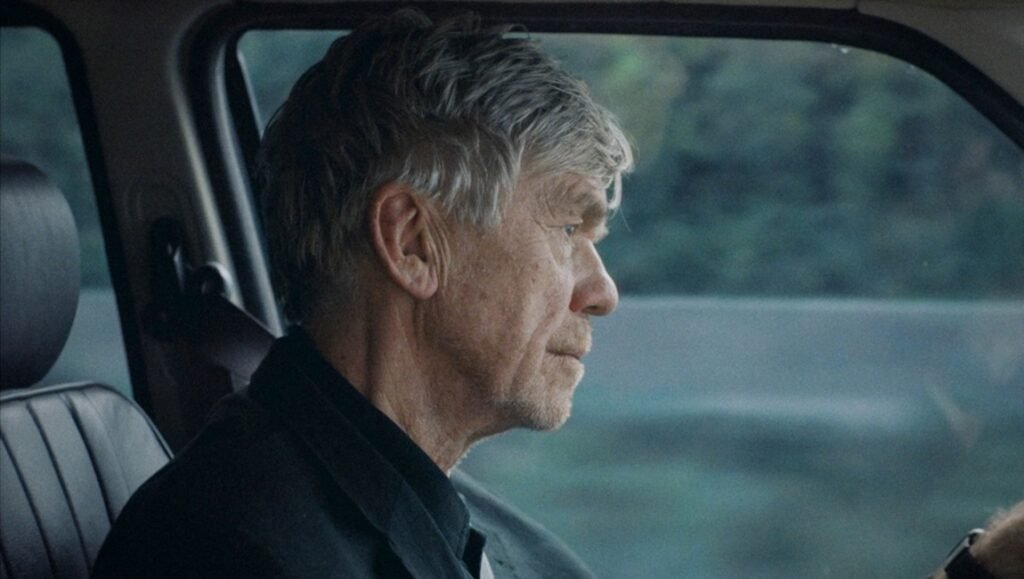
London
It’s easy to be lulled by the hum of rolling highways and pleasant conversation; they abound in Sebastian Brameshuber’s new film, London, which follows Bobby (Bobby Sommer), an aging but still restless pensioner, who makes regular trips between Salzburg and Vienna, Austria, to visit a sick friend in the hospital. To save money and enjoy something other than his own thoughts, Bobby picks up strangers in need of a ride along his unchanging route. This is a peculiar kind of road movie, less about the limitless possibilities of the open road than it is about confinement. The result reveals as much about the state of the world as it does the man in the driver’s seat.
The old adage of the road movie — it’s the journey, not the destination — holds up here. Not only do we never see one of Bobby’s passengers reach their destination, but Bobby himself never does. London is structured around scraps of ongoing conversations that have neither beginning nor end. The occasional pause, to pee at a rest stop, fill his Land Rover with gas, or rest his eyes, are exceptions to a seemingly unending journey affixed to a treadmill of Austrian autobahn. It keeps him in a kind of perpetual non-place between his vaguely estranged friend in Salzburg and a lonely life at home in Vienna. Adding another layer is the film’s production. The car interiors were filmed on a stage so as to make space for the conversations between Bobby and his passengers to unfold as naturally and uninhibitedly as possible — free from the distractions of the road.
This strategy seems to have worked. That’s thanks to Bobby himself, who, as both a captive audience and open book, has an uncanny ability to forge rapid, seemingly effortless intimacy with his passengers. One young woman talks about the struggles of living with her mother and younger sister, who have recently escaped Ukraine, and the sudden intrusion on her independence. Another is resigned over losing her parents’ support in the lead-up to her same-sex marriage. A young man, the first of Bobby’s passengers we see, is in the middle of mandatory basic training and already questioning whether he’s cut out for the physical effort and moral compromise of war, and afraid of the creeping likelihood of a real-life military escalation. Despite the magnitude of these subjects, the conversations, much like Bobby’s attention to the road ahead of him, never lose their even-keeled tenor.
The more light-hearted of Bobby’s interactions are no less substantial. In one breath a young man valorizes his Albanian family’s Communist credentials and lauds James Cameron’s Avatar as an unintentional Marxist masterpiece. Another teenager tells Bobby every piece of food he sells, and the precise place in their display, at the gourmet section of his local grocery store. In today’s unstable economy, it perhaps shouldn’t come as such a surprise to be moved by seeing someone fulfilled by not just a profession but a vocation. He’s still a kid, though, so when he’s done talking about work, he’s passively amused by the electric seats in Bobby’s car, his body rising and falling to the gentle whizz of the electric motors, another note in the film’s sonic repertoire.
Despite Bobby’s willingness, eagerness in fact, to talk with his passengers, we don’t actually know a lot about him. Where the strangers he picks up are more or less fully formed from the moment we meet them, Bobby’s character is hidden inside a hunk of marble ready for gentle taps and a chisel. We know he’s visiting a friend in the hospital who recently suffered a stroke and has yet to wake up, but we don’t know, until the 11th hour, the nature of their relationship or the event that caused a recent rift — and even then, we’re left guessing over the minor details. Is this friend a man or a woman? Was this friend just a friend, or something more? Are we meant to believe the reason Bobby has no family is because he valued his independence above all else, or because of the pain of this relationship ending? Bobby is a man wracked by invisible guilt that unfolds like the miles in front of him, doubling over and recycling like a cruel joke with no punchline.
One scene might affect how one thinks about the sprawling view out of Bobby’s windshield. In this instance, the young man to Bobby’s right (played by German-based independent filmmaker Ted Fendt) tells Bobby about the complicated history of the autobahns on which they cross the country. During the early days of the Nazi regime, engineers designed the nascent network of roadways to have the most scenic view possible, a subtle form of propaganda by which Germany’s natural landscape would be perched in the distance as an ideal, in view but unattainable, perfect — even at the expense of efficiency and cost.
After this scene, the impressionistic collage of souls that fills Bobby’s days necessarily takes on a hardened political edge. The Ukrainian woman whose refugee mother and sister are living with her once again; the Albanian young man with proud Communist heritage; the lesbian woman from the former Yugoslavia; the Philadelphia-born, Berlin-based Ted Fendt; the non-white grocery store trainee; and a Nigerian immigrant Bobby knows and encounters by chance after his car breaks down. Every passenger not only offers Bobby a fresh reassessment of how one might move through life’s puzzlements and setbacks, but offers the viewer a renewed vision of contemporary European life that is otherwise increasingly crushed under authoritarian paranoia and fascistic terror. — CHRIS CASSINGHAM
A Russian Winter
About a million Russians have left their country since the beginning of the full-scale invasion of Ukraine, fleeing the draft and/or political repercussions for dissent. To put the numbers into perspective, if all those people were to settle in a single American city, it would be right near the twelfth or thirteenth largest city in the United States. The novelty of Patric Chiha’s Russian-Ukraine war documentary lies in using these expatriates as its vantage point. A Russian Winter is unlike any other film about the war.
The conflict and its human cost intrigued Chiha, but after spending time in Ukraine in 2024 for a film festival and meeting Ukrainian filmmakers, he left, understandably, with a conviction: “It’s up to them to tell their story.” That’s how he arrived at telling a story that he was more equipped to tell, one of migrants and refugees adapting to life in new lands while conflict bubbles at home. Chiha, who lives in France but was born in Austria to Lebanese and Hungarian parents, knows a little something about migration and the way it shapes one’s identity. His documentary focuses on the lives of young Russians abroad as a glimpse into the itinerant and dispossessed lives of these “traitorous” expats, and the director spends most of the time with two platonic friends named Yuri and Margarita.
A Russian Winter is destined for controversy. Some will dismiss it for merely centering Russians and Russian speakers with no material connections to Ukraine. (The closest we get to this is one of the young men discussing watching footage of the war captured by Ukrainian soldiers.) But Chiha doesn’t set out to tell that story — nor does he erase Ukrainian voices in the process. This isn’t really a film about the war at all. A bigger problem isn’t the kinds of voices or what language they speak, but the voices themselves. The four lead subjects are, to varying degrees, living good lives, lack the rhetorical skills to adequately voice a full moral clarity, and instead speak in vague anti-warisms. Even their psychological trauma, if it can be called that, remains untapped.
One of the film’s more trying moments takes place on the bourgeois beaches of Istanbul, where the beautiful images of luxury strip the dissidents’ words of their sympathetic potential. Yet it never feels as if the director is ever aware of this disconnect. The stitching of footage of Yuri’s rock music, from his band Anti-Utopia, and the long wordless stretches testify to this; they are distasteful reminders of the privilege of leisure time these dissidents find in great supply. They aren’t engaged in any sort of actual political resistance to the war that we see; they are the Russian equivalent of the Democratic Party: all lip, no bite.
“We are not victims, but we can rely only on ourselves and those close to us,” one character entrusts. In translation, the “but” denies the first clause. Grammatically, this is an apophasis (or a paralipsis): the subject is only brought up in the first place by being denied. Think of the manipulative partner or parent who protests, “I won’t even bring up that time you hit my car,” while, in fact, bringing up the subject of hitting their car. Nobody really wants to think of these Russians, soaking up the sun on beautiful Black Sea beaches, as victims — and they know that. That is why one of them insists they are not victims, which, of course, makes victims of them anyway.
The non-invasive, non-interview style damages A Russian Winter’s ability to cut into the characters’ psyches. As Chiha stated in an interview for The Upcoming, he doesn’t speak Russian and had to use a translator, who couldn’t always be present while shooting. There were entire days of shooting where Chiha had no way to effectively communicate with his interview subjects. When one man hypothesizes his own inclination to dissent, he does so by connecting it to his family’s history with regard to the post-October Revolution (another move to victimization). Members of his bloodline were shot and killed, he tells a friend. Just as this train of thought becomes compelling, the generational interrogation winds down. Why were they killed? Does he mean to draw a line between Putin and Lenin?
To his own disservice, Chiha’s flashy cinematography turns their individual stories into a meta-narrative about the war. Thermal or x-ray-like imagery of Russian streets with red banners that bleed through the monochrome black and white opens the documentary, and the only signage he translates is the writing on the banners, “Victory!”, as tanks crush dirt on the streets. The strange and experimental imagery sets up the premise of “seeing through” the jingoistic pageantry like an X-ray, and he also uses CGI to mask specific buildings, as if to make the film more ubiquitous, more universal (as well as to, according to Variety, preserve a semblance of anonymity of the subjects, as if that were still possible). Removing the specificity of the locations can also be interpreted as making generalizing statements, as if the film is suggesting, “This is Russia. This is political dissent.” It’s not. This is a film about boring, non-political, anti-war Russians. Silver lining: at least they aren’t Putin bootlickers. — JOSHUA POLANSKI
Also Playing
The Weary Hours of Two Lab Assistants
Burak Çevik’s films often use a narrative framework as a jumping-off point for formal experimentation. This is perhaps best seen in his 2019 feature Belonging, in which a true-crime anecdote from his family history provides the basis for both a landscape study and a staged reenactment of the meeting that led to the crime in question. Since both portions employ the same story, Çevik’s film is largely about narration and memory, the way we perceive events differently based on familiarity and expectation.
A very similar structure underpins Çevik’s latest film, The Weary Hours of Two Lab Assistants. Running just 22 minutes, the film presents a conversation twice, once as a seemingly disconnected string of words, and then again as an exchange between the two titular lab assistants, played by Turkish actors Nalan Kuruçim and Bahar Çevik. In the first part we see the phrases printed onscreen, while in the second part they are performed. But even as the words are spoken, they seem somehow fractured and incomplete, as if we are not receiving the entire picture.
The first section is vaguely abstract, but in a manner that strongly implies some kind of scientific research. We first see a pattern rotating on a blue-gray screen, a rotating form that resembles icy mountain topography. This object’s boundaries wax and wane, and at various points it appears either concave or convex. In another context, this image-form might be read as pure abstraction, like the “visual music” graphics of John and James Whitney. But because of the title, the viewer is situated within a different interpretive mindset. This is some sort of hard knowledge, but we lack the knowhow to properly understand it.
After this we see a computer-generated diamond shape that could be a cross-section of the human brain. Next, we see a piece of lab equipment robotically infusing some substance into a tray of test tubes. This image gives way to a full-frame, color-coded radar screen with negative numbers distributed across the field. And then the topological object returns. All the while, text appears on these work screens, phrases like “something about this guy’s past” and “I was born with my mother’s umbilical cord wrapped around me.”
Çevik eventually reveals that the words onscreen are a dialogue between the two women, who have just enjoyed some Turkish coffee. One of the women is reading the residue of coffee grounds from one of the cups. So after taking in these phrases with one context, we are asked to shift our perception of them into another. What is most interesting here is that the first part dangles hard knowledge in front of us, with unclear visuals that nevertheless imply scientificity. Then, we see the performers speak these lines as if they were semi-spontaneous conversation, borne from the radically unscientific practice of fortune-telling.
Much like the work of American experimental filmmakers Ross Meckfessel and Zachary Epcar, Çevik’s film operates under the slightest aegis of narrative meaning-making, with character and plot information hovering just out of reach. The Weary Hours is a play on this uncertainty, since the title tells us that these two scientists are killing time while trying to stay awake, and the film is situated in that hazy twilight when inhibitions are looser, and people may be willing to reveal their otherwise-hidden superstitions. The laboratory is a closed field where outside influences and contaminants are removed so that “pure” results can emerge. Çevik suggests that the lab can never be completely purged of the human element. — MICHAEL SICINSKI
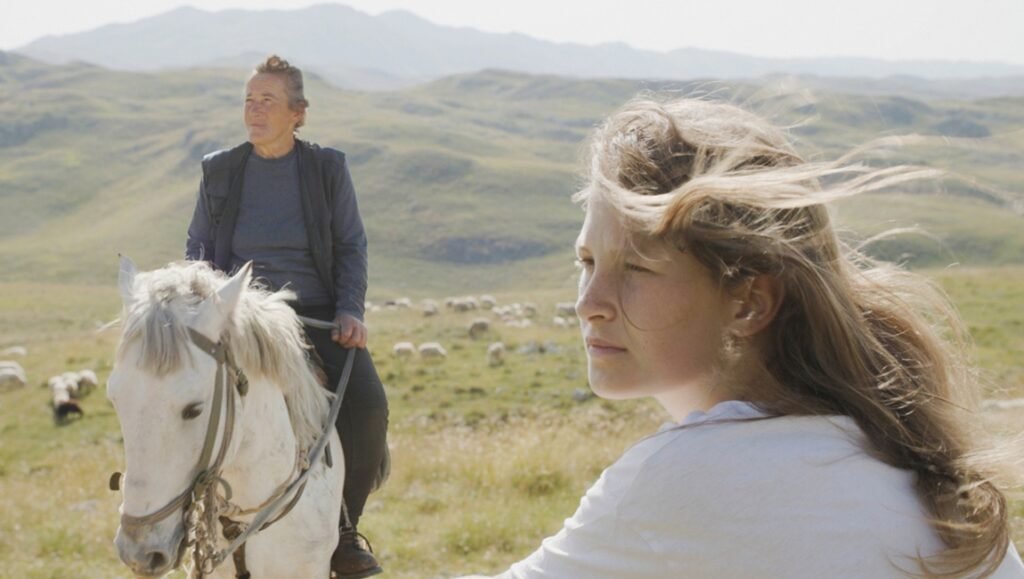
To Hold a Mountain
Winner of the Grand Jury Prize at 2026’s Sundance Film Festival, To Hold a Mountain, from directors Biljana Tutorov and Petar Glomazić, holds its observational vérite as an immediate method of narrativization. This temporal construction of pure linearity, based within a montage that is interested only in the broad strokes of a politics which contends with NATO expansionism, forces the complex of imperial encroachment, generational tumult, cultural continuity, and matriarchal affirmation into a flattened logic verbalized in the soft spoken dialogues between community and ecological activist Gara, alongside her adoptive daughter, Nada, and other members of the rural citizenry based within Montenegro’s Sinjajevina plateau. Tutorov and Glomazić’s perspective is one that stifles the complications of patriarchal violence and geopolitical problematization, comfortably fitting these dynamic and substantial experiences into a distanced portrait of resilience, a word this writer finds invariably reductive, one that more often than not objectifies these histories, as opposed to elucidating them in their knotted discourses.
Consequentially, these texts about the difficult work to confront government and the systemic oppressions it represents becomes transformed into tidy and digestible sentiments, the future being held out as a route toward reconciliation and maintenance, leaving little room for the persisting forces of power that ebb and flow outside of this community’s battle with empire. What are the implications of defeating this campaign of NATO expansionism? How does this project that leads to the exhumation of the community’s own internal problems relate back to the forms of expression of empire? These are questions asked not with hope instead for an essay film or exposé on these connections, but ones to challenge the observational method utilized here — and its very rudimentary montage — as an optimal form to capture this story. The copious amount of creative decisions that could have inscribed into the film’s thematic focus a discursive and reflective ideal are instead dictated by the most crude forms of informational transmission. And even with the community’s victory, which is to be celebrated, platformed, and taken as an example, these processes that led to such a historic gain are so imperceptible across this project. The focus on the daily routines of those who work the land, while impossible to misunderstand as a necessary representation of the relationship between those who fight and what they fight for, are molded into elliptical gestures. What made the substance of their fight becomes cursory, even if that material is also what makes up the substance of how we characterize those present within the film, especially as the documented time progresses.
What is to be argued here is that in the process of creating representation of these relationships across the project, the visual and editorial languages deployed operate less in tune with the labor being both inferred and displayed and more with the distanced, normative methodologies of signaling and shorthand, which very immediately subdue the relationships within a structural ploy of broad legibility. In that, there’s nothing specific or observant regarding the dynamics To Hold a Mountain centers, its construction obfuscating the contexts and opting for something more universalizing. It’s this writer’s opinion, then, that such a methodology dehumanizes these conflicts and envelops them in an industrial hegemony that is ideologically dictated by the very forces that enable NATO to perpetuate its globalizing ambitions. These are ways of filmmaking of which we need to deprogram ourselves.. — ZACHARY GOLDKIND
Eberhard as Seen by Amit
Amit Dutta’s fluid conception of art forms extends to the way he conceives of artists as well. Not bound by standardized, snobbish definitions that often consign folk dancers, weavers, and potters as skilled artisans or craftsmen because of their apparent entwining with religious tradition, folklore, and products (also addressed by Resnais and Marker in their Statues Also Die [1953]), thereby implying a form, which, seemingly unlike other hallowed art forms, doesn’t exist for its own sake, Dutta lets both “high” and “low” forms converse on an equal footing while sketching the traces of history and aesthetics that link them together. In this multidimensional space where forms and ideas collide, Dutta equally makes room for the peripheral characters — the critics, curators, and patrons — known mainly for their linkage to the world of art than as artists themselves. But the rasika (a person capable of grasping and relishing the “essence” or “soul” of the art; loosely, a connoisseur), in Dutta’s eyes, can open up new perspectives that expand our ways of engaging with the medium, even sowing the seeds for new art to spring up. His latest film, Eberhard as Seen by Amit, is on one such rasika, the ethnologist, art historian, and curator, Eberhard Fischer, and for fans of this director, the producer of his possibly greatest film, Nainsukh (2010). The latter film, though focused on the eponymous artist, also comments on the role played by his patron, Balwant Singh, in the deepening of Nainsukh’s art. This immediately puts this film in communion with Nainsukh, with the roles being reversed as the “art” takes the backseat for the curator.
In some ways, this is Dutta’s most conventional film, featuring a voiceover narration by the filmmaker in Hindi, which contains even statements of intent, either through direct address, such as “artists comprehending the past,” “the urge to create beauty,” or through Hindu philosophical parables on the interconnectedness of art forms. But this is a director who takes his title very seriously. Fischer is indeed seen throughout the picture, but barely heard. Dutta denies the illusory comforts of talking heads, and even relays their conversations through his narrations in Hindi or intertitles in English. His constant, disembodied voice obliterates any traces of objectivity, even if the invisible hand behind the camera is not always him. Fischer and his wife, Barbara, themselves double as artist and subject, be it in the use of their anthropological footage and photographs, or when Barbara shoots Fischer at their lakeside home in Ogiva, Switzerland, with Barbara even claiming that she took some of Dutta’s methodology from Nainsukh (Eberhard as Seen by Eberhard according to how Eberhard thinks Amit should see Eberhard, and so on). These layers — of objectivity, subjectivity, Fischer’s work and the content of his work, and Fischer’s life — penetrate into each other, threatening to collapse the loose linearity that moves from Fischer’s birth to his later projects through digressions, detours to the artwork concerned (special focus is on Fischer’s early work with the Dan tribe in Africa), philosophical meditations, and mediations sparked by Fischer’s footage (the aforementioned king parable), backtracks, and flash-forwards that bring his various projects in contact. As with his other films, Eberhard as Seen by Amit collapses all the rigid boundaries between art, religion, ritual, curation, tradition, and function, rendering Fischer’s approach to life through gardening, which prioritizes stillness, attention, engagement, and arrangement, as an organizational principle for Dutta’s frames themselves.
However, this collapse of boundaries also risks banal platitudinizing, particularly when describing the details of Fischer’s personal life, which are awkwardly shoehorned into the film. There’s the sense that Dutta is biting a lot more than he can chew, juggling multiple tonalities that don’t often cohere. Above all else, the film seeks to be a summation of Fischer’s multifaceted work, a cursory dive into the artworks discussed — with some dominating Dutta’s attention and others often relegated to a speedrun — a personalized portrait of Fischer, a chronicling of his life, and an elegy to B.N. Goswamy — an Indian art historian and a mentor of sorts to both Dutta and Fischer, whose death occasionally imbues the film with a reflective melancholy. Dutta’s weighted dissolves and staccato slo-mos do their best to resurrect the latter aspect, but his sensitivity is a little dimmed, perhaps by the sheer breadth and depth of his subject(s). More concerningly, however, is his glossing over of thornier questions regarding power differentials, wrought by Fischer’s position as a European outsider documenting civilizations unfamiliar to him. In a segment featuring the weavers from the state of Rajasthan in India, Dutta mentions that they were initially reluctant to share their methods, only to rather facilely resolve it with a pat quotation from Fischer on the “profound importance of documentation.” Clearly, the weavers did share their art with Fischer, but seldom has Dutta so callously smoothed his frictions, using the ends to justify the means.
In an early segment of the film, where Dutta pores over Fischer’s footage of the Dan tribe, something extraordinary happens: the ritualistic traditions and art of the Dan, which involve a combination of dance, performance, masks, and religion, possess the spirit of the film, even if only fragments of their art exist as footage. Dutta freezes on certain frames as the information is relayed, tinging them with a sense of foreboding through accentuated natural sounds and a minimalistic drone score. The dissolution of the boundary between performer and performance, where the loss of a tribesman’s mask almost equals the loss of his life, becomes incredibly moving for Dutta, and there’s the sense that all of the film’s threads converge at this very moment. But this doesn’t imply smoothing of any frictions, as both Dutta and Fischer are aware that the footage can only be viewed with a sense of loss. The villagers involved in the footage were killed in a civil war, and this disquiet continually lingers in the frames involving them. Dutta mulls over a question from Clyde Kluckhohn’s Mirror of Man during this segment, which asks if we study other cultures to understand the differences or to know how we are the same. Regardless of the answer, what is clear is that Eberhard as Seen by Amit is at its most wide-ranging and affecting in a segment that is the most alien to both of its makers, where acknowledging and confronting differences emerge not as hindrances, but as a necessity to profundity. — ANAND SUDHA
Comments are closed.