
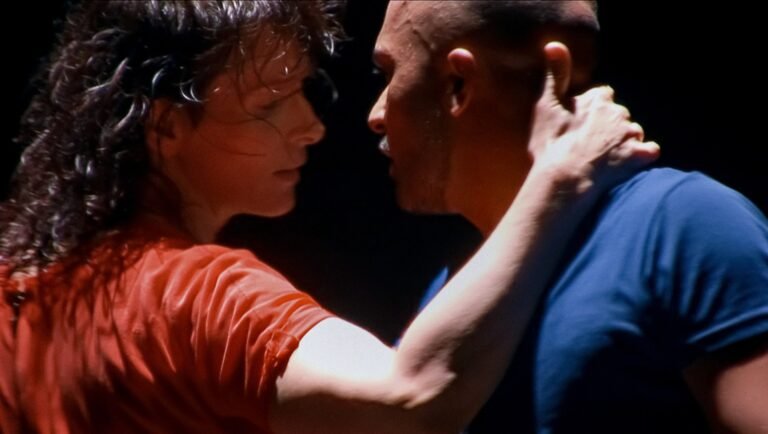
Where do you go once you’ve reached the top? By 2007, Juliette Binoche was running out of peaks to summit: she’d won international acclaim with Three Colours: Blue, bagged multiple Oscar nominations, including a win for The English Patient, and cast her lot for EGOT status with an acclaimed performance in Harold Pinter’s Betrayal. English-Bangladeshi dancer Akram Khan was enjoying similar levels of success: he’d toured the world in Peter Brook’s Shakespeare Company by the age of 13, performed original compositions internationally and launched his own dance company in London, and choreographed tours for Kylie Minogue. So, with little left in their respective fields to conquer, Binoche and Khan followed the lead of so many GOATs before them and took new paths.
In-I In Motion captures the fruits of Binoche and Khan’s respective and collaborative reinventions. The actor and dancer combined their trades to craft In-I, a choreographed theatrical production that toured internationally from 2008 to 2009. The show’s subject is straightforward enough — Binoche and Khan play a couple through the course of a tragic relationship — but its performance is demanding, an athletic feat that reduces both players to puddles of sweat by its end. Now, Binoche is adding another feather to her hat: that of director. In-I In Motion is both a making-of and a presentation of In-I’s full runtime, compiled exclusively of footage shot by Binoche’s sister, Marion Stalens. It’s an indulgent combination that offers little insight into Binoche and Khan’s artistic vision or the former’s directorial skill set.
At 127 minutes — reduced from a 156-minute cut that had initially screened across a handful of festivals — In-I In Motion can feel taxing. Its first half comprises behind-the-scenes footage of rehearsals in which Binoche and Khan hone their new endeavors and shape their performance. It’s gratifying to see a presence as magnetic as Binoche chop wood and carry water, especially when hurdles — distracting music, confusing notes from a dance coach — challenge the effortless precision with which she’s cemented her reputation. But these moments are rare enough to obscure themselves within In-I In Motion’s largely formless execution. Its documentary portion is nearly 50 minutes of placid exercise with barely enough conflict to yield a grimace or two along the way.
At times, it can even feel goofy. Binoche and Khan bring acting and dancing coaches into their rehearsals to help round out each other’s prowess. The former, Susan Baston, is the movie’s most kinetic presence: frazzled and boisterous, she commands the actors not as students but foot soldiers, barking commands like R. Lee Ermey and running deep emotional exercises with Olympic dedication. “Find her ass! Go for the knee!” she’ll shout as Binoche and Khan sweat ever more bewilderedly. But In-I In Motion’s edit renders her — and much of its documentary footage — a punchline. The movie crests a level of indulgence to feel like fodder for Christopher Guest; hard cuts to grunting and writhing sweep the legs of Khan’s catharsis after running through a scene about racial reckoning and Binoche’s breakthroughs on the dancefloor. Binoche and Khan are self-serious and wholly devoted to their production, but the footage is aimless and repetitive enough to threaten self-parody.
By the time Binoche’s movie transitions to the performance — nearly 70 minutes and shot with the utilitarian sobriety of a Broadway simulcast — In-I In Motion has spent the better portion of its good will. It’s a pity; In-I transcends the narcissism that dogs so many celebrity pet projects to arrive at a fully realized, formidable piece of theater. Both Binoche and Khan prove successful in their efforts to meet their partner’s expertise: Binoche matches Khan’s athleticism in each snap and pivot; Khan delivers a powerful monologue on the challenges a mixed-race relationship places on his character’s heritage. The set design — largely a single, spare red wall executed by British artist Anish Kapoor — is deceptively versatile and looms over its subjects with the command of a Rothko painting. But the performance’s placement within In-I In Motion demands more stamina than an audience is likely to wager, and the tedium of its documentary debits the impact of its final product.
It’s tough to divine why, after 18 years, Binoche decided to assemble In-I In Motion. Its footage is absent the talking-head or narrative reflections that often accompany similar retrospectives, favoring instead a moment and effort trapped in amber. Binoche and Khan were successful enough with their project to tour it internationally for over a full year; afterward, they returned to their native crafts with little evidence of In-I’s effect on their individual trajectories. In-I In Motion feels like a proof of life, an assertion that the performance indeed happened, that one can transcend a career path even at its peak. But its execution will do little to inspire similar risks.
Published as part of Cinéma du Réel 2026 — Dispatch 2.
Comments are closed.