
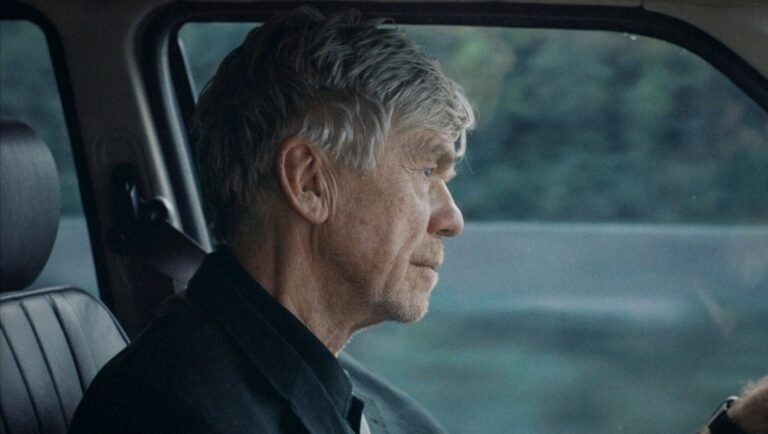
It’s easy to be lulled by the hum of rolling highways and pleasant conversation; they abound in Sebastian Brameshuber’s new film, London, which follows Bobby (Bobby Sommer), an aging but still restless pensioner, who makes regular trips between Salzburg and Vienna, Austria, to visit a sick friend in the hospital. To save money and enjoy something other than his own thoughts, Bobby picks up strangers in need of a ride along his unchanging route. This is a peculiar kind of road movie, less about the limitless possibilities of the open road than it is about confinement. The result reveals as much about the state of the world as it does the man in the driver’s seat.
The old adage of the road movie — it’s the journey, not the destination — holds up here. Not only do we never see one of Bobby’s passengers reach their destination, but Bobby himself never does. London is structured around scraps of ongoing conversations that have neither beginning nor end. The occasional pause, to pee at a rest stop, fill his Land Rover with gas, or rest his eyes, are exceptions to a seemingly unending journey affixed to a treadmill of Austrian autobahn. It keeps him in a kind of perpetual non-place between his vaguely estranged friend in Salzburg and a lonely life at home in Vienna. Adding another layer is the film’s production. The car interiors were filmed on a stage so as to make space for the conversations between Bobby and his passengers to unfold as naturally and uninhibitedly as possible — free from the distractions of the road.
This strategy seems to have worked. That’s thanks to Bobby himself, who, as both a captive audience and open book, has an uncanny ability to forge rapid, seemingly effortless intimacy with his passengers. One young woman talks about the struggles of living with her mother and younger sister, who have recently escaped Ukraine, and the sudden intrusion on her independence. Another is resigned over losing her parents’ support in the lead-up to her same-sex marriage. A young man, the first of Bobby’s passengers we see, is in the middle of mandatory basic training and already questioning whether he’s cut out for the physical effort and moral compromise of war, and afraid of the creeping likelihood of a real-life military escalation. Despite the magnitude of these subjects, the conversations, much like Bobby’s attention to the road ahead of him, never lose their even-keeled tenor.
The more light-hearted of Bobby’s interactions are no less substantial. In one breath a young man valorizes his Albanian family’s Communist credentials and lauds James Cameron’s Avatar as an unintentional Marxist masterpiece. Another teenager tells Bobby every piece of food he sells, and the precise place in their display, at the gourmet section of his local grocery store. In today’s unstable economy, it perhaps shouldn’t come as such a surprise to be moved by seeing someone fulfilled by not just a profession but a vocation. He’s still a kid, though, so when he’s done talking about work, he’s passively amused by the electric seats in Bobby’s car, his body rising and falling to the gentle whizz of the electric motors, another note in the film’s sonic repertoire.
Despite Bobby’s willingness, eagerness in fact, to talk with his passengers, we don’t actually know a lot about him. Where the strangers he picks up are more or less fully formed from the moment we meet them, Bobby’s character is hidden inside a hunk of marble ready for gentle taps and a chisel. We know he’s visiting a friend in the hospital who recently suffered a stroke and has yet to wake up, but we don’t know, until the 11th hour, the nature of their relationship or the event that caused a recent rift — and even then, we’re left guessing over the minor details. Is this friend a man or a woman? Was this friend just a friend, or something more? Are we meant to believe the reason Bobby has no family is because he valued his independence above all else, or because of the pain of this relationship ending? Bobby is a man wracked by invisible guilt that unfolds like the miles in front of him, doubling over and recycling like a cruel joke with no punchline.
One scene might affect how one thinks about the sprawling view out of Bobby’s windshield. In this instance, the young man to Bobby’s right (played by German-based independent filmmaker Ted Fendt) tells Bobby about the complicated history of the autobahns on which they cross the country. During the early days of the Nazi regime, engineers designed the nascent network of roadways to have the most scenic view possible, a subtle form of propaganda by which Germany’s natural landscape would be perched in the distance as an ideal, in view but unattainable, perfect — even at the expense of efficiency and cost.
After this scene, the impressionistic collage of souls that fills Bobby’s days necessarily takes on a hardened political edge. The Ukrainian woman whose refugee mother and sister are living with her once again; the Albanian young man with proud Communist heritage; the lesbian woman from the former Yugoslavia; the Philadelphia-born, Berlin-based Ted Fendt; the non-white grocery store trainee; and a Nigerian immigrant Bobby knows and encounters by chance after his car breaks down. Every passenger not only offers Bobby a fresh reassessment of how one might move through life’s puzzlements and setbacks, but offers the viewer a renewed vision of contemporary European life that is otherwise increasingly crushed under authoritarian paranoia and fascistic terror.
Published as part of Cinéma du Réel 2026 — Dispatch 2.
Comments are closed.