
Burak Çevik’s films often use a narrative framework as a jumping-off point for formal experimentation. This is perhaps best seen in his 2019 feature Belonging, in which a true-crime anecdote from his family history provides the basis for both a landscape study and a staged reenactment of the meeting that led to the crime in question. Since both portions employ the same story, Çevik’s film is largely about narration and memory, the way we perceive events differently based on familiarity and expectation.
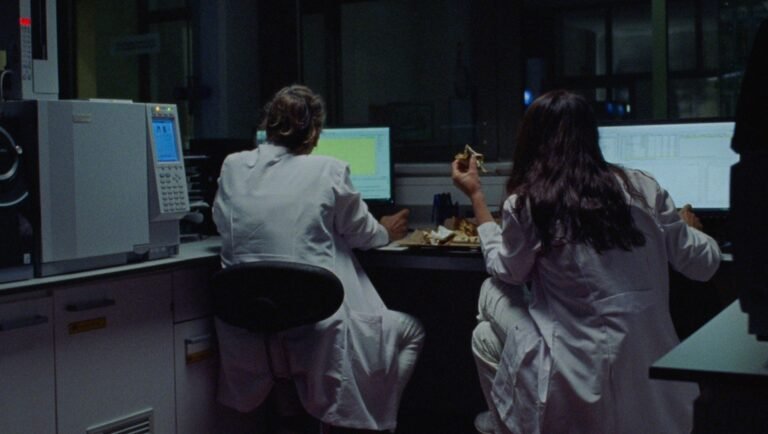
A very similar structure underpins Çevik’s latest film, The Weary Hours of Two Lab Assistants. Running just 22 minutes, the film presents a conversation twice, once as a seemingly disconnected string of words, and then again as an exchange between the two titular lab assistants, played by Turkish actors Nalan Kuruçim and Bahar Çevik. In the first part we see the phrases printed onscreen, while in the second part they are performed. But even as the words are spoken, they seem somehow fractured and incomplete, as if we are not receiving the entire picture.
The first section is vaguely abstract, but in a manner that strongly implies some kind of scientific research. We first see a pattern rotating on a blue-gray screen, a rotating form that resembles icy mountain topography. This object’s boundaries wax and wane, and at various points it appears either concave or convex. In another context, this image-form might be read as pure abstraction, like the “visual music” graphics of John and James Whitney. But because of the title, the viewer is situated within a different interpretive mindset. This is some sort of hard knowledge, but we lack the knowhow to properly understand it.
After this we see a computer-generated diamond shape that could be a cross-section of the human brain. Next, we see a piece of lab equipment robotically infusing some substance into a tray of test tubes. This image gives way to a full-frame, color-coded radar screen with negative numbers distributed across the field. And then the topological object returns. All the while, text appears on these work screens, phrases like “something about this guy’s past” and “I was born with my mother’s umbilical cord wrapped around me.”
Çevik eventually reveals that the words onscreen are a dialogue between the two women, who have just enjoyed some Turkish coffee. One of the women is reading the residue of coffee grounds from one of the cups. So after taking in these phrases with one context, we are asked to shift our perception of them into another. What is most interesting here is that the first part dangles hard knowledge in front of us, with unclear visuals that nevertheless imply scientificity. Then, we see the performers speak these lines as if they were semi-spontaneous conversation, borne from the radically unscientific practice of fortune-telling.
Much like the work of American experimental filmmakers Ross Meckfessel and Zachary Epcar, Çevik’s film operates under the slightest aegis of narrative meaning-making, with character and plot information hovering just out of reach. The Weary Hours is a play on this uncertainty, since the title tells us that these two scientists are killing time while trying to stay awake, and the film is situated in that hazy twilight when inhibitions are looser, and people may be willing to reveal their otherwise-hidden superstitions. The laboratory is a closed field where outside influences and contaminants are removed so that “pure” results can emerge. Çevik suggests that the lab can never be completely purged of the human element.
Published as part of Cinéma du Réel 2026 — Dispatch 2.
Comments are closed.