
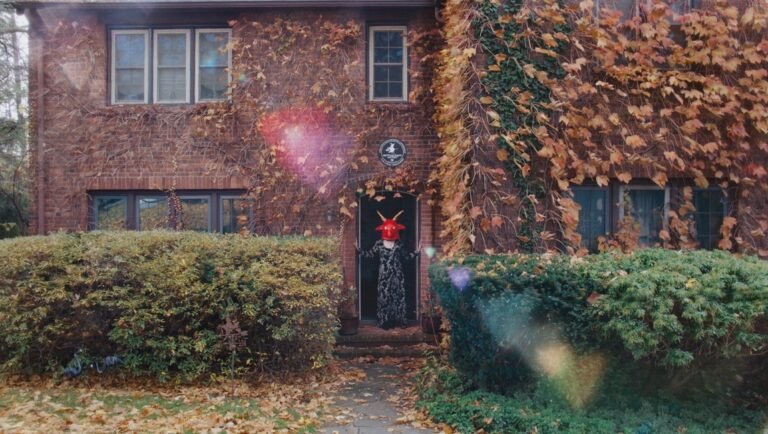
A goat gives birth; a paraplegic man’s soul leaves his body. In between, life and the flesh are one. Such appears to be the order of things in Realm of Satan, a largely wordless ethnographic portrait of modern-day Satanists whose metaphysical ambit is as shy as its hagiography is shameless. The feature-length debut of director Scott Cummings, Realm of Satan resists narrative and documentarian labels equally in order to don the mantle of both, much like Cummings’ 2014 short, Buffalo Juggalos, which sought to observe and possibly elevate the community of hardcore hip hop adherents. It’s frequently rich and evocative in style, in line with the centrality of aestheticism to the Satanist endeavor. But aestheticism, it seems, is the substance through which Satanism manifests and asserts itself, which begs the question: Is what we’re seeing substantial?
The answer, depending on who you ask, is either resoundingly positive or frustratingly otherwise. Much of Cummings’ film is devoted to platforming and valorizing the transgressive, oddball imagery of the Church of Satan and its flamboyant ways of life, and to this end, Realm of Satan eschews all commentary in favor of an intriguing juxtaposition of the banal and the bewildering. As its organizing principle, this juxtaposition will no doubt be solemnly rigorous to the converted, depicting in scintillating colors the array of domestic and social customs afforded them. To the uninitiated heathens, however, it comes across as flimsy and unconvincing. The doorway to hardcore transgression had been open in the 1980s, when growing unease over what was deemed a “Satanic Panic” threatened to violate the moral sanctity of Reaganite America; today, the subject leans much more enthusiastically into parody.
Shot from a clinical vantage point reminiscent of Ulrich Seidl and featuring an assortment of characters straight out of an Errol Morris doc, Realm of Satan unveils its patchwork of eccentricities with great aplomb: magicians, metalheads, art collections, New Age yogis, latex orgies, even a classically sacrilegious séance bathed in shadow and crimson-red light. A couple air out their laundry in between sets of thrashing it out to heavy metal; a singer croons affectingly to a synth rendition of Billie Holiday’s “Gloomy Sunday.” This portrait of carnality writ large coheres well with Satanism as practised by the Church of Satan (à la Anton LaVey), less so the political activism of the Satanic Temple, and its choice of locale (primarily the Hudson Valley) and subjects reveals a materialistic individualism whose practitioners are skewed toward a left-leaning, upper-middle demographic.
But is this a tacit admission of an inherent ridiculousness in the subculture, or a loving embrace of it? The creative liberties taken by Cummings and cinematographer Gerald Kerkletz suggest the latter, though the often mercurial register they employ — a smidge of VFX here and there, intertwined with framed, coolly defiant subject portraits — also lend their images an air of caricature. Context, the age-old adage goes, is everything, and even with the Church’s High Priest (Peter H. Gilmore) and Priestess (Peggy Nadramia) in unholy attendance, Realm of Satan appears more intrigued by its performative sheen than the background of its performers. Like its cultural forebear, Dungeons & Dragons, Satanic hedonism today hinges on the lodestone of magic, and a shot of a man shaving in the mirror, alternately appearing and disappearing in real life while his reflection persists, reveals more than just a staged, quirky bit. It’s an unwitting comment on the Devil’s shaky identity and credo.
DIRECTOR: Scott Cummings; DISTRIBUTOR: Monument Releasing; IN THEATERS: July 17; RUNTIME: 1 hr. 20 min.
Comments are closed.