
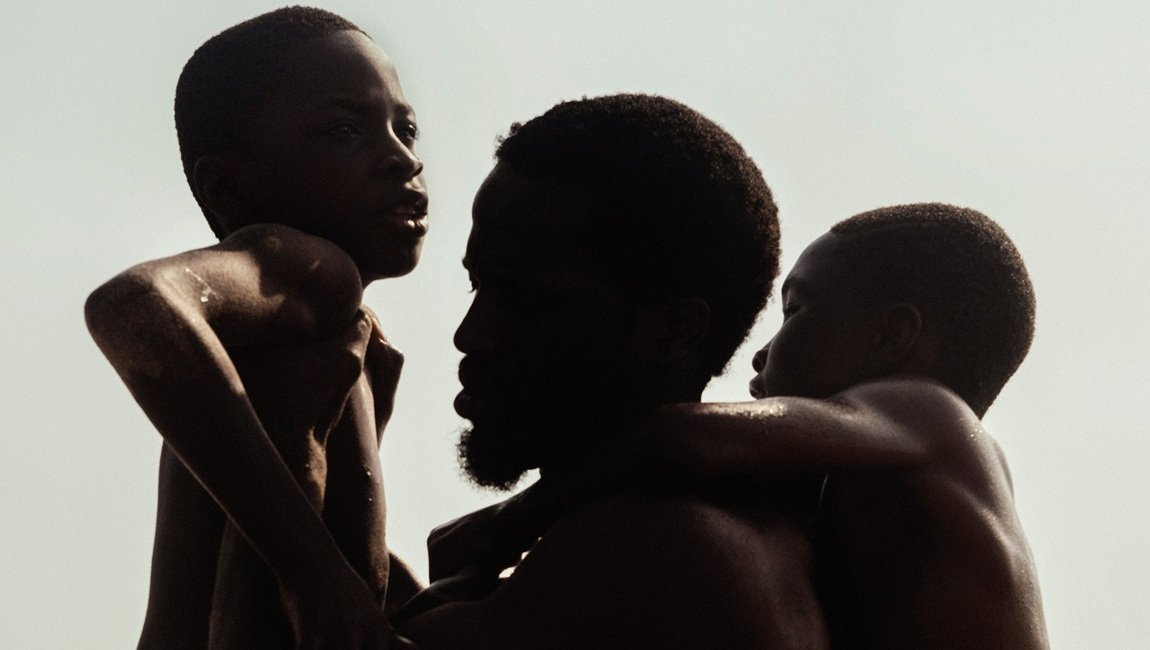
It’s June 1993 in rural Nigeria. Remi and his younger brother Akin (real-life brothers Chibuike Marvelous Egbo and Godwin Egbo) are bickering, eating food and playing outside with paper figures drawn to look like WWF Superstars. Their mother is away in another village, so they are all alone. That is, until they re-enter the house to find their father Folarin (Ṣọpẹ́ Dìrísù) has suddenly reappeared. Often absent from his sons’ lives, it is as if he has popped up out of nowhere. This return will be brief, as he must collect months of unpaid wages from his job in the city of Lagos. But then, perhaps capriciously, he allows Remi and Akin to accompany him.
Meanwhile, the results of the country’s presidential election are pending. After a decade of military leadership under Major General Ibrahim Badamasi Babangida, there is newfound hope for democracy and a brighter future under man-of-the-people candidate, MKO Abiola. Simultaneously, though, there is unrest bubbling under the surface. One person says the country needs “discipline” and army rule; newspapers are reporting a massacre at Bonny Camp; and as Remi and Akin spend the day with their father, taking in the city via trips to beaches and old fairgrounds, this proves to be a pivotal day on both personal and political levels.
The first Nigerian film to be part of Cannes’ Official Selection, My Father’s Shadow marks the directorial debut of British-Nigerian director Akinola Davies Jr. It’s a semi-autobiographical project made even more profoundly familial in that Davies Jr. has co-written it with his brother Wale (the two have a long-standing creative partnership, working together on shorts including the BAFTA-nominated Lizard). More important than such contextual information, however, is that the final product is a stunning, vibrant, and intimate film that merges familial and national uncertainties into a story that is both wholly engaging and richly realized. The U.K. has been on a bit of a hot streak with outstanding British debuts in recent years, and My Father’s Shadow manages to easily enter that pantheon.
The film begins quietly with sounds of nature, a flickering montage that provides scattershot glimpses of both newsreel footage and family life, and shows off how elliptical Omar Guzmán Castro’s editing is going to be. But there are also shots of rotting fruit and an ominous droning sound in this opening. An eerie tension looms (over this sequence and the entire film), accentuated by how Lagos is presented as a place loaded with urban bustle, cacophonous noises, and glimpses of soldiers on the streets. Hints of turmoil are never far away, and the score by Duval Timothy and CJ Mirra — impassioned and soaring at times — brilliantly encapsulates the sounds of a country and its unsettled nature during this period. And the spirit of ‘90s Nigeria is further evoked by exceptional costume design from PC Williams and production design by Jennifer Boyd and Pablo Bruhn of the creative studio ANTI (who have also worked on Beyoncé’s Black Is King).
Also working overtime in the film’s favor is Dìrísù, who gives a quietly enrapturing performance here as Folarin. Tough but tender, he is stern with his sons but never overblown in his anger — all of which is further softened by his sparks of charm. He’s also a fervent Abiola supporter, optimistic that “change is coming” for the country and for his sons’ futures. Yet in a wisdom-filled conversation he holds with Remi on the beach, we slowly become privy to Folarin’s feelings on his own past: on his father abandoning him when he was younger, on missing his boys growing up whilst he works in the city, and on the loss of his brother that haunts his dreams. Dìrísù allows rivers of emotion to slowly, subtly leak from Folarin’s mysterious and ever-changing nature.
But as its title implies, My Father’s Shadow is a film focused on Folarin’s boys, as we events and discoveries are primarily communicated through their point of view. Through Davies Jr.’s eye for detail and DP Jermaine Edwards’ naturalistic close-ups, there are copious shots of Remi and Akin looking, usually staring, at people’s faces — and discerning some of their father’s secretive movements and dealings (or, in one case, a waitress who gives a strange look to their father). Additionally, there is a compelling, natural air to the performances from the Egbo brothers, and the moving dynamic they share. The pair effectively exhibit a youthful playfulness and exuberance, while also believably evoking the brothers’ gradual understanding of who their father really is and what the world around them truly looks like. If childhood is built from the blissful illusion that things — be they are politics or absent fathers — are quite simple, then My Father’s Shadow is about the realizations and complications that arise when coming of age disabuses any such notions — and specifically, about coming to terms with parents as flawed, wounded humans.
But regardless of perspective or angle of entry, Davies Jr.’s film is one about fatherhood, its paternal sacrifices and future memories, all articulated with a deep uncertainty that builds and builds until a conclusion enveloped first in chaotic violence (mimicked in Edwards’ camerawork, which pulls off a number of staggering shots throughout), and then in breathtaking emotion. “The memories that cause you pain when someone leaves are the same ones that will comfort you later,” Folarin says to his sons at one point. By its ending, My Father’s Shadow has revealed the precise ways that such sage advice will function. This day and its recollections will provide for Remi and Akin, as evidenced in the film’s coda, adding a moving punctuation mark to a remarkable film and a special debut.
DIRECTOR: Akinola Davies Jr.; CAST: Ṣọpẹ́ Dìrísù, Efon Wini, Godwin Egbo, Chibuike Marvellous Egbo; DISTRIBUTOR: MUBI; IN THEATERS: February 6; RUNTIME: 1 hr. 33 min.
Originally published as part of LFF 2025 — Dispatch 1.
Comments are closed.