
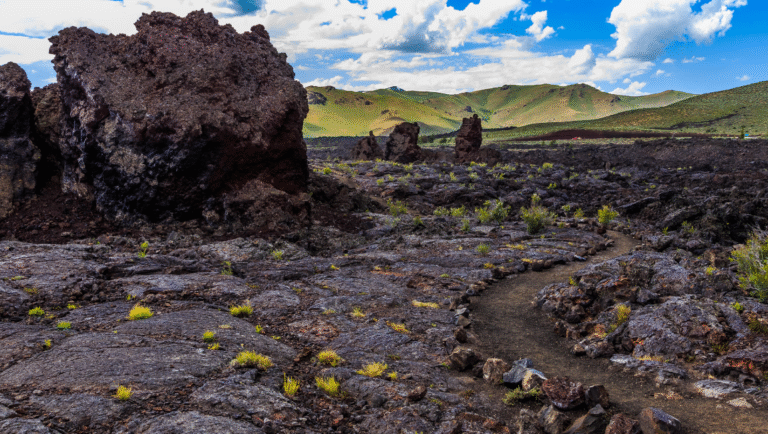
Peter Fonda’s self-produced Idaho Transfer (1972) exists online as a decrepit VHS rip and a few equally shoddy digital re-uploads. I’ve heard tell of an itinerant 35mm print, but it’s unlikely that such a strange, uncompromising film of hipster apocalypse will ever be blessed with enough attention to warrant a worthwhile re-release. But the film’s disrepair is not to its detriment. The waterlogged blacks and dull grays accentuate the scorched horizons of Craters of the Moon National Monument and Preserve, located a couple hours from Boise, ID, where much of the film’s time-jumping drama takes place. The silent, eerie whisper of corroded soundbites, too, does wonders for the film’s atrophied offices of muted grays and depopulated social quarters. It’s a film in the tradition of Philip K. Dick, Thomas M. Disch, and the dystrophy of the ’60s future-vision — risking cliche, it seems only natural the celluloid itself should be ravaged by time.
“Prescient” is an adjective liberally thrown around these days, but stop me if you’ve heard this one — met with the vague inevitability of climatic disaster, scientists elect a group of troubled youths to “transfer” to the far, inhuman future, to create a new society and ensure the continued existence of mankind. They are instructed to establish new resource pools, determine ecological conditions on this future earth, and, most important of all, procreate. But when the transfer machine malfunctions, leaving the teens stranded on the barren planet, the group begins to fall apart, and they quickly realize the same machines used to ensure humanity’s future also renders them irreversibly sterile.
The performers are (apart from a young Keith Carradine) all amateur; the sun-scorched, distantly familiar faces of midwestern youths. They neither manage to sell the drama nor reject it in the Brechtian sense. Sections are almost incomprehensible in their drugged mumbling, and the sci-fi elements are so slipshod as to barely register. Fonda’s direction is as spare and raw as the magmatic ground below, crafting an uneven game of distant and immediate apocalypses, one seemingly played in our own century ad nauseam.
We are met in this contemporary landscape with an array of apocalypses either possible, probable, or inevitable, preventable, negotiable, or untenable. I remember as a child being terribly frightened by the casual certainty of Earth’s heat-death. As if the average estimation of one billion years was within my grasp, I thought constantly of rising radiation in the earth’s atmosphere, capable of extinguishing all living creatures sans whatever monstrous mutations such conditions would produce. But even that wasn’t certain enough. Future sciences could no doubt produce an answer to a problem like that. Even the prophesied death of the sun only worried me momentarily, as visions of heat-resistant plasticine domes stretching far over the stratosphere flooded my nascent imagination.
No, I searched for a certain death, an impossible departure. These deaths disappointed me. They were simply accelerations of what was already in motion. The air couldn’t kill me, nor could the sun, because to the child’s mind, the death of humanity was no more or less significant than the death of myself. I went searching for what would end me, definitely. Maybe for curiosity’s sake, for adrenaline, or some private desire for oblivion I could not yet articulate; I was looking for a time after myself, where not even the notion of the self could survive, and imagine what that self would look like in that time of “afters.”
That oblivion would occur, but not privately, and not inevitably. Though the coming climate disaster, certainly comparable to Fonda’s parable of ecological collapse, lies squarely in the realm of the probable, it does not lapse so far into inescapability either. The “negotiable” nature of these disasters — among them: ecosystem destruction, rising carbon dioxide levels, comprehensive global warming, mass species extinction, intercontinental desertification, etc. — has been proselytized through the years, even as many of these discussions become tragically meaningless with every passing year of inaction. The word “prevention” strikes the most optimistic scientist as absurd. “Mitigation” replaces it. Society must find new structures of organization in order to avoid destruction. The total removal of capitalism is tantamount; no amount of reformation will suffice, some other system of survival, new but ideologically familiar, must rise to the occasion. The seeds of mitigation are already sown. To reap the rewards requires an international supermajority, not beyond our means or anyone’s in the future. The world does not require even a conscious lapse toward Marxism to support it, though that would be preferable. Even the most disorganized attack on the system would buy us a few more years than now.
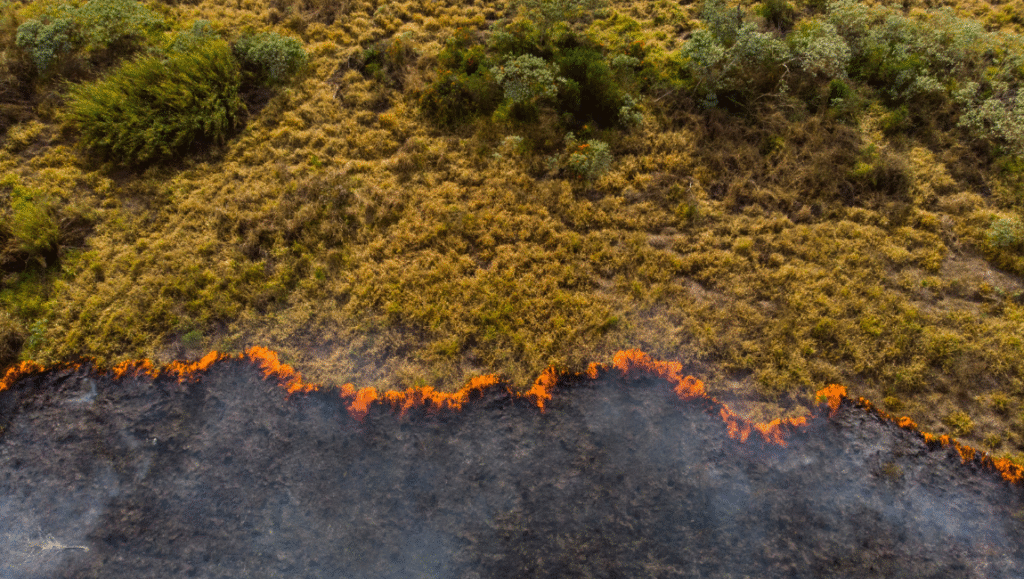 If capitalist disinterest continues (and there is no doubt of this possibility), however, perhaps “preparation” will sadly follow it. We rapidly approach this stage, where the conclusions are obscure in the sense that they are inhuman, unthinkable. Society is eschewed for the immediate necessities of survival, and what structures, if any, follow are anyone’s guess. These are your average post-apocalyptic scenarios, though made foreign by an encroaching reality which in some aspects corroborates, and in others qualifies, the fictional consensus. Is the future more like Mad Max or Snowpiercer? The Road or The Plague? — or “just what apocalypse is it, anyway?” These questions are sensationalist but not far from the ones that are more succinct — chiefly: how will we live when all is said and done?
But even still, active “preparation” for a coming disaster admits the spark of hope blazes forth, if feebly. Even in preparation, a quasi-intentional transformation of human intelligence and philosophy from the global, objective being we know today to the immediate and transient one we fear our future counterparts to be allows for the continued persistence of some kind of human spirit, some struggle that is not wholly new even as it is tactically rediscovered.
Fonda’s film, then, imagines the purest of apocalypses, more pure than the climate catastrophe, nuclear annihilation, or heat-death, because it imagines an apocalypse well within the grounds of negotiation that is then refused by its perpetrators. The adults in Idaho Transfer remain mostly unseen, and the operations of their organization go unexplained. They have a few designated avatars — the psychiatrist, the policeman, the mechanic — and are all united by the certainty of their mission, the protection and maintenance of the human race as it exists, and strict enforcement of its cultural dominance. They have come to the tyrannical conclusion to repopulate the barren earth with their own children. Predictably, their efforts only serve to make that disaster more certain. They deny outright even the chance of mitigation and presume an inevitability that does not yet exist.
The new generation — an anxious, aimless society of corroded national beliefs and a wavering moral core — appear straight out of the dreary Americana of Easy Rider. They are a collection of dopers, manic-depressives, disillusioned activists, and suicidal artists. We know very little about any of them, even the lead (Kelly Bohanon), who is mostly characterized by vague allusions to a past suicide attempt and sexual assault, and a distrust of her adult masters. She holds close to the idea of fulfilling her ultimate purpose within the project: procreation, though it appears doubtful she has any interest in creating this “new civilization” the scientists suggest, at least not in their interest. Her desire lies closer to visions of the commune, a self-sustaining world bereft of authoritarian figures. Love and sexuality get no more than an administrative acknowledgement from her. What’s at the bottom of the teens’ venture is secession: from capitalism, from pessimism, from gerontocracy, and to continue a society where such things are resolutely absent. Which is why when they are abandoned, rendered sterile by time machines now incapable of returning them to the present, they finally recognize what their elders have wrought, and the film lapses into its most elegiac mode.
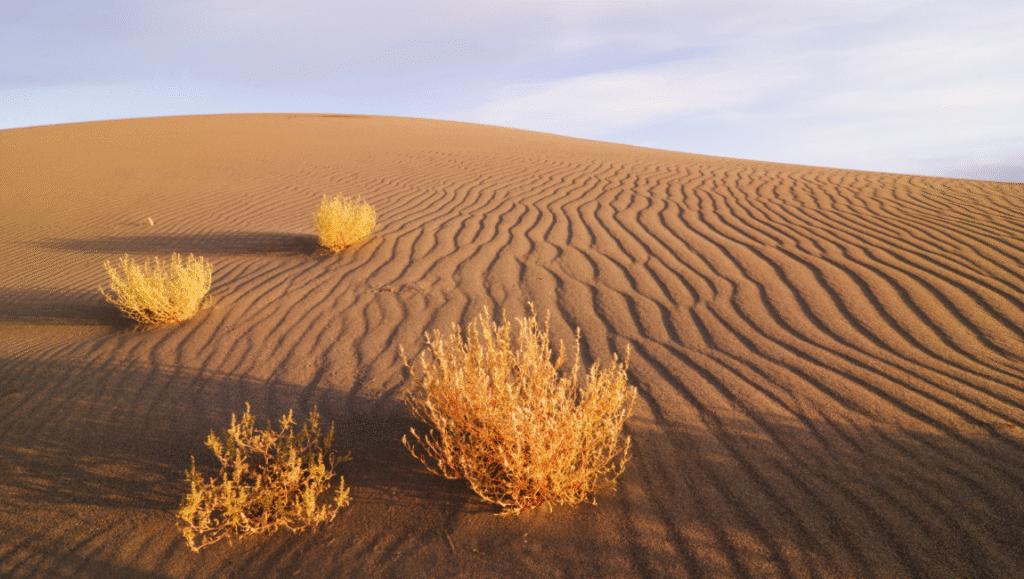
After this final insult, the group mostly relegates their time to oneiric drifting. Survivalist efforts are begun and just as soon fall to the wayside. Craters of the Moon is a surreal enough stage to support some aesthetic pleasures for the audience even as the narrative seems to unspool in the wind, but even that wonder is left behind. Bruneau Dunes State Park (along with some photography in central Butte county) is much less interesting to study. The sand dunes in Western Idaho may be a local novelty, but not much can be said regarding that setting’s potential toward science fiction. Beige loping hills with sickly gray cactus stalks are sporadically clothed in dull short-grasses. The sky appears to be perpetually wrapped in a thin layer of cirrus clouds, so the blues barely register on the already dilapidated celluloid. That same emaciated atmosphere is then reflected in desert pools, too dirty to drink or swim in, and too still to ever really trust. Though the two sites are less than one hundred miles from each other in actuality, they represent entirely opposite apocalypses, both describing the future but linked to the past in an ever-repeating möbius strip.
 Craters of the Moon, as its name suggests, is alien. Archaeological evidence leads researchers to believe no Indigenous tribe has occupied the region for 12,000 years, even before the region’s most recent eruption. Washington Irving dramatizes Captain B.L.E. Bonneville’s 1831 expedition along the Snake River, where he calls the craters the “result of a convulsion of nature” and a “waste.” 1 In 1913, a troop of Arco residents described the craters as that place where “the Devil and Mother Earth cut up ‘high jinks’ when she was young and giddy.” 2 Some decades before H.P. Lovecraft published his “Colour Out of Space,” explorer and amateur geologist Robert Limbert emphasized the formations’ unusual, positively unearthly blues, pinks, purples, and browns, all singular in his years of study, fraught with sublime danger. He described the landscape as inhuman, awe-inspiring, himself just a “fly on the wall” of a massive and mysterious ecosystem. 3 In Lovecraft, there is “the yawning black maw of an abandoned well whose stagnant vapors played strange tricks with the hues of the sunlight…” or “a nocturnal exhalation seen as a phosphorescent mist against the black and blasted landscape.” 4 To Limbert, “Not simply day and night but the changing conditions of light and air make this a place of color and silence,” and “the human voice seems a sacrilege in the amphitheater of nature such as these huge craters seem to be.” Perhaps Calvin Coolidge presented the most succinct description of the area when designating it a national monument for the purposes of “preserv[ing]… this weird landscape.” 5
There is no such sensationalism afforded to the sand dunes. Their discovery and subsequent national protections aligned with Craters, but would never boast the same ticket sales. Arguably, the ecology is just as uncommon in the Idaho territory as its estranged sister. The dunes are tall, crystal-white, overlooking wide lakeshores of aquamarine hues. Cactus stalks splinter spontaneous marshlands and desertified hillocks. The elevated dunes, semi-frequent sandstorms, and the Bruneau Dunes State Observatory have also made the park a popular site for UFO sightings, mostly of the traveling incandescence genre, strange globules of moving and still lights parade across the sky, usually chalked up to celestial events easily witnessed in the clear sky above the dunes, or military tests from Mountain Home Air Force Base, only 40 miles away. “The Colour Out of Space” may not be as relevant, but the region is no less attractive to Lovecraftian analogues. Perhaps “The Nameless City,” Lovecraft’s fable of a subterranean Atlantis, is more apt: “I alone have seen it… When I came upon it in the ghastly stillness of unending sleep it looked at me, chilly from the rays of a cold moon amidst the desert’s heat.” 6
In Idaho Transfer, the Craters offer our first representation of the apocalypse — in fact, in the very first scene. It’s a visceral, Miltonian landscape, an immediately arresting vision of scorched earth, suggesting nuclear annihilation as much as climate disaster. We begin to wonder if the scientists may be justified in their certainty, if this is the catastrophe that awaits mankind. But the Dunes are just a couple days’ hike away. Though far from an oasis, those strange pools and contorted cactus growths do not call to mind the same certain apocalypse. Even if we are to presume the entire country to resemble this husk, there is no presumption of annihilation or hopelessness. Among the teens, discovery of the dunes prompts celebration and renews their desire to survive and locate any community that may stalk the desert hills. Under the happiness, however, simmers a complex rage. Their apocalypse is a betrayal, a lie sold to them by the adult world. The topographies of the present are almost identical to those of the future — so could the world not heal? Could it not be saved, if only they tried?
Both the past and the future have left the parks unchanged. Both sites have existed in their current inhuman state for thousands of years. Craters is the presumed result of an eruption two millennia ago. The Dunes are even older, most likely the result of a flood 15,000 years ago, and have remained geologically stagnant ever since. Fonda does not bother to embellish the parks either; they are largely the same as you would find them on a visit today: weird, otherworldly, belonging to a series of natural and unnatural events. Idaho Transfer embraces the simultaneity of the land and its various disasters, which are also subject to the actions of the past, present and future all at once. The faceless adults have already determined an extinction, have theorized an encompassing disaster that would leave past, present and future in a tyrannical nothingness. Their science determines a future still in the process of becoming, and to put the final nail in the coffin, ensure the stagnancy of the present by sending their own children into the designed future, and of course, the effort sterilizes the ambassadors, and that present becomes the final present, and that imagined apocalypse becomes reality for past, present, and future.
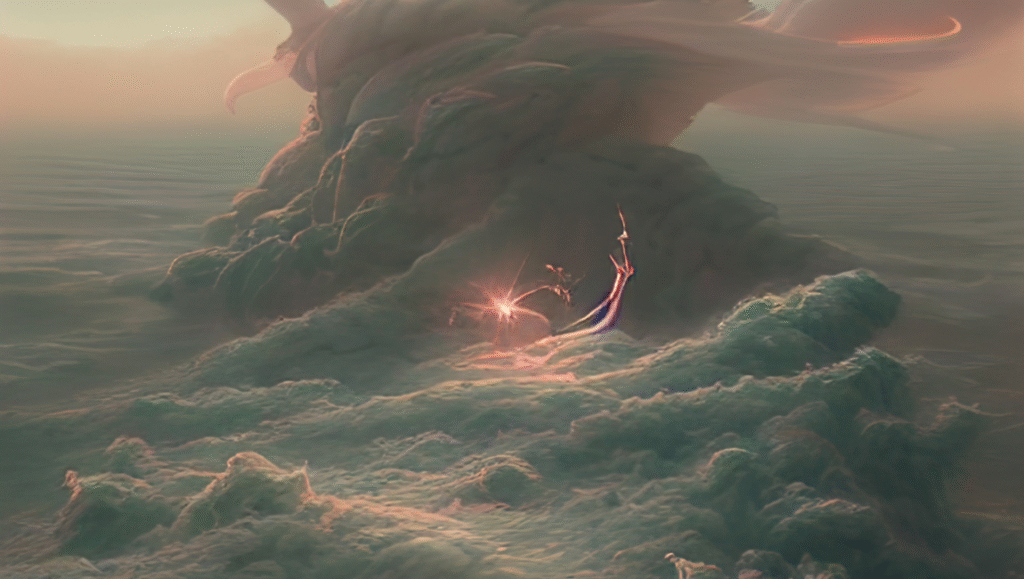 Time travel is a tricky business in narrative philosophy. It assumes two paradoxical concepts: linearity and simultaneity. Past events precipitate future events, the present being a formless product of both. Even though past events inform future events, they are also both in a constant state of happening, of creation and recreation, of constants and entropies. The scientists in Idaho Transfer, representing the entire adult world on trial for environmental irresponsibility, have not only created the looming climate disaster, but also squashed any form of resistance to it. They have refused the notion that anything can be done to stop it, and have decided to reinforce the authoritarian rule of the present. The unchanging landscapes of Craters and Bruneau, once regional oddities, are transformed into the encompassing landscapes of the future. But the regions themselves go unchanged in any epoch. The hellish formation of Craters, itself a record of recurring catastrophe, contains for the film the seed of apocalyptic, future-tense imagination. To the adults, human extinction is not created, but quoted. The natural world already sows the flower of its masters destruction.
Lovecraft understood this better than most. The Cthulhu Mythos, far from the exotic horror-fantasy it is frequently imagined as, is just as often a cycle of accelerated ecological disasters. The land, even when syphoned through Lovecraft’s mythopoeia, constructs its own omens of paradigm shifts that are then expanded into immediate, inexplicable raptures. In “The Call of Cthulhu,” the terrible monster of cosmic indifference rests first as a prehistoric creature imprisoned ice deep in the Canadian arctic. 7 Another deity, the Egyptian Nyarlathotep, is a relic of antiquity brought to life by modernity’s cruel forms — reincarnated as a cultist despot boasting mechanical marvels that slowly poison the earth. 8
But no matter how complete these raptures are in Lovecraft’s fiction — and certainly some of them are truly complete — they frequently end with the acclimation of living creatures (if not humans) to their new ecological conditions. Even the terrible disfigurement of plants and mammals in “The Colour Out of Space” itself leaves them crudely alive. The reign of Nyarlathotep trudges on, but so do the somnambulist citizens through his realm of nightmares. The glorified mole-people of “The Nameless City,” too, survive, and in fact thrive against their exile from the surface world. Lovecraft leaves the world fundamentally diseased, but never to oblivion. There is a population, no matter how small or distorted, left to establish community, culture, and negotiate their survival with an indifferent universe.
Rather than involve themselves in these negotiations, rather than find new ways of coexisting with the land’s newfound ferocity as their children do, the adults in Idaho Transfer prefer unabridged destruction. To relinquish power is their only true fear, and to bolster it is their only concern. Thus, they leave their children stranded, without present, past, or future. However, even when faced with their sterility, the teens’ civilization trudges on. The Dunes and Craters appear to surrender their “weird” indifference. Populations of unintelligent yet thriving humans lead nomadic existences, exploring the resources interred among the magma fields and collecting the primitive plants growing along the dunes’ ponds. They are simple, strange, and artificially happy, but nevertheless adapting. It is as if these strange lands, after millennia of dormancy, have finally elected to bring survivors into their confidence.
In our 21st century landscape, our own rulers are frighteningly similar to the faceless scientists of Idaho Transfer. Not even the most delusional statesmen dare to deny the disaster on the horizon. A healthy minority of them have even begun to advocate for immediate reforms, as minuscule and piecemeal as they may be. No figurehead manages to admit the seriousness of the problem at hand, because its only worthwhile solution is the sabotage of the system they serve. So, they stay in suicidal inaction, compelled to allow society a few more years of survival at the risk of its species. If there is anything to hope, it is the extinction of the system before the extinction of humanity. Either way, however, that structure will fall. Either way, the scaffolding of new methods of survival develop. Even after annihilation, one similar to my child-dreams of destructions: the world turns, the land reels, the children start to dream again.
1 Irving, Washington. The Adventures of Captain Bonneville, U.S.A. in the Rocky Mountains and the Far West. J.B. Lippincott & Co., 1873
2 Louter, David. Historic Context Statements: Craters of the Moon National Monument, Idaho. National Park Service, 1995.
3 Limbert, Robert. “Among the ‘Craters of the Moon;’ An Account of the First Expeditions Through the Remarkable Volcanic Lava Beds of Southern Idaho.” National Geographic Magazine. 1924.
4 Lovecraft, H.P. “The Color Out of Space.” Amazing Stories, Vol. 2 No. 6. 1927.
5 Coolidge, Calvin. “Establishing Craters of the Moon National Monument.” May 2, 1924. Washington D.C., District of Columbia.
6 Lovecraft, H.P. “The Nameless City.” The Wolverine, No. 11. 1921.
7 Lovecraft, H.P. “The Call of Cthulu.” Weird Tales, Vol. 11 No. 2. 1928.
8 Lovecraft, H.P. “Nyarlathotep.” The United Amateur, Vol. 20 No. 2. 1920.
Comments are closed.