
Should war documentaries be fun? At the very least, we don’t expect them to be boring. It often feels like the whole genre is less a tool for peace and understanding than a secret fount of morbid perversity, a self-important propaganda endeavor that seduces us with visions of the macabre and grotesque just like the best horror films. Very few would admit to enjoying scenes of human suffering, but do we really watch a movie, engage in the artistic experience, if there isn’t some remote pleasure involved? Is there such a thing as pure educational value or a moral obligation when aesthetics are involved? We watch war and suffering because, as the cliché goes, we simply can’t look away. In the 2020s, in an age filled with hysterical rage and cultural conservatism, the genre is alive and strong. Festivals love them. Independent cinemas program them. Ukraine, Palestine, wherever’s next: Americans and wealthy Europeans might not actively fight anymore, but they sure do love to watch.
Abbas Fahdel’s latest film, Tales of the Wounded Land, which focuses on southern Lebanon during and after the 2023 Israel-Lebanon war, often feels like little more than an exercise in the complete de-aestheticization of the war film. This writer was bored out of their mind, but is that necessarily a bad thing. The question, then, is what else does one expect or, really, want to feel? And this doesn’t mean Fahdel doesn’t have real capabilities as a filmmaker or know how to grab the viewer’s attention. Opening with astounding drone shots over a large funeral march through decimated streets dozens of coffins long, the film is more than able to make the scale of the destruction palpable and affecting. A quick cut into Fahdel’s two-year-old daughter Camelia picking flowers and giggling every time she hears a nearby explosion — “Boom! Fart!” she yells — feels simultaneously emotionally manipulative and philosophically potent. How might a child understand these events? How might they reflect on them later? How do we understand them and reflect on them? Can we square these atrocious events as just one more part of life and almost take them for granted? And, much more immediately, how can we, as an entire species, stand to subject children to even the secondhand effects of war? Unfortunately, this inquisitiveness, while invigorating at first, simply doesn’t extend very far.
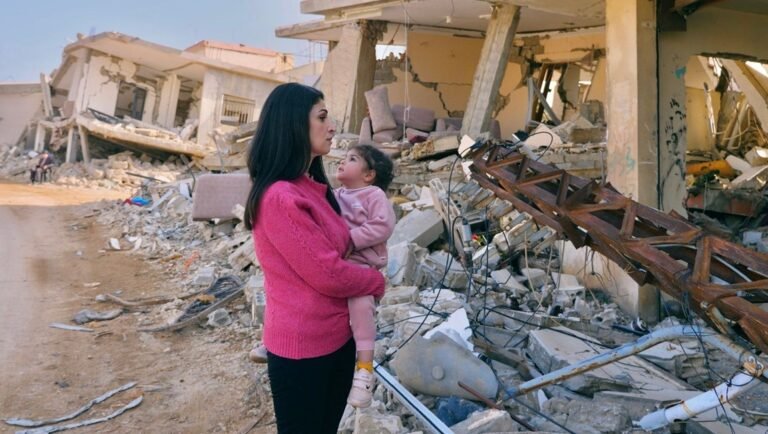
The bulk of what follows captures in astoundingly unadorned detail Fahdel, his wife Nour, and Camelia fleeing during Israeli bomb strikes on their southern Lebanese city of Nabatieh and then returning months later to a hometown now reduced to rubble. Shot largely on an iPhone with seemingly little concern paid to style or viewer engagement, the film consists mainly of lengthy interactions with local residents set against the ruins of war. That each scene lasts too long, that few provide more narrative or emotional information than the previous ones, that everything comes across in the same monotonous, affectless tone: this is either a mark of the film’s integrity or inanity. That Fahdel does make some, at least half-hearted, attempt to inject some poetry into the proceedings almost makes it worse. Between scenes, the film frequently cuts to poetic title cards that, while strained and pretentious — “It is a city where every stone is a raised fist/like a lily blooming among the ashes,” reads one — at least speak to an artistic aim that the relentlessly monotonous home movie footage never approaches.
To consider a film like this a failure — one that so ably presents a view of current events which many might find hard to find otherwise — might be a bit of a stretch, and it depends on how you look at it and what, exactly, you’re looking for. If you’re looking for a sense of curiosity, for an inducement to reflection, you’ll be disappointed. These are images that, for all their horror, provoke very little beyond their base reality. This writer wanted to leave out of frustration, but in a certain sense, was still moved in odd moments when approaching the subject matter in ways that it never feels Fahdel himself is provoking one to do. It’s a worthy failure, one that won’t necessarily reward tussling with, but there is no right way to capture war and there is no film that won’t have to grapple with the demands of both the market and the artform. To try to make an evaluative judgment on a film dealing with mass suffering feels not only impossible, but unnecessary. To many who don’t mind bad poetry, it might be moving. To those who believe in its cause, it will be noble. To those film festival denizens like myself who simply want a piece of art screaming at them from off the wall, it’ll stultify. It all depends on why exactly and for what hidden, maybe forbidden, reasons you sit down to watch scenes of mass suffering in the first place.
Published as part of Tallinn Black Nights Film Festival 2025 — Dispatch 1.
Comments are closed.